8 Fan Theories That Totally Change Your Favourite Movies
There's a dark truth behind Star Wars.

If there's one thing the film-obsessed side of the internet loves more than complaining about how dinosaurs should have feathers and lightsabers don't need a cross-guard, it's fan theories. Clogging up social media feeds and countless blogs is a never-ending stream of fan-created ideas that expand upon beloved movies (normally those created by Disney or Pixar).
Now some movies have hidden layers that have to be worked to uncover (Denis Villeneuve's Enemy, for example, has a mind-melting alternate reading that, judging from interviews, was very much intended), but sometimes a yellow VW really is a yellow VW. And that's generally the problem with fan theories - more often than not it's just someone with an overactive imagination willingly overlooking set-in-stone elements of a film to pursue their own ideas.
Take the countless "Person X was just in Person Y's mind" theories that permeate pretty much every film ever. Some of them (as you'll see later) can really add to a movie's subtext, or provide an alternate take on plot events, but most are just someone who doesn't like Leonardo DiCaprio tittering on about how Jack isn't real in Titanic.
The eight theories presented here are far from empty teases - each one vastly changes their respective movies, explaining away confusing elements, going deeper into a character's psychology, or even changing their very meaning. You'll never view your favourites in the same way again.
8. It's All Told By An Unreliable Narrator - The Hobbit Trilogy

Even The Hobbit's staunchest defenders wouldn't hazard that the new prequel trilogy in any way comes close to The Lord Of The Rings. Hampered by a myriad of problems, all stemming from a ridiculous decision to make the slight tome into an epic trilogy, there just isn't the same passion lurking behind these corporate exercises. Although if you really want to redeem the unnecessary journey slightly, here's a fan theory that (almost) gives it an air of inspired creativity.
Unlike The Lord Of The Rings, which is presented as a series of real events only retroactively written down by Frodo, The Hobbit is told by an old Bilbo looking back on events. And, when you consider that heis a hobbit who's recounting events from sixty years ago, many of which he was only passively involved in, all the while under the corruption of the One Ring, it'sclear he's a pretty unreliable narrator.
Suddenly the over-the-top action sequences, plot-hole heavy narrative divergences (why is Gandalf surprised Sauron is around in Fellowship when he met him in The Desolation Of Smaug) and unrealistic sheen to the whole thing are less Peter Jackson going so far up his own Hobbit hole that it's as dark as Moriaand more Bilbo embellishing events from an incredibly skewed viewpoint. It doesn't make the films objectively better, but it allows some of their more egregious moments to be a little more excusable.
7. Deckard Is Gaff's Replicant Replacement - Blade Runner

"Is Deckard a replicant?" It's a question that everyone still feels they have to ask after seeing Blade Runner, despite Ridley Scott coming out and explicitly stating that Harrison Ford's detective is indeed a manufactured human. He's even re-edited the film twice to remove confusion; the answer "yes" is now less a fan theory and more the conventional reading of the film. This next part, however, is not.
You see, not only is Deckard a replicant, but he's one created specifically as a replacement for another Blade Runner, Gaff, fake memories and all. Edward James Olmos' character spends most of his time in the film making little foil origami models of great significance, but only because, walking with a stick, he's clearly out of commission. And in lieu of that, instead of training up a successor for a job with low-levels of activity, the LAPD instead got one made with Gaff's memories implanted.
On a base level it provides an explanation for one of the central Deckard-is-a-replicant clues - Gaff knew about the unicorn dream (evidenced by the final origami model) because it was one of his own dreams - but nothing else from the film works against it. Throughout the movie, Gaff shows a quiet animosity towards Deckard, which given this theory is more than justified - is there any bigger insult to the hunter of replicants than being replaced by one? OK, maybe he's just an !*$%, but this idea better justifies his third act change of heart; when he pops up after Roy Batty's death to tell Rick he's "done a man's job" he's really showing acceptance of Deckard's humanity.
6. There's A Third Twist - The Prestige

You could spend days dissecting the symbolic and narrative brilliance of The Prestige's dual twist ending, but for the sake of brevity let's keep things as simple as they can be when dealing with Christopher Nolan. The final scene reveals that Borden (Christian Bale) and Angier (Hugh Jackman) achieved the same trick (The Transporting Man) through two very different, but equally soul-destroying, methods- the formerlived a sharedlife with his twin, while the latter drowned himself on stage every night so his complex (and totally real) magic could work.
But that's not the end of it, at least according this fan theory that has been doing the rounds. Turns out Tesla's machine didn't actually work and was all smoke and mirrors aspart of Angier's plot to incriminate Borden. The Real Transported Man, presented in the film as genuine magic, was actually realised with a double, just like every version seen throughout the film. The whole drowning element was only introduced on the final night, when Angier knew Borden's curiosity would get the better of him.
The main fuel for this theory is that only one of the drowned Angier's is actually shownon screen, meaning that there's nothing Borden, or the audience, sees that actually suggests the whole clone machine stuff is true - that body could have been the double's, potentially planted by a vengeful Cutter. Could Nolan have actually pulled a magic slight-of-hand in his movie about magicians?
There's some pretty huge inconsistencies that need to be got over for this to gel - there's no satisfying explanation of why Cutter would identifythe dead double's body as Angier's and it requires at least one scene (the flashback to Angier first testing the machine on himself and killing the duplicate) to be entirely fictional, which goes against the rest of the film's realism - but as a fulfilment of Michael Caine's "you're not really looking, you want to be fooled" spiel it's right on the jaw-dropping money.
5. Cobb Was Leaving Himself Open For Abuse - Inception

Just when you got your head around that, here's more Nolan because f*ck if he isn't a tricksy fellow. Keeping quiet about the meaning of his movies (he's still never officially stated the truth behind Memento), alternate fan takes on Nolan's entire filmography are unrelenting. Heck, release day wasn't over before someone wastheorising the ending of Interstellar was all in Matthew McConaughey's dying mind (which surely means ghosts are real).
Anyway, to Inception. The final shot of a possibly-wobbling spinning top had everyone going "wahh?" followed by a more coherent "wait, is he awake or not?" Obviously it doesn't really matter - Leonardo DiCaprio's Cobb has chosen this world as his reality - but for those who crave answers, Nolan snuck in a clue that provides the closest you'll ever get to a resolute answer. Turns out Cobb's real reality-testing totem is his wedding ring, which he only wears in the dream world where he's still obsessed with his dead wife. This obviously reshapes the ending into something more literal (he's not wearing it in the final scene, so must be awake), but also has the unexpected side effect of changing his entire character outlook.
Both Joseph Gordon Levitt's Arthur and Ellen Page's Ariadne refuse to reveal the secret of their weighted die/chess piece totems, yet Cobb is brutally honest about how (what he believes to be) his works. Which means he's actively leaving himself open for dream attack (the dreamer just has totopple the totem in a dream and Cobb's locked in unreality forever), suggesting he's becoming increasingly suicidal, actively choosing to lose his grip on reality in a way hitherto not suggested.
4. Mister Babadook Isn't Real - The Babadook

As jolting as having a jump scare every five minutes can be, true horror works best when it creeps under your skin and pulls it back to show something horribly real. The Shining isn't scary because Jack Nicholson is going wacko or there's ghosts roaming the halls of The Overlook, but because the family relationship that it tears apart is so tangible. The same is true of The Babadook, last year's sleeper horror hit that proves Australia can add more to cinema than just Baz Luhrmann and the Hemsworths.
The basic idea - a mother and child become haunted by a creature born from a pop-up book - is a killer concept, but it's the added depth that make it so brilliant. With single-mother Amelia still reeling from the loss of her husband and struggling to deal with an increasingly rebellious child, it's pretty obvious the monster's tormentsare a metaphor for her increasingly fragile mental state; Mister Babadook's ultimate defeat only comes about when she realises she can't escape it, but can keep it under control.
But is it really a metaphor, or actually something much more real-world? Pretty much every scene in the film can be seen as Amelia's depression-skewed view on the world, or Samuel's childhood comprehension of his mother's illness, making Mister Babadook potentially as real as Bruce Willis in The Sixth Sense or M. Night Shyamalan's directing prowess. Now that's chilling.
Of course, taking a film this terrifying on a purely psychological basis could be seen as just a way to rationalise its horror while lying awake at night, but it really works as a way to get to the heart of the movie.
3. Remy Is All In Linguini's Head - Ratatouille
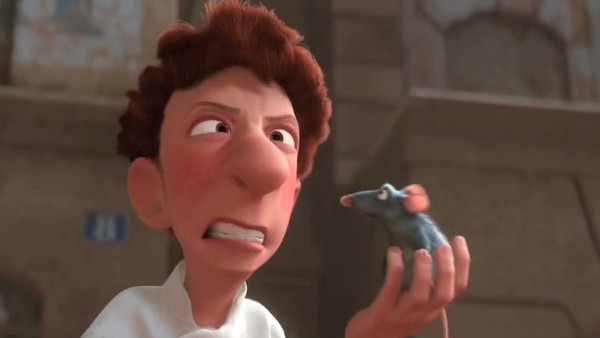
Typical of late-noughties Pixar, Ratatouille is built on ideas ranging from bizarre to unpleasant, and totally sticks the landing. The third act even features a gang of sewer rats operating a Parisian kitchen, yet in the hands of the animated maestros what could be a gag-inducing spectacle becomes a thing of beauty; you can't help but wish you could try the food. Still, for those of you who can't get past the "rat can cook" concept, there is an alternate explanation that takes the film to some interesting places.
Taken at face value, the hapless Lingini learns to cook with the help of gifted rat Remy. But what if the explanation everyone assumes when Lingini talks about his "Little Chef" - that it's a cute metaphor for traditional inspiration - is actually true? Remy isn't real at all, instead Lingini dreams up the most unlikely cook he can think of to give him confidence.
OK, so you have to ignore scenes where people other than Linguini interact with the rats, but the film proper isn't above have realistic dream sequences. It's no more outrageous than the basic idea of the film and furthers its status asan incredibly touching look at dreams, self-belief and the luck of being the son of a world-famous cook.
2. Travis Bickle Died In The Shootout - Taxi Driver

Taxi Driver's ending is one of the blackest jokes Scorsese has ever committed to film (and that's really saying something). After failing to assassinate U.S. Senator Palantine, loner Travis Bickle instead sets his psychotic aims lower, taking on the pimps of teenage prostitute Iris. A gory shootout ensues, but then, following a failed suicide,Travis is retconned by society to be a hero, mythologised by the media. In a wonderfully ironic twist, this undying praise appears to prove too much for the cabbie, despite him having chased the idea of being special for the whole film.
However, to get to that version of the ending you first must go through the moment that could very likely be Bickle's last. There's a distinct chance he actually died in the shootout, either by Harvey Keitel's or his own gun, with the entire hero worship merely part of a last-moments fantasy; the closing moments are so psychedelic it could easily be a representation of an end-of-life dream state. And if that's the case then things change drastically; instead of showing how vastly differently this disturbed individual could be regarded, the film is saying the down-trodden will never achieve their dreams.
This alternate theory has a pretty overwhelming effect on Taxi Driver, completely changing the entire point of the film. And, with the truth having been debated since its release in 1976, it's unlikely any unanimous opinion will ever be reached.
1. The Humans Are Just Avatars For A Bug-Like Species - Star Wars
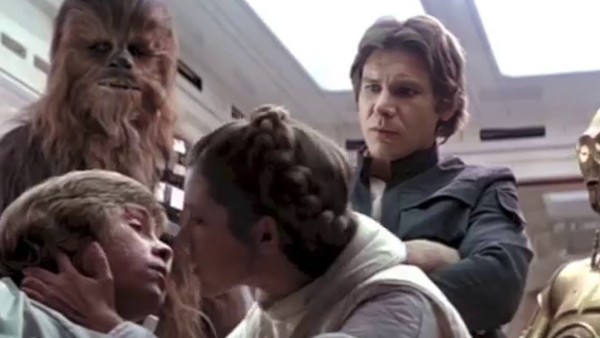
Have you ever thought it odd that there's humans in a far-flung galaxy? Or that they existed long before they evolved here on Earth? Or found it a little strange that of these oddly prevalent humans only a handful are female? Of course, it'd be easy to chalk all these niggles up to Star Wars being a sci-fi produced in the seventies, but this bonkers theory repurposes them as major hints at an underlying, and decidedly unhuman, power struggle.
Put simply, what appear as humans on screen aren't actually humans, merely an Earth-based representation of a bug-like alien species. Here, the typical Queen, fertile male and drone hierarchy is fulfilled by the female characters, Force-sensitives and general soldiers respectively. And, beyond that, the series is actually showing a shift in the status quo with the introduction of artificially produced soldier drones (clones) by a male queen (Palpatine), possibly in reaction to the fertile males' (Jedi) forced-abstinence. It all sounds ridiculous, but the more you think about it, the more logical it seems.
Max Gladstone, the creator of the theory, goes into the whole thing in much greater depth, managing to tie in elements from all six movies to produce somethingthat means you'll never watch the saga in the same way again. Sadly, it doesn't explain why you'd need a cross-guard on a lightsaber.
Do you buy into any of these? Are there any other movie-altering fan theories out there? Share your favourites in the comments below.