8 Heroic Movie Sacrifices That Ultimately Meant Nothing

8. Ron Weasley Harry Potter and The Philosophers Stone
 I'm going with a slightly different to start the list, insofar as Ron's the only entrant who doesn't die. Its the climax of the first Harry Potter film and Harry, Ron and Hermione are attempting to get through a series challenges set up by the Hogwarts faculty to protect the Philosophers Stone. By a combination of skill, luck and judgement they finally make it to the final challenge, Professor McGonagalls transfigured massive chess set, and the trio take up positions in their respective roles where theyre ordered around by the Weasley chess prodigy. Yet there comes a moment when Ron realises hell have to sacrifice himself to the opposing Queen so the others can checkmate the King, so the ginger-haired one who is on a stone horse as befitting his status as a knight in the game takes up position and waits for the most ominous looking statue in the world to bring the pain. Now in the books Ron isnt on a horse, so him being obliterated by a stone giant is given slightly more dramatic risk, yet in the film his mount takes literally all the punishment. I suppose seeing an 11-year-old getting pummelled by a golem might call into question the kid-friendly rating this film desperately needed, yet it opens up a whole other can of worms. Namely, why didnt Ron just get off the horse and stay on his square? If he did, his whole sacrifice would have just been him watching a stone horse get demolished, rather than the risk-afflicted affair it turned out to be. The whole thing was frankly unnecessary, and just served to make Ron look a bit ridiculous, to be honest.
7. Harry Osborn Spider-Man 3
 Let me ask you a question why the hell does Harry Osborn die in Spiderman 3? Oh, I get the reason why he sacrifices himself hes trying to save his best friend. However, there were such a better option available that his eventual decision seems silly. Ill set the scene Harrys come to an epiphany after his butler lets slip (probably about two films and a burnt face too late) that Spiderman didnt kill his father. With the mans words ringing in his ears, he sets off to the site where the webslingers getting his behind handed to him by the Sandman and Venom. Fighting ensues, and Harry manages to incapacitate the Sandman while Peter gets lassoed up by Topher Grace. Harry flies in to save the day, but gets swatted down by Venom, who then uses Osborns bladed hoverboard to try and stab Peter. Predictably, Harry jumps in the way. Now, this theory is based off the fact that the man managed to spin around so he can face Peter for maximum dramatic impact during his impaling. This surely implies that he clearly had time on his hands while running, so had some time on his hands to think about what he was doing. So heres my question why doesnt he just tackle Venom in mid-air? Its clearly a far better, less blade-filled option that what he eventually went for. That could give Peter the precious time he needed to break free of Venoms bonds and help Harry engage the travesty who sunk the third film in this once glorious franchise. Instead, we end up with one dead Osborn, for very little reason at all. In fact, his sacrifice looks embarrassing moments later after Spiderman easily breaks his bonds.
6. Jack Titanic
 Very much the Citizen Kane of pointless sacrifice, Jacks untimely end in Titanic has been a bugbear of movie-goers for years. Endlessly spoofed and parodied, it would be totally unfair if it didnt up on a list such as this. So, without further ado, here it is. Its just odd apparently that door wont stay floating with both Jack and Rose on it, so Jack decides to man up and freeze to death in the water, sacrificing himself in order to save Rose in something very tragic, romantic, sweet and epic. However, as the world and his dog (and most memorably, Bruce Nolan in Bruce Almighty) have pointed out, they couldve totally taken turns in the water until nearby vessels turn up. After all, fishing boats did eventually save the floating passengers, so they wouldnt have been waiting forever, just a couple of hours. Thats easily enough time to ward off the ridiculous hypothermia. But no, Jack decides to go out anyhow in the most memorable pointless sacrifice ever committed to celluloid. What makes it worse is that if Rose had just stayed in the damn lifeboat at the climax of the film none of this wouldve happened. She wouldve been home and dry, Jack could have floated to his hearts content and nobody would end up taking a permanent voyage to the bottom of the ocean. https://www.youtube.com/watch?v=NkzsfhqdQ0I
5. Vesper Lynd Casino Royale
 Vesper Lynds sacrifice is just plain baffling as it accomplishes precisely nothing, other than cause everyones favourite secret agent to have a complete mental breakdown. I understand that theres a need to infuse action blockbusters with emotions and drama, but having Vesper just yell screw it and choose to die in a Venetian lift seemed a bit lazy, in my book. Im aware you could possibly argue that Vesper felt incredibly guilty about betraying James Bond, but really, its all a bit melodramatic. Id feel bad if I betrayed my significant other, but this is James bloody Bond he deals with deception every day. Im sure if Vesper made an effort to get out of the lift and apologise hed have taken her back, especially after he figures out shes being expertly manipulated by a super-powerful cabal of genius villains. After all, its usually possible to apportion blame in the ending of a relationship, but being blackmailed by Quantum seems like a perfectly good get-out-of-jail-free card. Also, her death caused the super-serious Quantum of Solace. Dont get me wrong, I really that film but Im well aware it suffered from a loss of unique Bondian humour, something which can be laid directly at Lynds door. It wouldnt be unforgiveable, if wasnt so unnecessary.
4. Susan Deep Blue Sea
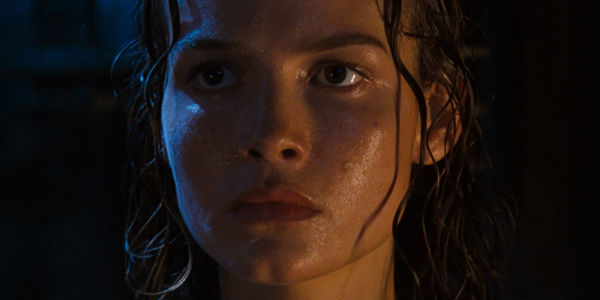 Deep Blue Sea was awesome in the way only films about genetically engineered sharks can be. It was big, boisterous, loud and stupid, and possessed one of the greatest death scenes ever shot on camera. You know which one Im talking about seeing Samuel L. Jackson get utterly demolished by a freaking shark mid-awesome monologue was a thing of terrible beauty, turning an objectively mediocre flick into something approaching brilliance. However, theres a nonsensical death in this film which frequently gets overshadowed by its infamous forebear the death of Saffron Burrows Susan McAlester. For those of you who dont know, she actually chucks herself into shark-infested water. I guess it might make sense that she went through some redemptive arc after all, the murderous sharks and all the ensuing carnage are kind of her fault, so some sort of self-sacrifice was probably necessary. But really, if she wanted to be a distraction, she could just make do with dropping blood into the water after all, if we invoke movie logic, bloods a perfect distraction for such a ravenous sea monster. She doesnt really need to chuck herself into the water, too far away from the ladder to get back thats like cutting off your hand to stop you shaking, surely the very definition of overkill. She couldve accomplished just as much with far less suicide.
3. Jonathan Kent Man of Steel
 Im sorry, I just have to mention Jonathan Kent. I know Man of Steel comes in for a lot of stick on this site for various reasons, but I could see the dramatic reasoning behind Jonathan Kents untimely death in the tornado, even if I didnt necessarily agree with it. The lesson that Clark needs to keep his superhuman nature a secret is a worthy one, and having Pa Kent sacrifice himself was a perfect way to put this across. Yet really, what does this accomplish? If the prologue of Man Of Steel tells us anything, faintly little despite his fathers sacrifice Clark still goes around performing superhuman feats such as holding up huge stanchions of a burning oil rig in front of witnesses and eventually shishkebabing an 18-wheeler in a public car park. It seems as if the guy hasnt learned anything the only revelation he really has in the film is how to fly and flounce about in a garish outfit, and that came courtesy of the awesomely-bearded Russell Crowe. Really, Pa Kents sacrifice might have been a poignant movie moment if his son had taken f his lesson to heart at all. However, hes instead so conspicuous in his actions that he can be tracked down. Now, I know Lois Lane is technically a Pulitzer Prize-winning journalist and thus has supreme investigating skills, but her journey to find Clark seemed to revolve around asking witnesses witnesses that wouldnt have existed if hed have taken his adoptive fathers sacrifice to heart.
2. Robert Neville I Am Legend
 The revised ending of I Am Legend serves as the perfect cautionary tale against executive meddling, because it didnt make any damn sense. Let me just set the scene for the travesty that occurs through the accidental haphazardness of his fellow survivors, Will Smiths fortified home is besieged by hordes of agile zombie-mutants, something made all the more inconvenient by the fact hes just discovered a cure for the virus which ravaged the world. Pushed back into his basement laboratory, he attempts to reason with the monsters but to no avail. So he gives the cure actually just some cured blood in a vial to the survivors and stuffs them in a coal chute while he blow up with a grenade, taking the monsters with him. Yet heres the question why does he sacrifice himself? He could just as easily put himself in the chute as well and fling the grenade out after all, the girl actually shouts to him that theres room for him. Yet no, Will Smith wants to go out in a blaze of glory, so he flings himself headlong into the zombies, grenade in hand. Its just stupid on so many levels, because not only is his death pointless, is actively detrimental to the film. Remember, Neville was already a super-genius before the virus, so with most of the population decimated his value would only increase. After all, its not as if that cure could be figured out by your average person after all, its still something which needs further refinement by a pharmacologist. Neville doesnt even know if there are any survivor communities out there, but he still flings himself and thus the only intellect capable of manifesting a cure into certain death. Good going, idiot.
1. The Iron Giant The Iron Giant
 The Iron Giant is brilliant and you should see it. There, Ive got that out of the way. However, it does possess a pretty pointless sacrificial scene which sticks out like a stain on the fine tablecloth. Namely, the Giant chooses to sacrifice himself in the most ridiculous way possible. Really, it should be spectacular its the climax of the final act and strangely for a kids film, the main villain has managed to release a nuclear warhead to kill the now-rumbled Giant, but now threatens to destroy the town of Rockwell. The missile arcs up, and everyone sort of cowers around, unsure of what to do next. Its a terrifying vignette, but the Giant knows what to do hes got a plan, and that plan involves flying up to meet that warhead head-on, obliterating himself but saving the humans. Yes, its all very noble, but theres surely a much better plan on the table involving shooting that nuke out of the sky. After all, we already know the Giant can produce gigantic blasters if threatened, and if the presence of warheads isnt threatening, I dont know what is. However, the Giant doesnt perform the most obvious action, instead condemning himself to an uncertain future and traumatising a young boy while hes at it. Really, the presence of those blasters turned what was an epic, grandiose ending into something riddled with potential flaws, providing a rare bum note to what was otherwise a wonderful film. Agree or disagree? Can you think of any more? Feel free to comment!