8 Horror Movies That Broke All The Rules
Conventions mean nothing when you already know you're in a horror film.
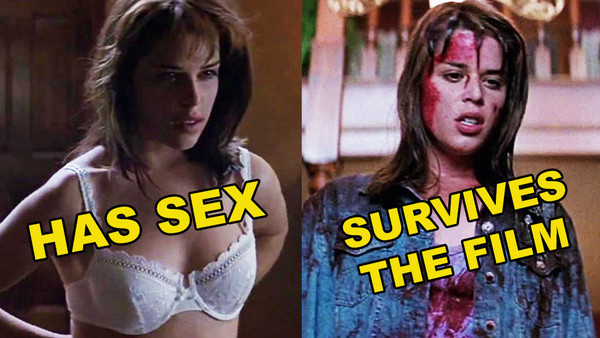
Horror movies are ruled by genre conventions. Whether it's abandoned ghost towns that come to life at night, run down psychiatric hospitals with one patient that never quite went away, or woodland monsters intent on giving campers an evening they'll never forget - there's plenty of familiar tropes that rule our movie experiences.
Whilst they're fun enough to begin with, in the end, we become bored knowing that the chesty blonde woman is inevitably going to get done in with a pick axe as she gets ready to have an excessively steamy bath. If only she'd run the water cooler and seen the message written in blood on the mirror!
Every now and then though, something's got to give, and a film comes along that challenges everything we thought we knew about the industry to create a whole new variant of horror. Truly throwing the mentos straight into our diet coke, these movies are the ones we never even knew that we needed, tearing up the rulebook and making history in the process.
Conventions might be the foundations that the genre stands on, but hey, rules were made to be broken, after all.
8. The Extended Slow Burn - It Comes At Night

One of the most recent additions to rule-breaking in modern filmmaking, It Comes At Night was a great example of the power of marketing - offering up a terrifying horror film in its trailers and delivering a slow, measured think-piece when it came to the actual release. It Comes At Night broke the usual rules set out by a movie to deliver a truthful representation of its content in its advertising by playing up something it wasn't - and then continued to eschew expectations by not essentially being a particularly horrific movie at all.
It Comes At Night was one of the first in the wave of 'post-horror' movies, films that look at conventional out-there spooky movies and work around them to deposit just a FEELING of fear in its atmosphere, rather than any outright attempt to scare the audience. The Witch is another great example, as are many of A24's other releases, bringing about a new realisation of the horror movie that looks at uncertainty and the incompleteness of human experience objectively rather than holding an audience's collective hand.
Themes of this have spun out into lots more cinematic efforts in recent years, but this feels like one of the more popular and poignant examples in memory.
7. Handheld Horror - Cannibal Holocaust

A film so realistic it was taken to court for potentially being a snuff film, Cannibal Holocaust was the first shaky step into the world of handheld horror, that being the found footage movie as we know it, later made infamous by titles such as The Blair Witch Project and Paranormal Activity.
Making a film in raw mockumentary style, Ruggero Deodato unwittingly created a whole new genre of movie, one where cheap budgets, amateur effects, and unknown actors all come together to make the most real-to-life examples of horror possible.
Cannibal Holocaust is the defining title, telling the story of a lost group of filmmakers in the Amazon rainforest making a documentary on cannibal tribes. You can probably guess where it went from there.
Featuring real life animal abuse and horrific special effects, the movie pushed the envelope both in its presentation and in its technological decisions, sparking both controversy and intrigue in equal measure. And it still stands up against its competition today, impressively enough, again reinforcing its genre-bending capabilities with high quality skinning and maiming. What more could you ask for?
6. Genre Bending - Alien

Haunted house movies are in escapable, and have been since the dawn of the horror genre. A classic dilapidated house or unsettling mansion has long been home to some disgruntled ghosts or eccentric barons, but what happens when you shift the whole template and just... stick it in space?
Instead of a restless spirit, throw in an acid-spitting alien, instead of a victorian manor with trick walls, knock up some corrugated corridors and a blast-ready airlock, and instead of a mysterious entity who was Dead All Along, substitute a secret robot with cream cheese for insides. Why not, eh?
Alien did all this and more, becoming one of the first and best series to truly mesh science fiction and horror into one terrifying bundle - breaking away from classic representations of Universal monsters and gothic norms to bring something truly out of this world. Alien was also one in the wave of defying expectations by killing off their star power early on, reinforcing the final girl trope by having Sigourney Weaver the last woman standing.
And, if all THAT wasn't enough to blow your socks into space, Alien also purposefully avoided gendering its characters in a script that was devoid of male or female markers, making it another in the unintentional staple of progressive genre films that steered clear of societal expectation. 'Broke' the rules? More like 'obliterated' them.
5. All Out Gore - Hostel

If you ever felt a little frightened whilst travelling alone that something terrible could happen in a country you're unfamiliar with, then don't worry. Hostel is here to allay all your fears by proving that you don't need to travel alone, you can be kidnapped and sold off as an object for rich people to torture in a group too, so just go ahead and cancel that European holiday as there's no avoiding it either way.
Of course, both Hostel and Saw are to thank for the permeating torture porn genre in modern cinema, popularising films where the main end goal is just to see quite how messed up they can get along the way, but it's Hostel that stands as the most intensely visceral. Cutting fingers off with chainsaws, slicing tendons, and blowtorching faces, Hostel was the amalgamation of every video nasty into one horrible cinematic effort, bringing the culture to the mainstream and sparking off a trend for explicitly gut-churning gory sequences.
It wasn't the first of its kind, but it was one to popularise the sub-genre and bring it to the forefront in a way others hadn't generally done before - making a lasting impression on films being solely about mindless gore rather than a convoluted story, or with one central slasher.
4. Spooky Children - The Exorcist

We already know The Exorcist is one of the most seminal films in the entire genre, making waves with its impact as a visceral and often disgusting look at a demon inhabiting a young girl's body - but exactly why the film is so important is often forgotten when heralding it as a master of its craft.
Yes, The Exorcist still stands up today as a gross out spooky flick due to its masterclass in horror, but it's William Friedkin's use of a child as the central antagonist that truly broke the genre back in the day.
Back in the early 70s, featuring religious institutions and children was a recipe for outrage - which is exactly what the film got - to the point that no-one would have dared to make something as outlandish as an exorcism flick revolving around a 12 year old girl. Even any that did, such as The Bad Seed, didn't dare go as whole-hog as the spinning headed crucifix jabbing, vomit spraying Regan, making it truly one of a kind upon release.
And look at where it has taken us today. It fundamentally shifted how outrageous a horror movie can be, and brought in taboo subjects previously thought untouchable.
3. Killing The Protagonist Off - Psycho

It almost goes without saying that a film like this belongs on this list. Alfred Hitchcock made history by setting up a wonderfully taut and suspenseful narrative of a woman on the run, stealing $40,000 from her lecherous boss and making off into the distance before the police can catch her. Stopping at the ill-fated Bates Motel, however, turns out to be a bad decision, in which Marion gets offed in her shower by a mysterious, stabby figure.
Wait, what? We were invested, damnit! Psycho challenged the expectation of sticking with one character throughout the narrative by just straight up murdering her without a second thought. It stunned audiences of the time, and fast became one of the most widely known and parodied film scenes... well, ever; a testament to its lasting impression on the industry since first act deaths became a surprising commodity.
As a side note, Psycho also broke the rules of censoring at the time - being the first film to ever show a flushing toilet on screen and getting around gory violence bans by filming in black and white, even though colour was widely available. Chocolate sauce, anyone?
2. Violence, Zombies, And Diversity - Night Of The Living Dead

One of the fundamental pieces in the modern zombie genre, Night Of The Living Dead broke all the rules when it first released - defining a generation of violence, gore, and outright body-feasting madness with its humble 1968 release. People just really didn't like seeing people eating silly putty and animal organs on screen back then.
Absolutely panned by critics who found it senseless nonsense, Night Of The Living Dead got called all sorts by an outraged public who weren't fond of it's undead appeal. Described as a "pornography of violence" and an "unrelieved orgy of sadism" in a review by Variety, it obviously took a bit of getting used to for it to now have the widespread acclaim that it's gathered in the years since.
Night Of The Living Dead was also one of the earliest movies to put a black man in a lead role without bringing racial themes into its script, having Duane Jones portray Ben in effortlessly brilliant style. George A. Romero paved the way not only for the undead, but diversity in a duel pronged attack on the film industry - leaving his Living Dead series as one of the most influential horror movie collections to have ever graced the screen.
1. Every Rule In The Book - Scream

Of course, no dissection of the horror film industry would be complete without a hearty nod to Wes Craven's Scream, since it's the film that tells you every trick in the book before ripping the pages out and starting a fire with the scraps.
Considering it's got its very own character built in to tell you exactly what should be going on at any given point - the inner horror nerd within all of us, Randy - it's pretty easy to see how the film autopsies itself on screen, proving to be one of the most effective movies that's literally a spoof.
Horror films are supposed to keep you guessing, and the character's aren't supposed to know they're in them - but does Scream give two sh*ts about that? No, it does not. And, of course, it's biggest rule that it manages to obliterate in the closing sequences is that there's always one iconic killer. Instead of a lone slasher taking out the residents of Springwood, we get both Stu and Billy, working together as the central villain Ghostface as revealed in a literal double whammy.
If there's a film that knows how to break the rules, it's going to be directed by Wes Craven - the man that wrote them all in the first place.