8 Horror Movies With Surprising Deeper Meanings
What The Descent was REALLY about...
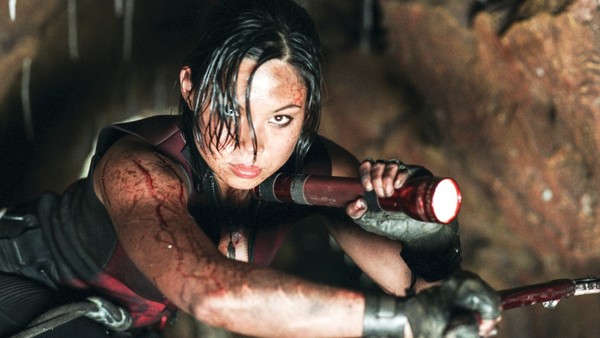
Horror is a genre that often gets looked down on by those in the film community, case in point: The Academy of Motion Picture Arts and Sciences. This is a shame considering how far horror has come, with many films over the last few years garnering the praise of both mainstream critics and weirdos in Camp Crystal Lake t-shirts alike.
Many modern horror films are considered complex, but "scary movies" were not always over-analyzed like the Scarlet Letter by a 9th grade literature class. Hereditary, The Babadook and The Lighthouse have deeper themes and meanings woven into the plot that everyone is praising. While this feels fresh and new, horror has always had a way of sneaking in smart subtext amid all the gore, sex and other genre stuff critics used to deem offensive.
Yes, most 80s body horror and slashers were secretly about AIDS and most late 70s American horror movies are somehow a metaphor for Vietnam, but going over all those again seems redundant. With some horror movies, you have to peel back the grimy, gross and weirdly wet surface layers to find truly surprising deeper meanings.
8. Resident Evil Is Filled With Alice In Wonderland Symbolism

Resident Evil is a fun, turn-off-your-brain horror movie. It is primarily remembered for Milla Jovovich ninja kicking zombies and looking stellar while doing it, but there is also some deeper symbolism going on.
Director Paul W.S. Anderson told Fangoria magazine way back when we all unironically liked Sum 41, “It struck me that the fundamental idea of girl in a dress goes into a hole in the ground is exactly what both Alice in Wonderland and Resident Evil is.”
This connection to Alice in Wonderland is found all throughout Resident Evil. For example, the T-Virus being tested on white rabbits, the Umbrella Corporation's commandos constantly worrying about time and the Alices of both stories go through a looking glass. Though we concede, the looking glass in Alice in Wonderland does not have death lasers like the one in Resident Evil.
There is also the aptly named AI baddie, The Red Queen. Like her Alice in Wonderland counterpart, the Red Queen causes many decapitations and even demands our protagonist does some decapitating of her own as her friend is turning into a zombie.
Off with their heads!
7. The Stuff Is About Mindless Consumption

The Stuff is another movie in a long line of 80s horror films that made no money and was rediscovered by hungry horror fans long after its debut. Surprisingly, its scathing commentary on advertising and health is more relevant today than it was in 1985.
The Stuff is about the titular food product that has found its way into every refrigerator in America thanks to an extensive marketing campaign and The Stuff’s strange addictiveness. Unfortunately, The Stuff is alive and after you consume enough of it you turn into a zombie and eventually white goo explodes from your face as you melt. It is up to a little kid and a former FBI agent to stop The Stuff, because...the 80s.
If by the third act there was any question as to what this movie was actually about, director Larry Cohen answers it when a shack-style restaurant dedicated to selling The Stuff, conveniently located between two popular fast food establishments, explodes.
The Stuff is a stand in for any product that has been marketed to the general public regardless of health concerns, from sugary cereals to cigarettes. The symbolism isn’t exactly subtle, but it is clever, unfortunately timeless and gory-good fun.
Is anyone else craving fast food?
6. Texas Chian Saw Massacre Wants You To Be A Vegetarian

For a movie with “Chain Saw” and “Massacre” in the title, the blood in the original Texas Chain Saw Massacre is kept to a minimum. However, you can see the characters sweating. You can feel the Texas summer heat. The sun-scorched tone leaves you wanting to take a shower more than a privileged college student after Coachella. The film, despite the lack of gore, is brutal, unforgiving and strangely has a very pro-vegetarian message.
After the gang pulls the mystery machine over to pick up a hitchhiker, he spends the better part of the first act explaining a couple different ways cows are slaughtered. He tells them how smashing cows in the head with a hammer-like device was a better way to kill them, as opposed to using a gun that uses air pressure, because that gun “puts people out of jobs”. The psycho family the hitchhiker belongs to proceeds to murder the gang in the same way cattle are killed. The gang are systematically slaughtered for good eating.
The Texas Chain Saw Massacre wants you to know how the sausage is made. It forces the audience to question the morality of meat production, as they see people being treated like cattle. The film's director, Tobe Hooper said he couldn't eat meat while making the movie.
Shape of Water director, Guillermo Del Toro said he was a vegetarian for a few months after seeing Texas Chain Saw Massacre, which isn't suprising considering how pro-sex-with-fish he is.
5. Slumber Party Massacre II Is About Repressed Sexuality

Slumber Party Massacre II is a sequel to a sleazy 80s slasher. Therefore, by the rules of 80s sequels, it has to be sleazier and slashier than the first movie. The movie is about a teen girl named Courtney. As a child Courtney survived the events of the first movie, but she soon discovers she is summoning the driller killer back from the grave with her dreams. The movie does not make a lot of sense unless you stop focusing on the surface of the plot and look at the film from the perspective of a teenage girl coping with sexual anxiety.
Courtney has serious anxiety about sex after learning all her friends are way more experienced than she is. This anxiety manifests itself into nightmares about a rock-a-billy version of the driller killer from the first movie. When Courtney goes to have sex, the worst thing that could happen to a teenage girl about to have sex for the first time happens. Her sexual anxiety manifests into a killer. Who hasn’t been there, right?
In Slumber Party Massacre II, the killer is not a human that can be conquered. It is instead the creation of Courtney, an actual manifestation of what she perceives as forbidden sexual desires. Instead of making a direct sequel, writer-director Deborah Brock takes a small theme from the first film - female sexuality - and hyper focuses on it. This creates a horror movie villain out of literally one of the scariest things people have to confront in their lives, having sex for the first time.
4. Candyman Is About The Struggle To Not Be Forgotten

On the surface, Candyman is just a big screen adaptation of the popular folk story Bloody Mary. Dig just a little deeper and you can see how the movie tries to take on issues involving race and sexism. However, if you keep tunneling your way into the plot you realize the movie is actually about a dead man who simply does not want to be forgotten.
The film gives us the origin story of Candyman. He was a black painter in the 1890s in America, just 25 years removed from the American Civil War. After falling in love with a white woman, a lynch mob attacked him and cut off his hand, the hand he used to create things he would be remembered for. They then cover him in honey attracting bees that sting him to death. It is gruesome, but it gives birth to Candyman. His paint brush is now replaced with a bloody hook and painting is replaced with his newfound notoriety as an urban legend.
We can see how seriously he takes his new artform when a gang leader who has taken on the moniker of Candyman is arrested and gets charged with the murders committed by the real Candyman. Candyman is enraged by this impostor taking credit for his art and warns he now must “shed innocent blood.”
Fear is his new artform, an artform he will use to be remembered even after death. When he was alive he painted to remain relevant. In death, he kills so he does not disappear into irrelevancy. Like all of us, he simply does not want to be forgotten.
3. Silent Hill Is About The Horrors Women Face

2006’s Silent Hill was supposed to be entirely female driven. There is a subplot with Sean Bean that feels disconnected from the rest of the movie. The only reason the out-of-place subplot exists is because screenwriter Roger Avery only added in Sean Bean’s character after getting screenplay notes back from the studio complaining about the lack of men in the movie. The lack of men, though, is the entire point. The film takes all the monsters from the video game it is based on, which were manifestations of a male protagonist’s sexual frustrations as his wife was dying, and gender swaps the perspective.
In the game, the nurses represent the male protagonist’s guilt for sexualizing the medical professionals caring for his terminally ill wife. These monsters are faceless and zombie-like, their only notable human features being their slender female figures and large breasts. When this is viewed from a female perspective, the nurses become a representation for the horrific ways men sexualize women, ignoring their faces and personality.
The movie goes all in on female horror with the children made from ash representing the fear and pressure of motherhood and Pyramid Head symbolizing male sexual brutality. Director Christopher Gans even goes as far to describe the scene with Pyramid Head stabbing at an elevator our heroines are hiding in as a rape scene.
If you still need convincing that Silent Hill is about the horrors women face, one of the first monsters our heroines see upon entering Silent Hill is an ominous phallic with legs that spits at them.
2. The Descent Is A Tragedy About Mental Illness

A short plot description of The Descent sounds like your typical horror movie fodder: a girl named Sarah loses her husband and daughter in a car accident. In order to help her cope, her friends conceive the worst plan ever, take Sarah caving on the anniversary of the terrible tragedy. In the cave, some monsters called crawlers begin murdering all of her friends. However, The Descent has much more going on than what is on the surface.
There is a popular fan theory that Sarah is the killer in The Descent and there are no monsters. This theory has traction because before the girls all go spelunking in the middle of rural Tennessee, there is scene that reveals that Sarah is on some heavy anti-psychotics. She does not bring her medication with her on the caving expidition. There are also many visual and audio clues that connect Sarah to the crawlers. Sarah is often framed and blocked the same way as the monsters. There is even a scene where she screams and her scream sounds like the shriek of a crawler to her nearby friends. However, instead of Sarah being the monster, the real monster in this film is mental illness. The cave is Sarah’s mind and the crawlers are her anger and grief.
If you stop taking your medication you will most likely not murder all your friends at the first sign of trouble, but you do lose parts of yourself when you begin to give in to mental illness. In this way, Sarah murdering her friends represents her killing parts of herself, or it could even be symbolic of Sarah’s deteriorating mental health killing her real-life relationships. The movie’s title The Descent is not simply about a descent into a scary cave, but a woman’s descent into mental illness.
While in and out of the cave, Sarah has several hallucinations of her deceased daughter holding a birthday cake. Usually, the cake has five candles on it, likely representing Sarah’s five friends, but in the last scene her daughter’s birthday cake has six candles on it. If the ghost of Sarah's daughter is a representation of her grief slowly chipping away at her life and mental health, then this is her illness winning. She has blown out five of the candles. The sixth and last candle to be snuffed out is herself.
When looked at from the perspective of someone losing their battle with mental illness, The Descent is one of the most heartbreaking horror films ever made.
1. Demon Knight Broke Racial Barriers

Tales from the Crypt is a television series that aired on HBO in the late 80s and early 90s that paved the way for HBO to become the network known for supernatural creatures having sex and uncensored violence, a torch that continued to be carried next by True Blood and then by Game of Thrones. In 1995, the world decided that Tales from the Crypt's nudity and violence could not be confined to the small screen and Demon Knight was made.
The most anyone takes away from Tales from the Crypt: Demon Knight is usually just a cheesy good time, however, the movie is actually exemplary of the way race should be represented in horror films.
The film is helmed by a black director, a rarity in 90s Hollywood. Demon Knight also features what is likely the first black “final girl” in Jada Pinkett-Smith, and no one in the film feels the need to constantly point out she is black. She just so happens to be a black character in a horror movie, with none of the tropes or stereotypes that usually entails.
Demon Knight was already an obscenely underrated horror movie featuring a great cast, including William Sadler taking his role way to seriously, Billy Zane at his Billy Zaniest and Pinkett-Smith knocking it out of the damn park. Considering its historical context, it may just be one of the best horror movies of the last 30 years.