8 More Horror Movie Fan Theories That Make The Films Even Creepier
From real-life deals with the devil to the secret Hellraiser sequel you've always wanted.
The beautiful thing about films is that they leave themselves so open to interpretation, encouraging fans to dive into their plots to search for hidden meanings, connections and brand new ways to view even the most seemingly straight-forward narratives.
Horror films especially invite this level of thinking, with their abstract, often ambiguous shocks and scares relying on audiences to fill in the blanks and come up with their own explanations for just what the hell is going on.
Some of these go right down the rabbit hole however, and must have been put together on a giant evidence board with silly string connecting every detail that supported whatever grand conspiracy had been etched out.
While going that deep on a movie is a little ridiculous, the crazier thing is that sometimes these fan theories actually make total sense, and can make horror films even more terrifying in the long run...
8. Sarah Killed Everyone - The Descent

Joining her five friends a year after losing her husband and child in a tragic accident, Sarah embarks on a caving trip to rekindle the group’s relationship. What’s supposed to be an action packed (but safe) adventure to a known cave system soon turns sour when the entrance collapses and traps the women inside. It’s revealed they’re in a completely unknown, unmapped part of the underground, sharing the space with a bunch of pale humanoid creatures with a taste for human flesh, leaving the women to be picked off slowly until only Sarah remains.
The theory goes, however, that instead of the monsters wreaking havoc on the caving group, it’s actually Sarah after a psychotic break.
Obviously portrayed as suffering from PTSD, Sarah crawling through the entrance and becoming trapped in the sheet rock is potentially the catalyst to snapping her mind completely, and being trapped in the cave leads her to kill all her friends, as they die one by one. Her continual visions of her daughter’s birthday cake reinforce Sarah’s break from reality - finalised at the end of the film where she hallucinates her escape before seeing her one last time.
Interestingly, the candles on the cake change from five to six in this final shot. Five friends murdered, and six deaths when Sarah succumbs to her last moments in the cave. The Descent’s title also parallels not just descending underground, but Sarah’s descent into madness.
That Sarah is the first one to see a crawler and Juno tries to convince her it’s her eyes playing tricks on her is the cherry on the blood-soaked cake.
7. Weir Is A Hellraiser Cenobite - Event Horizon

From the focus on extreme body horror to its themes of blurring the line between pain and pleasure, Paul W.S. Anderson's Event Horizon more than earned the "it's Hellraiser in space" comments when it released, as the movie plays out incredibly similar to its obvious influence, only with a harder sci-fi edge.
However some theories state that the connections go even deeper than homages (or blatant rip-offs, depending on your opinion of the movie), and that the two films actually take place in the same universe. Sure, Event Horizon brings about an orgy of bodily destruction thanks to a wormhole to Hell rather than a puzzle box like in Hellraiser, but there's plenty to suggest these two alternate dimensions are one and the same.
First up is the relationship between the Cenobites of Hellraiser and the monsters of this movie, both of which take perverse pleasure in torturing their victims, and getting them to lose themselves in sadomasochistic activities. Of course Pinhead and co. don't pop up, but it's argued that's because main character Weir is actually transforming into the alpha Cenobite of this realm after he returns from his trip to the underworld, mangling his own body and becoming "enlightened" about what he saw down there.
Throw in the obvious visual similarities, as well as haunting lines like "I have such wonderful things to show you" which are almost word for word lines from Hellraiser, and Event Horizon could genuinely be a sequel in disguise.
6. Everyone Is Being Killed By... Nature? - The VVitch

Telling the tale of a puritan family banished from their home for undisclosed reasons, their venture out into the wilderness is fraught with difficulty. From farming struggles, to family disputes, to a f***ing witch stealing children on the forest line, their move isn’t working out well. By the end of the film, it’s revealed a demonic presence is the cause, and young daughter Thomasin chooses to ‘live deliciously’ with the witchy inhabitants of the woodland.
Up until this point however, we’re inundated with ambiguity. Are supernatural elements really at play here, or are there perfectly reasonable explanations? One theory suggests that the titular witch is but a fantasy, and in fact, it’s the elements at work tearing apart the family.
If we take the idea on face value that the initial baby disappearing was in fact due to wolves, and not a witch, and the following scene of the child being used in a ritual is representative of the family’s superstitious fears - then this is where it starts.
Each death on screen is a further push on the idea that nature is killing the family rather than witches: Caleb is delirious and ill from being lost in the woods, the father William is killed by the goat, and the twins disappear, presumably into the forest much in the same way as their siblings. Everything is an exaggerated version of a natural cause of death, seen through the lens of what the family assumes to be evil at work - but that doesn't necessarily mean it's the truth.
Only Katherine is killed out of self defence. And, to neatly round this theory off, the grain the family is growing is covered in black spots - a sign of a fungus called ergot that induces LSD-like hallucinations. This would explain the random acts of violence and paranoia from both the family and their animals. And just about everything else, really.
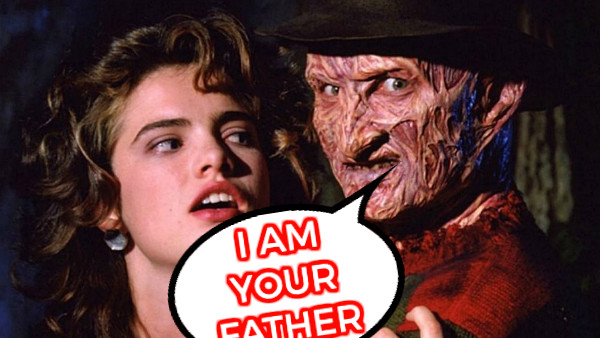
5. Freddy Is Nancy's Dad - A Nightmare On Elm Street

Though a lot of horror series get lost in their own mythology, A Nightmare on Elm Street kept it relatively simple. Sure, it introduced dream wizards and eventually revealed the whole thing to be a movie inside a movie, but Freddy's origin remained pretty consistent throughout. The idea was that he was a child murderer (and suggested molester) who was burned alive by the town when escaping formal criminal punishment, returning later to kill his own murderers' children by way of invading their dreams.
His first big foil is Nancy, who goes through untold punishment in the original movie, watching her friends get taken out one by one while trying to make sense of what's happening. Much of the exposition comes courtesy of her alcoholic mother, who struggles to live with her murderous actions years prior. However Nancy's mom seems to have a more intimate connection to Freddy than most, even having some of his possessions in the furnace below.
One theory suggests this is because Freddy is actually Nancy's real father. Whether he knows that or not is unclear, but it would explain how personal Freddy's taunts get as the movie goes on, where he's quite content to cleanly kill off everyone else. He seems to be concerned with punishing her the most, potentially in order to get back at her mother for keeping the real parentage a secret.
Yeah, it kind of taps into the trope of every hero and villain needed to be intimately related somehow (blame Star Wars and Halloween for that), but it certainly would add an even more sinister angle to the entire series.
4. Jay Is The Chosen One In A Pagan Prophecy - Kill List

Initially, Kill List looks just like any other British crime thriller from the early 2010s. Former military hard men Jay and Gal are left taking work as Hitmen after returning home from a disastrous mission in Kiev, and are assigned to kill three targets by a mysterious client in the film's opening.
The whole thing gets weirder from there though, with Gal's new girlfriend carving a strange symbol into Jay's house, the victims of the hits thanking them before being killed, and then a full-on cult coming out of nowhere to ambush the two friends whilst on the final job. The film ends with Gal being gutted and Jay being forced into a sick game, put in a fight to the death with a disguised "hunchback", who turns out to be his wife and child that he's unknowingly stabbed to death.
It's certainly effective, but it's easy to walk out the film wondering just WTF happened. One theory claims to have put the pieces together however, and explains that Jay's eventual fate has been orchestrated from the start. It posits that he's been viewed as the "chosen one" for the pagan cult, who's set to bring about "reconstruction" of their religion - essentially bringing it back to full strength from a weakened state - through blood sacrifice.
This does admittedly tie into the film's weirder moments, most evidently with every victim accepting their role in the overall prophecy and thanking Jay for making them a part of it. It's also reflected in the movie's religious imagery, with Jay's always-bleeding cut on his hand acting as a stand in for stigmata. We never see if the completion of the ritual does bring about something supernatural, but it still implies that this cult is far larger, and far more powerful, than it initially appeared - and Jay is looked upon as their new God.
3. Oren Peli Made A Deal With The Devil - Paranormal Activity

One of the more interesting theories to populate the horror genre is that Paranormal Activity director Oren Peli actually made a deal with a demon to record his film, explaining how he got it to appear so realistic, captured the nuances of the entity, and, of course, the fat profit margin that came with the production.
Considering the whole film was made on a budget of roughly $15,000 and made over $193 million back, maybe it’s not that far fetched - a profit margin of over 12,000% has to have something to do with supernatural dealings. But being as serious as we can about the whole ordeal: the evidence for the spooky shenanigans explains the phantom's actions across the series.
The entity causing a load of haunting problems for Katie and her partner obviously knows it’s being filmed, and couldn’t give a flying crap about it. The theory goes that there is something to gain from appearing to the masses: power. The more people that know and fear the creature, the stronger it gets, which is why some insanely strong supernatural entity isn’t destroying the obvious footage being taken of it at every opportunity.
That’s as well as some moments of recorded footage clearly being there to frighten the viewer rather than to be reviewed by the characters on film, such as the ending of the first movie. This would be explained by the demon knowingly trying to affect us rather, than its movie prey.
2. It's All About The Bible - Mother!

Darren Aronofsky's mother! is abstract and intentionally abrasive to a fault. Essentially, it's almost two hours of the director wanting the audience to be as miserable as possible, putting them into one awkward social situation after another, and then having hell literally descend on the film in an explosive finale that features mass executions and the decapitation of a baby.
There is a method to the madness though, and the primary theory surrounding the movie's confusing plot spins off some details Aronosfsky has revealed himself, such as Jennifer Lawrence's character being a stand in for Mother Nature and Javier Bardem being an Old Testament God, but ignores how these characters have supposedly been used to primarily comment on how humans treat the planet.
This theory instead states that the movie is actually more of a pessimistic retelling of the world's creation (and its destruction), rather than offering an eco-friendly message. The first half is a bloody depiction of the Creation myth, with Ed Harris' "Man" and Michelle Pfeiffer's "Woman", who are Adam and Eve stand ins, warring with their two sons, one of which kills the other just like in the story of Cain and Able.
This gives way to the full-on apocalypse by the end, with the anarchy of the final 20 minutes reflecting each apocalyptic "seal" in the book of Revelations. It starts with war, moves onto famine, death, martyrdom, an earthquake and, ultimately, silence. Each of these stages are cycled through quickly in the final third, forcing a hard reset that takes us right back to the beginning with just God, Mother Nature and their creation, with the whole thing destined to play out once more.
1. Psycho's Sam Loomis Is Michael Myers' Psychiatrist - Halloween

Sam Loomis isn’t really a popular name, so it popping up in both Psycho and Halloween has of course been chalked up to more than a mere homage. With a little bit of creativity, Dr. Loomis can easily be a part of both movie universes, with his humble beginnings being chronicled in Hitchcock’s seminal work as Marion Crane’s boyfriend.
In that story he serves as the man who discovers Norman Bates’s true identity, finding the killer dressed in his mother’s clothing and getting his stab on. Apprehending Norman and handing him over to the police - Loomis is some sort of hero, but it all comes too little, too late. Marion is already dead, and the guilt drives him to a life of redemption by taking on psychiatry as his new profession.
Training as a doctor, Loomis becomes Dr. Loomis, treating psychopaths over the country before one Michael Myers, a child that has killed his sister, comes under his care. He’s a young man in Hitchcock’s 1960s thriller and ages appropriately (if quite badly) by the time Halloween is released in 1978 - and Michael’s treatment is the closest he’s ever come to rehabilitating someone akin to Norman Bates.
Loomis reacts so viscerally to Michael’s escape and consequent killing spree as it parallels Norman’s state of mind, and he can’t bear to lose people to these murderers twice. He knows that the only thing that will stop Michael is killing him - which is why he irrationally pursues the guy for five freaking films.
It’s not professionalism, but obsession, born from experience.
Which other horror movie fan theories belong on this list? Share your suggestions below in the comments thread.