8 Most Confusing Movies Nobody Understands
WTF did we just watch?

In a world where blockbuster action movies dominate the Hollywood headlines, it doesn't hurt to take in a film with a bit of substance every now and again. Although the majority of new releases tend to be sequels, remakes or the latest addition to a cinematic universe, there are thought-provoking movies out there, if you know where to look.
Tackling weighty subject matter and challenging the audience is all well and good, but some movies take this too far and become impossible to wrap your head around. Directors like David Lynch and his many imitators have made careers out of this.
Certain films are difficult to grasp because they're steeped in ambiguity, while others are impossible to follow unless you have a masters degree in an obscure subject like theoretical physics or quantum mechanics. Either way, the audience leaves the cinema with WTF written all over their faces.
There are movies which start to make sense from the second viewing onward, after you've boned up on wikis and fan theories, while others remain enigmatic and open to interpretation for all time.
8. Eraserhead

David Lynch is a master of surrealism, ambiguity and downright weirdness. Depending on your point of view, he's either a tortured genius or certifiably insane. After watching his feature-length debut Eraserhead, people tend to agree it's a bit of both.
Like many of Lynch's films, Eraserhead plays out like a nightmare. It follows a man named Henry Spencer (Jack Nance) as he attempts to care for his mutated baby, facing all kinds of bizarre obstacles and challenges along the way.
The narrative is murky but the imagery this movie throws at you permanently embeds itself in your mind's eye. There's a weird woman with bloated cheeks who lives in a radiator, giant sperm cells, and some darkly disturbing dream sequences.
Everything about Eraserhead is surrealist and abstract, but Lynch has never been one to explain the content of his movies. Some believe it's a commentary on sexuality or the fear of parenthood, while others have dismissed it as pretentious nonsense.
7. Primer

Primer might just be the smartest time travel movie ever made; so smart that it's almost impossible to keep up with during the first dozen sit-throughs.
Filmmaker Shane Carruth is a college graduate with a degree in mathematics who also happens to be a former engineer, and he tapped into his expertise in both fields to ensure the movie's time-bending mechanics are as authentic as possible.
The theoretical mathematics behind the concept of time travel aren't exactly simple, and Carruth refused to dumb them down for the audience's sake. As a result, the two leads sound like they're speaking in code for much of the film.
You'll need several PHDs to your name to fully understand the science behind Primer, but at its core is a story about the breakdown of a relationship and power falling into the hands of two guys with no grasp of the ethical implications of wielding it.
These aspects of the story will resonate with lay people, but only a select few have a firm grasp of the who, what, when, where, why and how of Primer.
6. Bug

Bug's premise finds a woman holed up in a rural Oklahoma motel with a paranoid man who's obsessed with conspiracy theories about insects and the government. The plot barely develops from here, with director William Friedkin aspiring only to conjure claustrophobia and mess with the viewer's head.
Lead actors Ashley Judd and Michael Shannon are caught up in a feedback loop of their own delusions and there's a creeping sense of their minds unravelling throughout, visually represented by the hotel room's increasingly tin foil-coated walls.
Friedkin's intention was to make the viewer feel like they too are descending into insanity, and it's difficult to claim it wasn't mission accomplished while you're being assaulted by Bug's darkly hallucinogenic imagery.
Bug plays out as more of a visceral experience than a narrative-driven story. You'll come away feeling unsettled and relieved it's all over, but nobody can say for sure what really went down in that seedy motel room.
5. Donnie Darko

Richard Kelly set out to boggle minds with Donnie Darko, a barely coherent tapestry of time travel, alternate universes, wormholes and giant rabbits. Those are some weighty concepts to serve up in your feature-length debut, but the way the movie was cut for cinema only made it more difficult to understand.
So many key scenes that would have added context to the movie's underlying mechanics were left on the cutting room floor. Only when the director's cut was released in 2004 did it become apparent what Donnie Darko was actually about.
Even without understanding what a Living Receiver or an Ensurance Trap is, it's possible to enjoy Donnie Darko as an ambiguous piece of science fiction. It's palpable sense of creeping doom and Jake Gyllenhaal's break-through performance alone make it worth a watch, and that's even true of the inferior theatrical cut.
But can anyone really claim to fully understand every one of its philosophical and scientific concepts? There have been extensive essays written about them in the hope of finding clarity, most of which barely scratch the surface.
4. Only God Forgives

Not many films can claim to have inspired a chorus of boos and a standing ovation at the Cannes Cannes Film festival, but that's pretty much what happened when Only God Forgives debuted footage there in 2012.
When Nicolas Winding Refn released his follow-up to Drive, the finished product proved no less polarising. Critics couldn't decide whether what they had seen was an abstract masterpiece or a case of the Emperor's New Clothes.
It's clear both Refn and lead actor Ryan Gosling had no desire to make another movie with mass-market appeal like Drive, this time delivering a surreal slog through the neon-drenched cityscapes of Bangkok.
Nothing is quite what it seems in Only God Forgives. There are scenes of utter depravity with underlying beauty and characters so enigmatic that they're more like walking puzzles for the viewer to solve than human beings.
The more you watch this movie, the harder it is to determine whether it deserved to be booed or applauded more at Cannes.
3. Pi
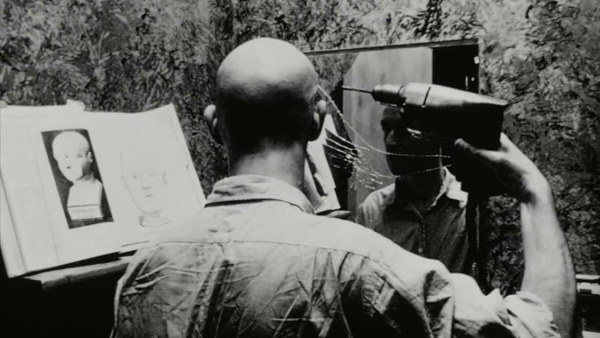
Darren Aronofsky has never been afraid of defying filmmaking conventions and his feature-length debut Pi is the perfect example of experimental cinema. The movie follows a mathematician named Max Cohen who becomes obsessed with the idea that everything in life can be understood with numbers, and it's as weird as it sounds.
Aronofsky uses number-crunching as a means of exploring the fragile mental state of a man gradually succumbing to paranoia, hallucinations and social anxiety disorder, but also to highlight life's infinite possibilities.
Although it's easy to get lost in Pi's strange world of numbers and patterns, nothing quite prepares you for the final scene, which involves DIY surgery with a power tool, although you will be able to empathise with Max's brain trauma.
When you boil Pi down, it's basically a thriller about a man who puts his mind on the line to pursue an obsession, but being so stuffed with references to maths and mathematical theory, it's a heavy watch that few people truly understand.
2. The Tree Of Life

The Three of Life starts out in fairly unspectacular fashion, following a family called the O'Briens in 1950s Texas. What appears to be a vanilla look at suburban life in a bygone age suddenly takes a sharp turn into WTF territory when the story becomes interspersed with shots of the creation of the universe, for some reason.
The movie continues along this strange avenue, continuing to spin its story about the O'Briens, but suddenly jumping to scenes depicting everything from the origin of life, to the destruction of the Earth after the sun goes supernova.
By the time the unconventional narrative reaches its conclusion, director Terrence Malick is serving up dream-like images of death and resurrection. At times, it's visual poetry in motion, though you have to dig deep to find coherence under all of this.
Tree of Life opens with a quotation from the book of Job and understanding its religious connotations is the key to making sense of it, but it's one of those movies that 20 people can watch and each come away with a different interpretation.
1. Cloud Atlas

The Wachowskis enjoy messing with people's minds, but with Cloud Atlas, that probably wasn't intentional. A movie that attempts to intertwine six unrelated stories was always going to struggle to find coherency, and it doesn't help that people are forever searching for things that aren't there when it comes to this film.
Film fans make the mistake of attempting to figure out how this sextet of tales connects together and get frustrated when they can't find a common thread. But here's the thing: they aren't supposed to link in purely narrative terms.
Cloud Atlas is a tapestry of stories which explore the human condition. When combined, they do this in a deeper way, making them greater than the sum of their parts, but most viewers are too busy trying to figure out who's been reincarnated as whom and which story is supposed to be fiction in the in-movie world to appreciate what the film is trying to do.
Unless you're armed with this knowledge in advance - and most people weren't unless they'd read the book - the chances of making sense of its six narratives were slim.