8 Movies With Ambiguous Endings (That Weren't Really Ambiguous At All)
 Ambiguity can be a film-maker's best friend, especially when it's understood correctly and harnessed properly. To my mind, it should go something like this sometimes, you need to understand that less equals more, because in certain situations it's far more poignant and powerful to leave the ending up to the viewer. Think Total Recall's dogged determination not to tell you if Quaid was hallucinating, or Blade Runner's dancing around the issue of Deckard being a replicant. Hell, to get out out Phillip K. Dick-inspired fare, think of whatever the damn hell happened at the end of 2001: A Space Odyssey, or the is-it-a-delusion finale of The King Of Comedy. My point is this in certain situations an open ending can really aid a film, because occasionally bashing the audience around the head with heavy-handed moralising or signposted endings can jar with the experience. It's the show-don't-tell model of storytelling, and it leads to those best kinds of films, the ones you can mull over in your head, day after day, replaying the events again and again. It's these endings to which all film-makers aspire when they wish to make their audience think. However, just because film-makers want to make their ending as nebulous as possible, it doesn't mean they always succeed. Indeed, they can often be hoisted by their own petard instead. It's an occupational hazard if you write an open-ended conclusion, you should take it as a given that someone, somewhere has done the whole several-watches-of-analysis thing to it, and attempted to APPLY concrete solutions to your inconclusive work. In fact, this is just what I've done here I've taken some of the great and the good films that didn't have proper conclusions, and attempted to slap one on anyhow. You might call it blasphemy, and to be honest, I'd probably agree with you this is just a thought experiment writ large, so feel free to heckle me if you disagree with my theories. Hell, they probably deserve it, but I thought I'd give it a crack. Before I begin, I must point out that there is a SPOILER WARNING is in effect. Also, all of this is my opinion, and should in no way be represented as objective fact. Except Deckard being a replicant, that one's totally true.
8. American Psycho
 I think this is a strange one, and it's probably apt that the film took a shot at ambiguity the whole thing is supposed to represent just how mental Patrick Bateman is, so it's only natural that director Mary Harron would've left us to make up our own minds about just how much of the chainsaw-wielding yuppie's escapades were all in his head. Well, I don't think it really needs too much debate to my mind, Harron is so overt about it being a dream that all debate is pretty much hamstrung before it can come roaring out of the blocks. I mean, look at it between the miraculously clean apartments, the fact Bateman can blow up police cars with a pistol and the ATM begging to be fed a stray cat, the argument is awfully weighed to one side by the amount of pitch-black comedy on display. It's obvious that Harron wanted us to come away as dazed and confused as her protagonist, and those who argue that the murders actually happened can wax lyrical about the fact no-one seems to know what the damn hell Paul Allen looks like, never mind a bevy of anonymous hookers, and that everything turns up roses for Bateman because of his position though only implied in the film, the book makes clear that he's able to sit around all day and do sod all because he's got his position through nepotism are fighting a losing battle against a cavalcade of evidence heavily weighted to the opposing view. I'd put this down to an error on Harron's part she left the door ajar to invite debate, but there's just not enough evidence on balance to support the ending's claim to true ambiguity. If she hadn't been so blatant with the conclusion she wanted us to take away from Bateman's sorry life, this would've turned a great film into a classic, and saved it from a mention on this list.
7. Oldboy
 Oldboy is magnificent, and if you haven't seen it, I suggest you stop what you're doing and remedy that right now. I'm serious if you've got a strong stomach, don't mind subtitles and like your films daring and edgy, it's right up your street. Go on, go and see it I'll wait. Done now? Good. Well, not good, because you've just been b*tchslapped with the fact that Oh Dae-su had sex with his daughter Mi-do, and has taken the controversial step to have that knowledge hynoptised out of him so he can continue with his life, and most likely his screwed-up relationship. Yet still, you can't have your disturbing cake and eat it, and Oldboy attempts to throw ambiguity into the mix with the last shot of the film where the newly-blanked Oh Dae-su embraces the oblivious Mi-do, who, clearly still in love, embraces him. Then we cut to our protagonist's face and see it's in a strange contortion between happiness and tears, leading people to wonder whether he's managed to elude his hypnosis and remember what a horrible thing he's doing, or if it's just a look of confused elation. However, I put it to you that the face is clearly one of horror. It's so incongruous to any other face you'd pull in a regular situation that it must be a result of neural programming, implying that the hypnotist has left another cue in there as Lee Woo-jin's final act of vengeance. Yet how do I know she's sabotaged him again, on behalf of her deceased paymaster? Well it's simple really just because he's dead, it doesn't mean his money's gone, and he's been so meticulous about structuring Oh Dae-su's life thus far that to let him get away in any way would seem utterly out of character. Also, it explains why the hypnotist a woman previously content to force incest and complicit in life-ruining imprisonment performed such an out-of-character volte-face. Plus and most convincingly she's just too good at her job to be undone by negligence of half-assery. Again, if she can make a father and daughter do the horizontal tango through the cue of a mobile phone, I'm willing to bet her work's not going to be scuppered at the first hurdle. No, it's more likely that she put in a cue to break Oh Dae-su all over again for the sake of vengeance, thus confirming the theme of Park Chan-wook's trilogy.
6. Prisoners
 This'll require explaining, because at first glance you'd probably think that Prisoners' ending isn't ambiguous at all Hugh Jackman's hysterically-named Keller Dover gets imprisoned in a hole in the ground, and Jake Gyllenhaal's Detective Loki finds him courtesy of the safety whistle Dover's daughter left down there during her own incarceration. The only thing we lack is a proper ending there's no ambiguity, but what's happen is so obvious implied that you might almost call it super-liminal ('HEY YOU, JOIN THE NAVY!'). However, screenwriter Aaron Guziowski is determined to make us think he made the film's ending totally ambiguous, judging by an interview he gave to Buzzfeed. Have a read of his choice of ending below.
"They move the car. They see he's down there. You know he's going to be taken out of the hole. I like it much better being ambiguous. Even though you assume that's what's probably going to happen, I like that there's a small chance that he's not going to get him out of there for whatever reason."Guziowski believes the audience could think Loki is so unbalanced at that moment that he would possibly leave Dover down there, because of his antipathy toward the guy. Yet honestly, I didn't get that at all, and neither did anyone in the screening with me. This wasn't like Inception's will-the-top-stop-spinning ending which drew audible gasps when it cut to black it was very cut-and-dry, and we all knew from his face that Loki knew where Dover was, and that he'd fish him out to conclude the case that came so close to utterly destroying him. Frankly, I've honestly not come across a single person who bought into Guziowski's attempt at ambiguity, and I'm not sure I ever will. It just seems like the writer is trying to make a mysterious mountain out of a mundane molehill. And now, I'll stop with the alliteration.
5. The Italian Job
 We all know how The Italian Job the 1969 version, not the serviceable Marky Mark fronted remake ends, but hell, I'll remind you anyhow. The gang appears to have gotten to the end of their elaborate, Mini-themed gold heist unscathed to the extent that they're partying in a coach with their gold-brick haul. For a moment it really does look as if everything will come up roses, but then the coach driver loses control and the vehicle is left tottering over a precipice with the gang at one end and the gold slowly slipping toward the back. Of course, it's at this point we're left with the classic line from Michael Caine's Charlie Croker, proclaiming how he's got a good idea, and we don't ever get to see what solution he was going to pull from the ether to save both the crew and the precious bullion. It's one of cinema's great cliffhangers, and it's been bothering people for years. In fact, it bothered Britain's Royal Society Of Chemistry so much that they started a competition to see if anyone could come with a solution for Croker's conundrum and naturally, the bored and obsessive among the UK's subjects responded with gusto. After much sifting through failed solutions, they declared the winner John Godwin, a Surrey resident who proposed smashing all the windows on the bus to stabilise it, before emptying out the vehicle's fuel and having one man stabilise the front end with rocks. However, as cool a fact as this is, it doesn't detract away from the fact that Croker's crew are never getting away with that gold. Why's that? It's simple Godwin's perfect solution took a whole damn day with a calculator to figure out, showing three luxuries Croker definitely didn't have time, a calculator and a reviewing body to throw out any flawed solutions. Plus, the guy's got an understandably panicked but counterweight-integral crew operating as a wildcard if they get spooked, then everything's going to hell even if Croker does beat the astronomical odds and pull out a solution. So I'm afraid to say it, but we just might have to say Croker's going to the bottom of that precipice, or at least his gold is.
4. The Grey
 Joe Carnahan makes good action films, and what's usually crucial to his winning formula are spadefuls of payoff in big, memorable scenes think the Aryan brothers shoot-out in Smokin' Aces, or the three-cups-and-a-ball sleight of hand trick writ large in The A-Team. For the longest time, we all thought we'd be treated to something similar in The Grey, thanks in no small part to the acres of foreshadowing involving Liam Neeson and the Alpha Wolf, the leader of the wolfpack hunting down Neeson and his erstwhile colleagues. Yet when it came time for the ending's big payoff, everything was left strangely ambiguous Irishman lying against his lupine adversary. Leaving aside that the film skimped out on its biggest scene a vodka bottle-wielding Neeson taking on the four-legged menace was used as a major selling point in the trailer we got absolutely no hint as to what the hell had gone down, and who the hell had won. Especially in an action film, this can somewhat stick in the craw. However, I think it's quite obvious what happened by hook or by crook, they ended up killing each other, and what you saw was both of them breathing their last. I mean, it has to be this way there's no way Neeson would use that beast as a giant throw pillow unless he was one breath away from kicking ass in the afterlife, and I highly doubt a giant monster of a wolf would approve of having a hardy Irishman draped over him without being some way toward knock-knock-knocking on heaven's door.
3. The Wrestler
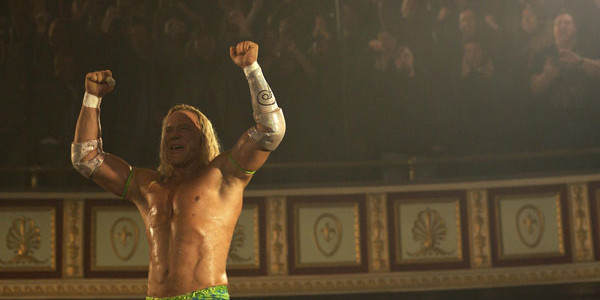
 The Wrestler operates as something akin to the anti-Rocky, where Darren Aronofsky makes it halfway through the archetypal second coming/reformed character story before violently smashing it over the head with the reality of the situation. That reality goes a little something like this Randy Robinson's unable to shake off what put him on skid row in the first place, and ends up alienating his daughter, ruins his chances with his love interest and gets fired from his deli counter job in spectacular fashion. Alongside this, we learn he's got a dodgy heart which should keep him out of a wrestling ring, the one place he's ever felt at home. This is made doubly sad by the fact that he's got a lucrative bout coming up which celebrates the 20th anniversary of his fight against the controversially-titled Ayatollah, so he can't even relive the days where everything was right for him. Of course, by the time the bout rocks up, Randy's had life knock the stuffing out of him so hard that he throws a screw-it and enters the ring anyhow. Naturally, it goes as you might think our protagonist's heart starts giving up the ghost within minutes, to the extent that even his long-retired opponent recommends they should cut the match short. Yet Randy refuses, climbing the turnbuckle to deliver his aerial finisher, a move so ambitious that it's probably going to put paid to our protagonist, right then and there. But we don't get to see that instead, Aronofsky lathers on the ambiguity, cutting out just as Randy leaps from the turnbuckle under the glare of the ring lights. I don't know why he did this I guess it works poetically, but it's clear he's going to have a cardiac arrest. Remember, the director makes it clear that he could barely pull off a regular wrestling move before without his ticker packing up, so I'm willing to bet that if he smacks into the ring canvas with force, he's going into the great beyond. Yet by adding mystery to the equation, you could almost argue that it takes away from the oddly uplifting tragedy of it all. Instead of leaving us with final Randy's Pyrrhic victory, the dramatic oomph is lessened by all this speculation of whether he survived his fall, even when it's obvious he didn't.
2. The Shining
 With its nightmarish imagery, direction from a madman who liked to emotionally break his actors and clever little tics like the Overlook Hotel's layout making absolutely no sense, The Shining was a mindf**k at the best of times. True to form, it carried this reputation for balls-out insanity right to the end, where we see a 1921 picture containing Jack Torrance along with the other revellers of the hotel. This picture operates as something of a gamechanger for what's happened in the rest of the film. Jack's affinity for the hotel had been hinted at numerous times, and the idea of other 'guests' in the hotel was made a reality when Wendy wanders in on the most bizarre sexual encounter you've seen outside of deviantART, legitimating Jack's hallucinations. Yet the photo reveal does more than that it's ambiguity in its best form, an open ending which asks legitimate, mind-bending questions of the viewer and what's gone on before, rather than adding a strand of cheap mystery for titillation. But still, just because it raises questions, it doesn't mean those questions can't be answered, and here's my attempt at just that. I personally think the theory that the Overlook is some kind of hungry purgatory is the best way forward that it seeks to devour souls to add to its menagerie of ghosts. It goes after Jack because he possesses the weakest resolve of the family, and when he dies in the maze it claims him, supernaturally adding him to the photo and the ever-expanding community of phantoms at the Overlook. It's simply an act of the hotel as a sentient, malevolent force making overtures toward the Torrance paterfamilias it drives the film, and offers a simple explanation to a true head-scratcher of an ending without getting bogged down in the more timey-wimey and spirtual theories which have sprung out of this particular dramatic well.
1. Lock, Stock And Two Smoking Barrels
 Lock, Stock And Two Smoking Barrels featured a humdinger of an ending which decided to eschew the whole everything-wrapped-up-in-a-neat-little-bow approach for something altogether more befitting to that film universe. To remind you, it went a little something like this (deep breath) the noble foursome of Bacon, Soap, Ed and Tom go back to their flat to find the crew they stole some already stolen money and weed off have been shot dead by the first lot of guys who had the money and weed stolen from them. However, the cash has been picked up by Vinnie Jones in his breakout and best role (although that's not saying much) who's working as a debt collector to the folks to original foursome owe. Yet when our heroes attempt to explain what's happened to their money, they find their loan sharks have been killed too, by two guys looking for a pair of antique rifles on behalf of the very people they shot. Somehow Vinnie gets the money back again, but Tom manages to walk off with the antique rifles, which he's purchased earlier as part of the operation to turn over the neighbouring crew. He's then told to dump the rifles the only thing linking them to the massacre at their home but Vinnie comes back in, saying he's taken the cash but the rifles are worth a pretty penny. Cue frantic phone-scrabbling for Tom, whose phone goes off when he's dangling over the side of a bridge holding the guns in one hand. It's a cool ending to an utterly labyrinthine plot, dumping simplicity in favour of the character anarchy which punctuated Guy Ritchie's opening films. To me, that's a wise move frankly, with this many people, methods and motivations knocking about, it's only natural that something would go unresolved, and here we have it does Tom answer the phone, or does he drop the guns? To this question, I ask this why can't he do both? As has already been established in the scene, Tom's first attempt to get rid of the guns failed because there's a platform behind the railings on which they got stuck. So really, why can't he put the guns back on the platform, take the call and then armed with this new knowledge, re-save the guns? After all, he's got himself a way to drag his body back over the railings and out of his precarious position. Sure, it would take some thought to right himself properly, but I truly think Tom could get back to stability on either side of that railing (that platform looks pretty large), and answer that £500,000 phone call. Then he can go back to JD's for another pint, which he can now totally afford. Agree or disagree? Know of any more? Fancy yelling at me? Feel free to comment!