8 Movies With Seriously Insane Details You Didn't Notice
Someone actually counted every hair on Lots-o'-Huggin Bear's body...

Great attention to detail is often an inherent part of what defines a great movie: it's also the feature that separates the auteurs and directorial geniuses from the hacks who just turn up to get paid and abuse the catering budget.
In most cases, directors will spend as much time as the production schedule will allow to imbue their movies with as many fine details as possible. Whereas these directors are merely passionate, there are some directors who are completely, balls to the walls over-the-top - so much so, in fact, that they're just as concerned with an object in the background of the frame that nobody will ever see as they are Brad Pitt's acting or the opening credits.
These directors are to be admired for their dedication, not mocked. Is there anything more beautiful than a filmmaker feverishly pursuing the most unlikely of goals, all for the sake of bringing their products as close to their vision as possible?
There is not.
To celebrate such delirious dedication on account of some of the world's best loved filmmakers, here's eight movies with insane details that you've probably never noticed... which, bizarrely, is likely what the filmmakers involved intended anyway.
8. Those Were Real Arrows Being Fired At Toshiro Mifune - Throne Of Blood (1957)
Akira Kurosawa is often considered to be the greatest of all Japanese directors, what with a body of work that includes Hidden Fortress, Seven Samurai, Yojimbo, Rashomon and Ran. Even if you haven't seen movies, you've got to admit that even the names sounds good.
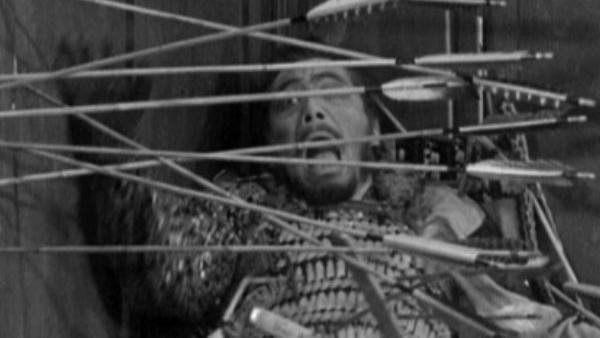
Throne of Blood, which transposes Macbeth to feudal Japan, is considered to be another Kurosawa classic, and starred Toshiro Mifune in the lead role. Towards the end of the flick, Mifune is fleeing from archers, which would be rather frightening should it happen in real life. For some directors, like Kurosawa, "acting" frightened just wasn't considered good enough. In fact, the only way to really achieve the kind of genuine horror that he'd conjured up in his mind's eye was to subject his leading man to some genuinely terrifying circumstances.
Which is to say, Kurosawa ordered the use of real archers and real arrows in the scene where Mifune tries to avoid the damn things from, you know, killing him.
Yes, to get the most realistic reaction possible, the director hired some of the best archers around and had them fire into the wood right next to where Mifune was standing, who had to be absolutely fine with this, apparently, 'cause Kurosawa. Anybody who thought that Mifune's acting in this scene was "realistic" had no idea what the poor guy was being subjected to.
Kurosawa later commented that Throne of Blood was "very hard to make." But for who, exactly?
7. Stanley Kubrick Demanded That The Equipment Featured Would Actually Work On The Moon - 2001: A Space Odyssey (1968)

Stanley Kubrick is probably the quintessential "insane genius" movie director, because that's precisely what he was. In fact, the man's name has become common amongst film types requiring shorthand for "obsessive perfectionist."
2001: A Space Odyssey, which, today, is still considered to be one of the greatest - if not the greatest - sci-fi movies of all time, luckily found itself helmed by the only man who could have likely done it justice in 1967. The movie, which spans the beginning of time all the way up to the present and, uh, back again (or something), also concerns itself with a doomed space journey that pairs Dave, an astronaut, with an eerie computer, HAL, as they plough across the universe and, like, bicker and stuff.
You need to skip to a random frame of 2001 to understand just how much detail Kubrick squeezed into every frame. The ship's layout is extensive and brilliantly-realised, and the movie is technically sublime in every aspect. Even now, it looks mind-blowing.
Kubrick's assiduousness was certainly justified, then, though we're not quite so sure why the director insisted (demanded, even) that all the equipment and props used during the moon sequence could really work on the moon. Seriously. The props that were built had to actually work should they find themselves on the moon's surface for some reason. Which, given Kubrick's experimental nature, might've paid off one day, since we can absolutely imagine him proposing that his next project "is to be filmed on the moon."
6. Johnny Depp Learned To Speak Near Fluent Vietnamese - Platoon (1986)

Platoon is considered a rather accurate portrait of what it might have been like to fight in the Vietnam war, given that the movie's director, Oliver Stone, actually fought in the Vietnam war. The film stars Charlie Sheen in the central role, though there's a large ensemble cast to be had, including talented actors such as Willem Dafoe, Forest Whittaker, John C. McGinley and Johnny Depp, who is only in the movie for a couple of minutes.
The surprising thing is, Depp originally had a much larger part, and - for his role as soldier who speaks fluent Vietnamese - learned to speak nearly fluent Vietnamese, only a small amount of which makes it into the movie. Considering anybody watching the flick would reasonably presume Depp only learned the lines he needed to actually speak in the foreign language, the fact that he had a huge vocabulary just waiting to jump on the screen (and never got the chance to use it) remains one of the movie's most interesting hidden details.
So why was Depp's part cut down considerably? The reason is somewhat amusing: director Oliver Stone found himself so enamoured with Depp's performance (not to mention his good looks), that he decided to remove as much footage of the actor as possible, as not to detract attention from the not-so-enamouring Charlie Sheen.
5. Somebody Actually Wrote Out All Those John Doe Diaries - Se7en (1995)
Se7en is one of the best movies of the '90s, and arguably David "Serial Killer" Fincher's most accomplished film. Set over the course of a week, the plot concerns two detectives, one Brad Pitt, the other Morgan Freeman, as they attempt to track down a batshit crazy serial killer (known only by the genericism "John Doe") who is subjecting his victims to horrific deaths inspired by the seven deadly sins.
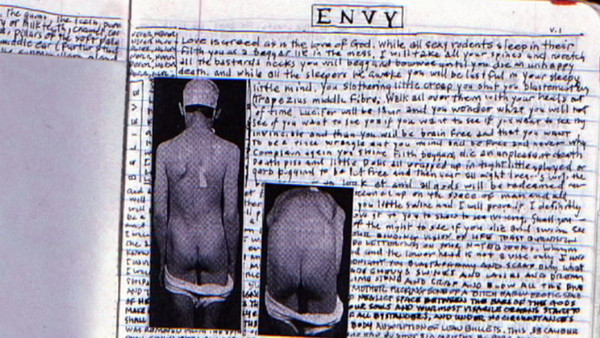
At one point in the movie, Pitt and Freeman break into the madman's apartment, where they discover that he has panache for writing down his thoughts in a diary. And the man has lots and lots of diaries. Hundreds of them, even. Enter John Sable, the production designer who David Fincher commissioned to construct John Doe's mind in paper form. That's to say, he asked Sable to create the props for Doe's scattered notes.
To really capture Doe's madness, Sable apparently went to extreme lengths himself: he bought $1500 worth of old journals, which he proceeded to rip to pieces, sew back together, and attach weird pictures of limbs and mutilated bodies to. Sable then wrote like it was going out of style. Like, hundreds and hundreds of thousands of words, spread across thousands and thousands of pages. He filled notebook after notebook with John Doe's scrawl, because that's what a good production designer does.
Eventually this stuff was scattered around Doe's apartment, and you can just glimpse some of it in the background of a few scenes, not to mention in the movie's iconic opening credit sequence. Most of Sable's is purely for set dressing, as it's generally too small to actually read. Sure, it could have just been printed out and faked, but where's the fun in that when you could have someone fake the ramblings of a serial killer instead?
4. Agent Smith's Number Plate Refers To A Biblical Passage - The Matrix Reloaded (2003)
The Matrix is one of the seminal sci-fi movies of the '90s. You can't say the same for its sequel, The Matrix Reloaded, for two reasons: 1) it wasn't made in the '90s, and 2) it's far from seminal, in the sense that it compromised a whole lot of what was good about the original flick.
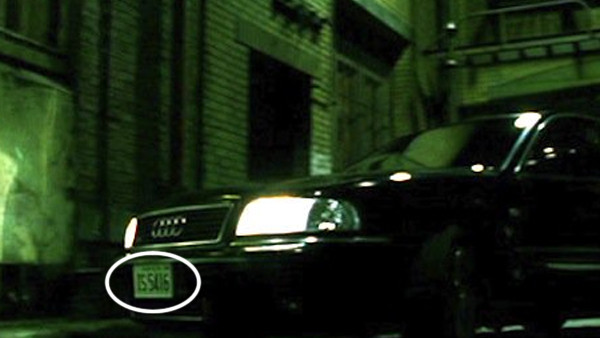
Still, aside from all those Zion raves and Zion scenes and Zion-based plot points, Reloaded has some great action sequences and a rockin' soundtrack. In true Wachowski style, there's lots of attention to detail too. As an example, refer yourself to Agent Smith's license plate on his Audi A8, which reads 'IS 5416'. Just a random series of letters and numbers, right? Wrong! It's actually a reference to a Bible passage, Isaiah 54:16, which reads as follows:
"Behold, I have created the smith that bloweth the coals in the fire, and that bringeth forth an instrument for his work..."
Fire! Smith! Instrument! All words which you may or may not be able to shoe-horn into an allegory for Agent Smith's destiny within the realms of The Matrix. And though rather playful, it's still a nice detail, one that you probably never noticed whilst watching the movie itself, 'cause why would you be wasting your time looking at a car's license plate?
3. Michael Mann Insisted That Everything Was Shot In The Exact Spot That It Really Happened - Public Enemies (2009)

Public Enemies was Michael Mann's 2009 biopic on John Dillinger, at one time, America's most notorious bank robber. In the movie, he's played by a broody Johnny Depp (very broody), and is chased down by a moody FBI agent, as played by Christian Bale (very moody). During the shoot, Michael Mann - already well-renowned for his insane attention to detail - managed to irk the hell out of Depp, who insisted that the director was...
"[All about] the details of the details of the details. They should invent a word to describe it because it's not just details, it teeters on microscopic obsession with every molecule of every moment."
Woah, boy! So what was it exactly that caused the usually mellow Depp to make such an outburst? Well, it might've been that Mann insisted that nearly every single shot (where it was possible, at least) was done in the exact place and in the exact spot that it really happened. In movie production terms, that's a freakin' nightmare, for reasons we probably don't need to explain.
Still, Mann managed to get most of the footage that he wanted, despite the fact that the majority of audience members wouldn't be able to tell the difference. The climatic shootout was shot at the Little Bohemia Lodge right where it really happened, and Mann even managed to get footage of Depp lying on a bed that Dillinger himself had slept in.
A shame, then, that the movie wasn't as engrossing as reading up on the details.
2. There Are 3,473,271 Individual Hairs On Lots-O-Huggin Bear - Toy Story 3 (2010)

Toy Story 3 is set a good eight or nine years after the events of Toy Story 2, meaning Andy has grown out of his "playing with toys" phase and is soon to be somewhere in the midst of his "getting krunk" phase. (Thankfully, Pixar tastefully chose not to animate that.)
The toys - which include iconic characters like Woody and Buzz Lightyear - are accidentally shipped to a daycare centre, and find themselves under the tutelage of the secretly-evil Lots-o-Huggin Bear, who runs the place with an iron fist.
Lots-o-Huggin Bear (or Lotso, as he's known in the movie) is one mean son of a gun, but Pixar liked him enough to animate a whopping 3,473,271 hairs on his pink, fluffy body - an incredible achievement, considering that he's just one of nearly fifty characters featured in Toy Story 3.
Yes, we all know animated films are a painstaking affair, but rendering three million individual hairs on a toy bear's skin rather takes the biscuit.
1. The Pirate Ship Had 44,000 Moving Parts - Pirates! In An Adventure With Scientists (2012)
At one time or another, we've all probably thought - for just a second, at least - "wow, those stop-motion movies must take so long to create, I really admire whoever has the patience to complete such a task," before going back to not thinking about that for a couple more years.
Nowadays, there are enough stop-motion movies out there that it's easy to get over the fact that they take so long to make, in the same way that fully CGI-rendered films have been old news since A Bug's Life. We just don't really consider it anymore, 'cause "bah", right?
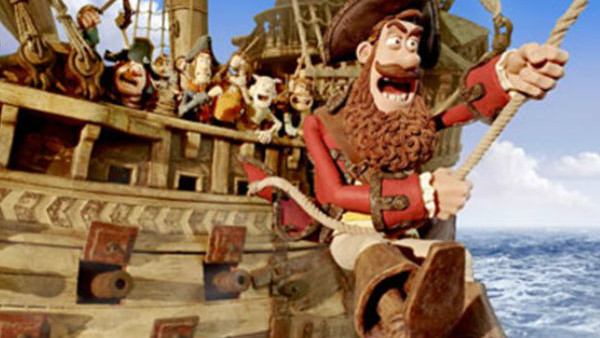
The point is, we all think we know how hard they must be to make, but do we really know? Do you really know how much effort went into Pirates! In An Adventure With Scientists from the acclaimed Aardman Animation studio, for example? Here's where dedication and passion can be glimpsed at their most potent. Because it's not just as simple as building the characters and props from clay, getting the image, moving them, and repeating the process (though that, in itself, is hellish). To create Pirates!, it took over 500 people five years. Five years! Think on that for a second. Five years to create one, relatively short children's film.
That's not all (and here's where it gets seriously impressive): the pirate ship used in the film was built from over 44,000 moving parts. Imagine trying to construct something of that scale (if you're a real ship builder, ignore that comment). If you think that's impressive, you might find it interesting to learn that over 10,000 mouths were used throughout production, too, which enabled the characters to speak.
What this proves, then, is although you think something like Pirates! would be extremely difficult and arduous to construct, it's likely doubly so in reality. It also makes you feel worthless, because you can't build something with more than sixteen parts and an instruction manual. Boo.