8 Original Movie Endings That Never Made It To Screen
There are deleted scenes, then there's the stuff they never even shot...

There's a lot riding on a film's ending. Even without the requisite twist of any modern blockbuster script, the ending determines - to an extent - the degree of audience satisfaction. But even before such factors enter into the equation, the ending begins on the screenwriter's desk, and though underappreciated in the system the writer will not be satisfied until the ending successfully concludes every theme and arc explored within the script. Most of it will be jettisoned by the time shooting rolls around, but at least the effort is there and you've provided a few deleted scenes for the Blu-Ray. But once it's handed over to the studio, the film's ending is out of the filmmaker's control.
Filmmaking is very much a democratic process with a top-heavy executive branch, and often the interworkings of a film lead to drastic changes. These can result from negative test screenings, political pressure or just simply the whims of an out of touch studio executive.
Nevertheless, here are the endings we always wanted to see. They may have been storyboarded, but few were even shot.
8. Thelma And Louise - Gory, Gory Death

It makes sense that Ridley Scott would appear on this list. His problematic Blade Runner is notorious for the number of cuts available, each with variations on the ending that is, at best, ambiguous. Needless to say, the man has trouble getting a point across.
When he would like to make a statement, however, he does it with the gritty bluntness of Black Hawk Down. It's the same kind of brutal truth he wanted to apply to...Thelma and Louise?
Despite winning a Best Screenplay Oscar, the movie that launched 1,000 Men's Rights Activists was more an escapist fantasy for downtrodden housewives. Thelma (Geena Davis) and Louise (Susan Sarandon) embark on a crime spree road trip after being neglected too long by the men in their life.
The ending is meant to be a blaze of glory, with the duo driving off a cliff while being pursued by the police. At long last, it appeared women had their Butch and Sundance.
But Scott almost robbed them of that, shooting and originally including the gory car crash and corpses, which the audience was supposed to mourn. Gone were the outlaws battling injustice toward women - just a few added frames reduced them to victims of brutality, rather than survivors of it.
7. The Birds - Ambitious, Golden Gate Bridge Ending

The Birds was the third time Alfred Hitchcock adapted the work of Daphne Du Maurier, following Rebecca and Jamaica Inn. It makes sense that the director would be attracted to the author's grim take on romance, particularly the blood-curdling sense of humour they seemed to share toward their later years. Rebecca, both the film and novel, were instant hits. The Birds, however, opened to a perplexed audience.
The director was coming off of Psycho, so his unpredictability was at an all-time high. But critics didn't know what to make of this nature run amok film. The desired ending wouldn't have changed reaction, but it would have been much more chilling.
The Birds doesn't have a traditional ending, its heroes wandering away quietly from flocks of menacing winged creatures as news reports of other attacks around the country. Originally, according to storyboards, all of this would still take place in the original ending: it would just happen on the Golden Gate Bridge.
Hitchcock had already used San Francisco seemingly for all it was worth in Vertigo, but a quiet, suspenseful walk across the bridge might have topped it. The budget, unfortunately, just wasn't there.
6. Alien - Hats Off, Ripley

Alien was a seminal film in both sci-fi and horror, with even critics who viewed the film negatively agreeing it was effective. It was also a landmark, both for the way it portrayed space travel as a blue-collar gig and the fact that it featured a strong female protagonist - something largely absent from the cinematic landscape of the era. Sigourney Weaver's Ripley has endured four decades and some embarrassing installments, yet fans were still willing to come back for the ride so long as she did.
But it wasn't always that way. Alien was originally scripted by Dan O'Bannon and Ronald Shusett, the former of which went on to write and direct horror comedy Return of the Living Dead and had previously worked on John Carpenter's "Alien, but with a soccer ball" film Dark Star, so his twisted sense of humour was on full display.
Aside from being surprisingly homoerotic, O'Bannon's Alien still kept Ripley as the lone survivor to do battle with the xenomorph, but it ended rather abruptly: the creature bit off Ripley's head with one quick bite, then sat down and, in true Twilight Zone fashion, recorded a message in her voice saying she was setting a course for earth.
Cooler heads prevailed, the script had a few more names added to it and the idea was all but erased.
5. Rocky - Throws The Fight, Opens A Bird Shop

Sylvester Stallone's Rocky is the only sports film to ever live by example: the little film that could about the little fighter that could. It was modestly budgeted and studios didn't hold it in high regard, allowing an unknown Stallone to take the film's lead from proven knowns like James Caan, but it fought its way into the hearts of the country and, yes, Adrienne.
It's apparent to even the most casual viewer that Rocky is doomed from the start. His rags-to-riches story is orchestrated by champ Carl Weathers as a publicity stunt to fail. And while he may not be literally taking the fall, participating is unwittingly doing so. It's only that he is fighting for Adrienne's heart that we're ultimately on his side at the end. It's almost as if it didn't matter if he threw the fight.
Because it was written as such. Originally, Stallone's own ego worked its way into the script and he couldn't see his way clear to letting his creation see defeat in the ring fair and square. Instead, he threw the fight for the mob, using the profits to live out Adrienne's dream of owning a pet store.
Thematically, it's still by and large unchanged, but the character's sudden shaky moral high ground wouldn't have gone over well with audiences.
4. The Shining - Hospital Epitaph
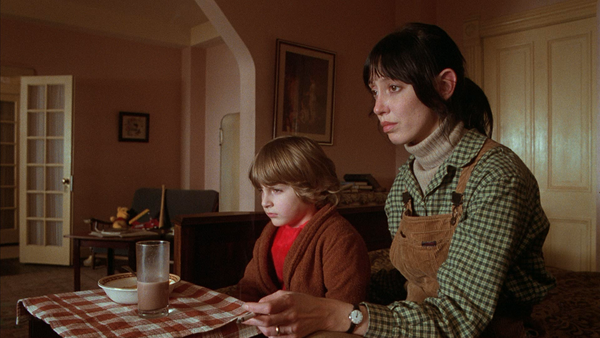
Stanley Kubrick and Stephen King notably clashed when they spoke about his adaptation of The Shining. Their collaboration went something to the affect of a late night phone call from Kubrick asking King, "Do you believe in God?"
"Yes," King would say.
"Yeah. I don't." And from there on, he required no input from the writer. And while the writer finds the adaptation wrong-headed, with Jack Nicholson being too crazy from the outset to generate tension, it's lauded as one of the best of its kind.
And much is still debated about the symbolism and meaning behind some of the imagery behind the Overlook Hotel, which forever now houses the soul of the late Jack Torrance. This ending, left on the pages, wouldn't have made things much more clear.
Apparently, despite his cynical nature and abusive behaviour on set, Kubrick had developed a soft spot for Jack's wife Wendy and their son Danny, and felt it imperative that there be a concluding scene with the two at the hospital, visited by the owner of the hotel. It was a horror film, and Kubrick felt that audiences needed reassurance that everything had returned back to normal.
Thankfully, he regained control of his more sadistic tendencies.
3. E.T. - E. T. And Elliot Stay In Touch

E.T. is the quintessential 80s Spielberg film - a semi-autobiographical tale of a young boy growing up in the suburbs with a freshly divorced mother and absentee father who must find an outlet to bond and co-exist with his family. It just so happens that outlet is a cute, Reese's Pieces-obsessed alien and not a Super 8 camera.
It's the heart of E.T., the spirit of riding through suburban streets on bicycles on Saturday afternoons, that allow it to endure, as well as its heartfelt ending that finds our sweet hobo extraterrestrial hitching a ride back to his planet, never to see those whose lives he changed forever again.
But even Spielberg can grasp a little too firmly to that nostalgic reverie, not wanting to let go. So much so that, originally, the director had his surrogate Elliot (Henry Thomas) stay in touch with E.T. via makeshift radio atop his house. It's a silly addition, one that would have added nothing even if they had gone forward with the sequel involving an evil clan of aliens.
2. Snake Eyes - Screw It, Just Drown 'Em All
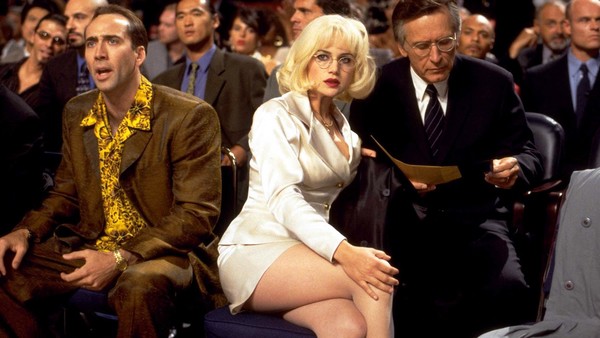
Brian De Palma has a bit of a reputation for outlandish, complex climactic sequences usually set in motion by a Rube Goldberg machine with guns. Even his lesser works have notably loud, almost out-of-place setpieces at the heart of their climax.
Snake Eyes was one of many occasions studios looked at the finished product in De Palma's cannister and put their foot down with a firm, "No." And they weren't unreasonable, but the compromised ending we wind up with knocks the wind out of an otherwise taut assassination thriller. Set in Atlantic City during the groundbreaking of a new casino that will debut with a heavyweight fight, Snake Eyes' corrupt cop Nicky Santoro (Nicolas Cage) finds himself in the middle of a plot to kill the Secretary of Defense.
Most of the film plays out like a nuetered Hollywood version of Rashomon, with each character recounting the opening 20 minutes from a different perspective, however De Palma was aiming at a different truth than Kurosawa. More specifically, he was plunging the depths of Cage's tortured soul, who with each new retelling realizes just how deep the corruption of his town runs. The only way he could possibly see clear in a world awash with sin is to cleanse it.
So De Palma did, literally. Throughout the film, a tropical storm menaces just outside the arena, threatening to become a full-blown hurricane. Originally, as Cage inadvertently leads former friend and conspirator Gary Sinise to the last witness who can expose him, the hurricane was supposed to flood the coast, drowning out the entire cast.
There's even reference to the ending in the film's weak compromise, with Cage saying he keeps dreaming about "being underwater."
1. Se7en - Many

No one could have seen Se7en coming. In an era chock full of serial killer cat and mouse thrillers, it didn't appear to be anything special; just another in a long line of serial killers who have a specific M.O. In this case, his victims were selected for their heinous abuse of the seven deadly sins.
But we didn't expect the killer, then unidentified, to wander into the station covered in blood at the start of the third act, changing the game entirely and leading to one of the most disturbing endings in which we never actually see anything.
John Doe (Kevin Spacey) had orchestrated his surrender at a specific location and time so that a package be delivered. The package? Detective Mills (Brad Pitt) wife's head. Mills shoots Doe, becoming the final sin of wrath.
It was a bleak ending, particularly one for an up and coming lead like Pitt. But he was insistent about keeping it, despite studio attempts to alter it and allow him to come off more heroic. The first option was that Somerset (Morgan Freeman) do the shooting, sparing his younger partner the jail time. Other choices were that the box contained only the family pet.
But Pitt won out, ultimately proving intellect and the right ending isn't always the feel-good option.