8 Ridiculous Origins To The Names Of Iconic Movie Characters
No, Darth Vader doesn't mean "Dark Father".
Getting a movie character's name right is more important than you realise. You can have an amazingly nuanced plot with endless twists and turns and dialogue that leaps all the way across the room, but no Hollywood executive will green-light, no actor will sign onto, and no audience will go see a film if the protagonist goes by Stinks McGee (no offence to any Stinks out there).
But what makes a cool name then? After all, so many famous character monikers gained weight over time, becoming highly regarded despite being rather bland, meaning that when stripped of context they don't quite hold up; the respective self-titled movies for John Carter, Jack Reacher and Jack Ryan all felt incredibly insipid precisely because they sounded like they were named after some disinteresting bloke from down the pub.
Writers love to dip into Latin or other foreign languages for inspiration, finding attractive terms that carry some underlying meaning, although then you risk populating a world that's supposed to grounded with a bunch of mumbo gumbo names. It's a minefield, so no wonder creative types have turned to some odd places for names when bringing the most beloved and iconic characters to life, from the shockingly simplistic to the obscenely convoluted.
8. Blofeld Is An English Name Ian Fleming Nabbed From A Schoolmate
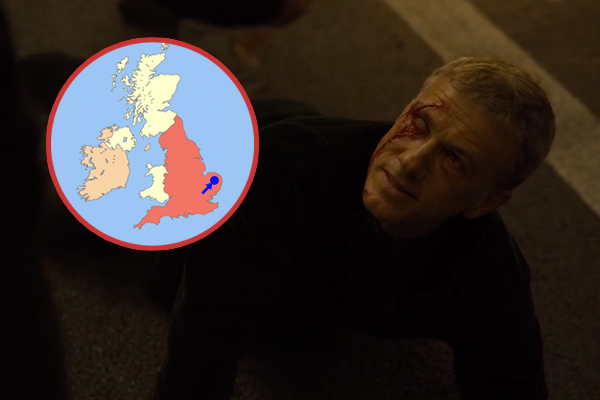
Is there a more evil name than Ernst Stavro Blofeld (when delivered with some sense of menace, of course, not the blaze murmuring of Christoph Waltz)? Well, probably, given that it's actually a pretty standard surname. According to cricket commentator Henry Blofeld, Fleming used his father's name as inspiration for the supervillain - the pair had attended Eton together - which means the Germanic sounding title (in Spectre it's said to be Austrian) is actually of Anglo-Saxon origins; it derives from the town of Blofield in Norfolk.
That it now carries such potent menace is really all down to Ian Fleming's excellent characterisation, Cubby Broccoli's restraint in introducing the supervillain to the film series and Donald Pleasance's incredibly chilling inaugural performance, forever shaping a common name to a degree rivalled only by "Homer" (seriously, who would ever name their kid that now?).
Although if the sense of Blofeld's name has changed a bit, that's nothing compared to 007 himself; the name James Bond was originally chosen because it was the most utterly boring thing Fleming could come up with, reflecting his initial notion that the man was little more than a blunt tool.
7. Voldemort Is Pretty Neat Foreshadowing
For the ultimate villain of the biggest multi-media franchise of a generation, there's something incredibly cheesy about Voldemort's name. Not the assumed moniker itself, but the in-universe derivation; it's an anagram of Tom Marvolo Riddle's full name, complete with the worked in the phrase "I am Lord..." as well, just in case he ever needed to make a dramatic reveal.
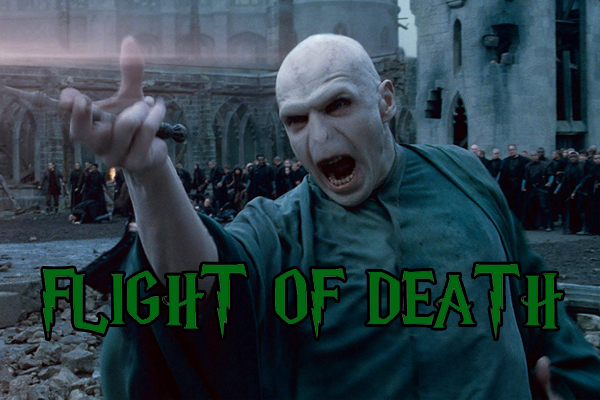
It makes sense within the context of kids book, but not the epic fantasy Harry Potter became. Thankfully the real world backstory of the name is something a little less silly; although Rowling initially stated it was an original creation, she later confirmed that Voldermort is actually derided from the French phrase "vol de la mort", which means "flight of death" or, in a more contextual translation, "escape from death".
Grandiose and foreboding, it acts as a nice emblem of the Dark Lord's goal - ignoring the obvious (he's capable of unsupported flight and brings death wherever he goes), it encompasses the character's defining fear of his own mortality.
After revealing this, J.K. has actually insisted that it's pronounced Vol-de-more, like how the French phrase is. Yeah, I think you're a $7 billion movie franchise too late there.
6. Every Marvel Character Has Alliterative Names Because It's Easier To Remember

Peter Parker, Stephen Strange, Reed Richards, Matt Murdock, Bruce Banner (and those are just the masthead characters); Marvel loves its alliterated names, doesn't it? Although the Distinguished Competition had several similar cases - Superman found himself surrounded by Lois Lane, Lana Lang and Lex Luthor - it's a definitive Marvel trope. So, surely it was some attempt at distinct branding started with the inaugural alliterative sixties breakthrough, Fantastic Four, right?
No, turns out Stan Lee was juggling so many characters that alliteration was the only way he could remember all of the names (a similar reasoning for frankly ridiculous names like Pepper Potts). Not that this method always worked; in early Hulk comics, Bruce Banner was sometimes recognised as Bob. Maybe he should have just kept a list?
Regardless of purpose, this remains such a prominent trope that it's been repeated in light homage all over the place; Heroes' lead character was Peter Petrelli and one of the key Agents Of S.H.I.E.L.D. is Melinda May.
5. Indiana Jones Is Literally Named After The Dog
The whole idea behind Indiana Jones is that it's a throwback to the cinema serials of the thirties (in much the same way that Star Wars is an approximation of Flash Gordon), so when George Lucas and Steven Spielberg came to naming their action icon, they went for a name that at once had a sense of adventure and reliability.
Lucas' first suggestion was Indiana Smith, which Spielberg didn't take to. It probably took all of two minutes to suggest the equally as prominent surname Jones. And there you go.
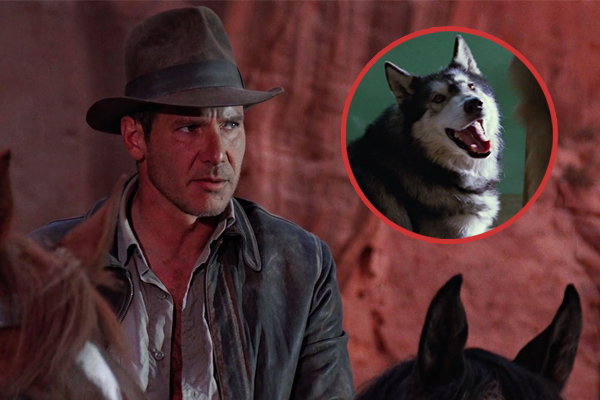
But where did the Indiana come from? Well that's where things get funny - it was the name of George Lucas' own dog; that moment at the end of The Last Crusade, where Indy's father reveals his son, Henry Jones, Jr., took his name from the family pet, isn't just a nice comedic beat to end the trilogy on, but a flagrant in-joke.
Indiana (the animal) even cameoed in The Last Crusade... as the Jones' family dog who in-universe gave Junior his self-appointed title. On top of that, the Alaskan Malamute was also the inspiration for Chewbacca, meaning ol' Indiana was behind two of the most iconic creations of the 20th Century. Good boy.
4. Peter Jackson Did Use The Source To Name Tauriel In The Hobbit
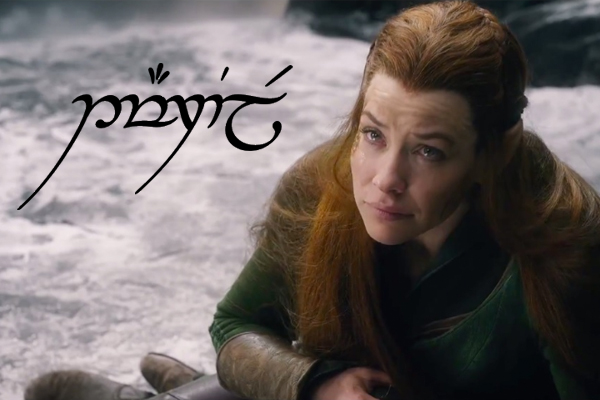
There was so much "added value" cr*p in The Hobbit to make it into a Lord Of The Rings-aping trilogy that it's a shock there was even more left over for the "Extended Editions". On top of plunging into the depths of The Return Of The King's appendices for expansive story beats, so many Rings characters reared their heads for incredibly distracting cameos; so on top of giving us Gandalf, Bilbo, Gollum and Elrond, the prequel set sixty years prior to the original also had us meeting up with (deep breath) Leoglas, Frodo, Saruman, Galadriel, Sauron, along with references to Gimli and Aragorn.
But those extraneous additions pale in comparison to Tauriel, a wood elf warrior who never featured anywhere in Tolkien's works. And boy you can tell; putting aside the shoehorned, cross-species love triangle between her, Legolas and Kili, she managed to get an inordinate amount of screentime yet impacted the story in exactly zero ways.
The whole character seemed like a rushed mistake, which makes it all the more odd that Jackson, taking a break from having a mental breakdown, went to the effort of giving her a developed Middle-Earth name; Tauriel quite translates to forest maiden in Elvish. Why not make, say, anything else about her, fit into the world?
3. Dom Cobb In Inception Is A Christopher Nolan Throwback
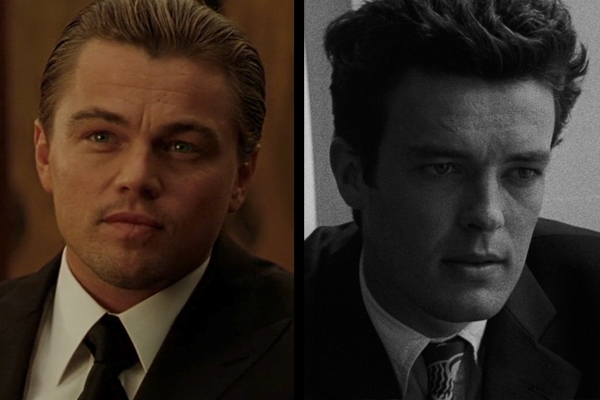
Christopher Nolan doesn't always get the double-meaning of names right; Interstellar boasted a character named Dr. Mann who served as a metaphor for humanity and another called Murphy who, in her first scene no less, brought up Murphy's Law. But there's something pretty intriguing about Cobb, the surname of Leonardo DiCaprio's dream extractor from Inception.
Not because there's a smart double meaning a la Voldemort. In fact, there's no clear indication what the motivation behind the name is - Cobb typically means large, although as a derivation of Jacob could also mean "supplanting", which is kinda what the character does with ideas, but it doesn't really add much. No, he's intriguing because, like the theme of professional men tortured by the loss of a female loved one, Nolan had used it before; the main character of his debut feature Following (which, incidentally, also featured a non-chronological narrative and a reference to Batman) was also named Cobb.
As Dom is a character utterly haunted by his past, having him literally be named after something Nolan's already done makes for a nice metatextual commentary (and also lends credence to the theory that Inception is really all about the filmmaking process).
2. The Names In The Matrix Are So Dumb It's A Wonder People Ever Thought It Was Smart
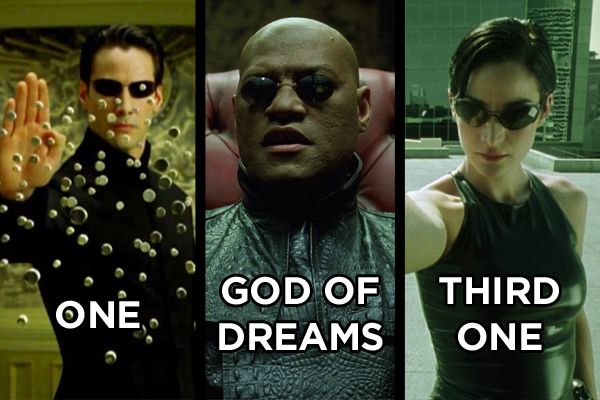
When The Matrix sequels hit in 2003, everyone was aghast. How had the deft blending of kinetic action and high-flying philosophy become something so ponderous and pretentious? But, seriously, it should have been patently obvious from the off that the Wachowskis weren't as smart or talented as they were initially heralded. I mean, just look at the one-note character names they came up with; Neo is literally an anagram of One, Morpheus is simply one-to-one translation from the Greek God of Dreams and Trinity is called Trinity because she's the third of the main characters.
Like, that's literally it. Things didn't get better in the sequels. The pair of identical rasta-ghosts are simply called "The Twins" and the cr*p-spouting, French program who is very powerful, the Merovingian, is named after a French dynasty who were very powerful. I know they're programs made by robots, but seriously?
There are some nice readings to be made of Neo's real name, Thomas Anderson, with allusions to his double life (Thomas means "Twin") and his messianic future (Anderson means "Son of Man"), but given how obvious everything else is it's more likely the siblings simply picked it because it was pretty bland.
1. Darth Vader's Names Doesn't Come From "Dark Father"
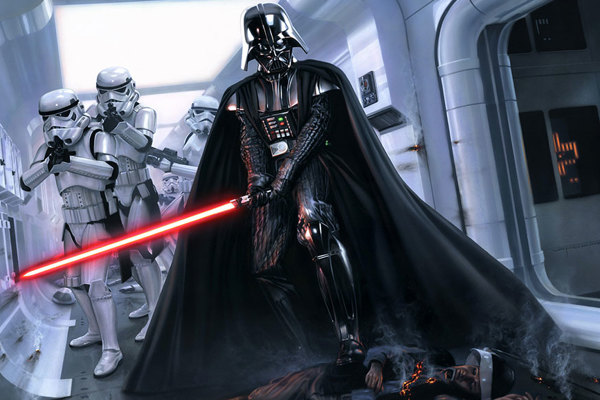
Darth Vader translates in Dutch to "Dark Father", right? An amazing bit of foreshadowing that pretty much ruined the big twist of The Empire Strikes Back for an entire nation? Well, not really.
This is something George Lucas has really pushed, trying to make it look like it was always his plan for Anakin Skywalker to be the centre of the Star Wars saga, but nothing about the development of the film suggests this was the case.
For starters, that isn't exactly how it translates; Darth is a nonsense word and while Vader does mean "father", it isn't pronounced as it's written. But, beyond that, Vader was originally conceived as a lowly Imperial officer, only getting his Dark Lord title in redrafts of the script. Heck, the character wasn't even Luke's father until the second draft of The Empire Strikes Back, so even if the name was some sort of approximation of words like "Dark" or "Death" and "father", it's a total coincidence that they line up with the story.
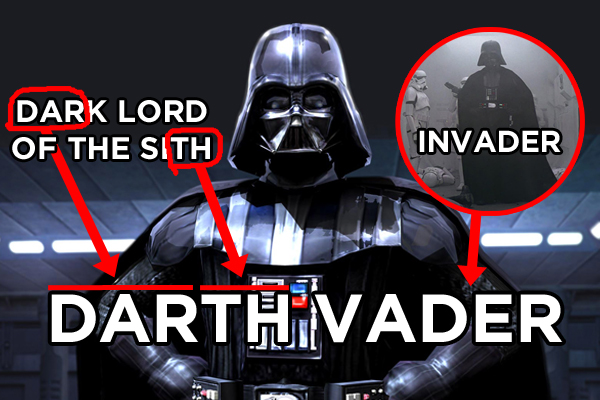
No, the true origin of Darth Vader's name is something much less complex: Darth is a portmanteau of Dark Lord of the Sith (a phrase that wasn't used in the movies until Episode I, but existed in Lucas' original drafts from before the character's conception), while Vader is a shortenting of "Invader", which, lest we forget, is how the character is introduced - boarding the captured Rebel cruiser.
As Star Wars progressed the names somehow got even more obvious, with Sidious, Maul and Grievous (were you even trying there?) all trotted out. Although I have no idea where the hell they got Snoke from.
What other character names have bizarre origins? Shout out any more down in the comments.