8 Star Wars Prequel Moments George Lucas Planned Way Back In 1977
Love them or hate them, you can't argue George Lucas didn't come prepared.
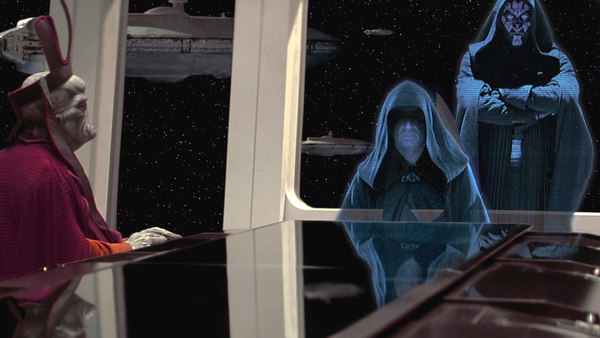
The year is 1977 and George Lucas has just released Star Wars. All those years spent painstakingly creating the effects and fine-tuning his perplexing scripts have been worth it; the film is adored by audiences, has redefined how studios approach the box office and will go on to get nominated for some serious Academy Awards (including Best Original Screenplay, Best Director and Best Picture).
With Marvel already keen to represent the galaxy far, far away in comic book form and a sequel an inevitability, Lucas sat down to set out the greater scope of the world. Writing short monologues in first person view from the characters, they set up the context of the world or the previously unconsidered back-stories.
These early musings in the immediate success of Star Wars (still yet to acquire its Episode IV: A New Hope subtitle) became the bible by which the immediately following films and Expanded Universe material followed.
Now available in the incomparable The Making Of Star Wars coffee table book, looking back on those early notes makes an interesting read. In the year's since the original trilogy (and in some cases even before that ended), ideas have been slowly dropped from official continuity.
But while there's lots of little things in Lucas' notes that no longer apply to the saga, what's really remarkable is how many of the ideas that would go on to define the less-beloved prequels have their roots here. Altered to some degree by story requirements, they're shockingly on point with the trilogy's broad strokes. Here are eight unbelievable prequel moments George Lucas had envisioned way back in 1977.
8. C-3PO Was Built By A Child
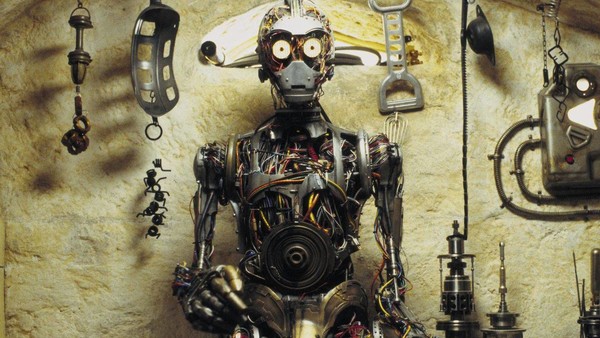
"I was in the Outland areas. Many of the droids would fall apart very rapidly. I was lucky to be totally reassembled by a young boy working for a junk dealer." - C-3PO
How did a child, even an extremely powerful one born by the Force, manage to build a factory-spec protocol droid from scratch? A way to avoid this contrivance is to take the claim young Anakin's just built a droid as a nine-year-old-trying-to-impress-the-hot-girl-he-just-met hyperbole. Thankfully, the often film-faithful Expanded Universe has ran with that argument, saying C-3PO was a mass produced droid whose remains Anakin found and did up. One of the stranger shoehorned elements of the prequels, explained with logic.
Except it's not the fans, but Lucas, who came up with this solution; that's the backstory originally envisioned for 3PO. I'm not even kidding; in 1977 Lucas said that C-3PO was rebuilt by a young child. Nowhere does it say it was Annakin (the early name of Luke's father) or Darth Vader (remember, different people at this point in the story), but it's still an oddly specific prediction.
As pre-Episode I Threepio has little influence on the story, much of what Lucas wrote all those years ago about his origins has become canon as the character's backstory. According to the Star Wars website databanks, the droid is 112 years old at the time of Episode IV, exactly what was originally stated.
7. The Emperor Overthrew The Republic Using Trade Laws
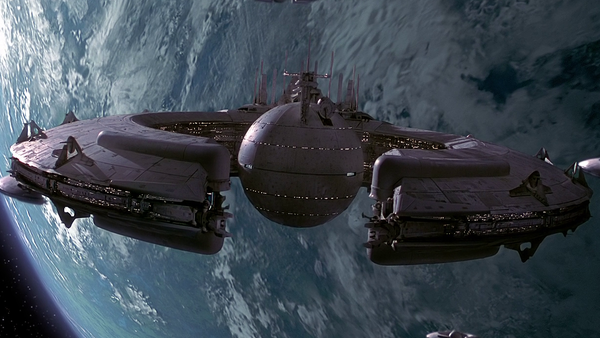
"One of the Chancellors began subverting the Senate and buying off the Senators with the help of some large intergalactic trade companies." - Leia Organa.
It's strange to think that the mighty Galactic Empire that had an impact on even outlying systems like Tatooine (where the Republic didn't exist) even though it was only around for twenty-five years. Obviously for Ben to remember what it was like before the dark times it couldn't be centuries old, but with the prequels explicitly showing how recent the Empire's beginnings were, it feels even more indestructible than originally presented.
The original notes reveal nothing of this quick timeline and suggesting the Republic had been gone for decades. Yet this was ultimately cut short by the prequels to allow Luke and Leia's birth to coincide with the Empire's.
But just because the dates were vague doesn't mean the events were undefined - we can learn the Old Republic was a democratic system, ruled over by a Chancellor who was replaced every four years once their term was over. The future Emperor managed to swing it so he could get re-elected with the backing and influence of major galactic corporations, messing with the trade laws.
The rise we're told of (with slight bias from Leia) is essentially the entire plot of the prequels, minus the whole Sith influence. That old trade laws that made The Phantom Menace's opening crawl so plodding has its genesis here, as does Attack of the Clone's orchestrated conflict intended to increase the Chancellor's powers.
6. Darth Vader's Past Was A Mystery

"The Death Star had readouts about everyone on board, except Darth Vader" - C-3PO
In 1980 everyone learnt that a lot of Darth Vader's past was incredibly subjective, but even before the series-defining decision to make him Luke's father, Lucas was keen to play up the character's mysterious past.
Although R2-D2 had the Death Star plans when the gang ended up in the space station, he'd have been silly to not have checked their records. And according to C-3PO he did; he tells us there were detailed files on everyone on board, except for Darth Vader, of whom there was no trace.
Although in the film he felt partially like Grand Moff Tarkin's lapdog, this is something that points towards his grander power; he's close to the Emperor and far from just another member of staff. It seems obvious, but given how the character had proven a major draw in the film's box office haul Lucas probably wanted to formalise it.
Even though Obi-Wan was very open about Vader's past (if missing key details), this decision to highlight his mystery shows how Vader's place in the saga was starting to shift. As these notes originate in the immediate aftermath of Star Wars' release, this could be the first official trace the story was slowly morphing into that of Darth's life.
5. The Rebellion Was A Splinter Of The Senate
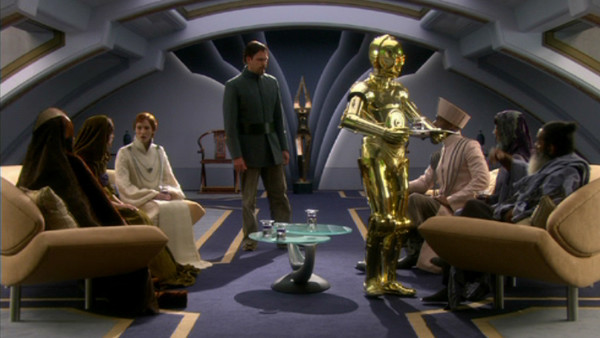
"When he became Emperor, little over half the Senate ... was not corrupted - and they reacted strongly against the whole thing. Most of these planets harboured great resentment to the Empire and the Rebellion was born of them." - Leia Organa
In the original history, as the Emperor tightened his grip on the Republic, he bribed and blackmailed his way to having half of the systems (24,372 by original count) in his pocket. These corrupt senators turned a blind eye as the Empire rose, leading to the totally-for-show Imperial Senate. Those on the other side first tried for political resolution but Darth Vader swiftly dealt with them, which led to an increasingly radicalised opposition.
A major subplot of Revenge of the Sith that was all but cut from the film (it still survives in the deleted scenes) dealt with the early seeds of the Rebellion in a similar manner. Featuring Padmé conspiring with Bail Organa, Mon Mothma and other future Rebels, it's the motivation for her otherwise out-of-the-blue comment on the Separatists legitimacy. It's not well explored in the final film, but the suggestion's definitely there.
Interestingly enough, the notes also shed some light on the scope of the Rebellion. The group who destroyed the Death Star are described as the militant branch, controversial to the point Bail Organa fell out with his daughter when she joined them (that sentiment was never explored beyond these notes).
4. C-3PO Had His Memory Wiped

"I believe Artoo had his memory erased several times, but I'm sure that horrible fate never befell me." - C-3PO
Even with CGI Jabba and visual continuity issues smoothed over, A New Hope still presents some unavoidable plot holes, with characters keeping schtum on key issues for no apparent reason other than plot necessity.
Not much can be done about wise exposition-giver Ben, but Lucas had a good stab at explaining blabber-mouth C-3PO not knowing who Vader is by retroactively giving him a memory-wipe. Narratively simplistic (it's skirting very close to All My Circuits' amnesia), it does the job of tying up a loose end that was stupidly created by the prequels' lack of foresight.
However, as one of the better written excerpts from Lucas' notes reveal, 3PO was always intended to have a heavily-influenced view on the world. Talking about his relationship with R2, Lucas uses the first-person style of these notes to have some fun in suggesting, but not confirming, some less galaxy-shattering events.
Less ambiguously, the passage also explains why the Tantive IV's translator wasn't aware of the consular ship's ambassador; he was specifically programmed to not reveal any information on Leia. Although in explaining that one piece of erroneous dialogue, we get the question of why he needed a whole memory wipe in the first place.
3. R2-D2 Was Originally A Ship Repair Droid

"Artoo-Detoo's function is to be a repair robot. His primary function is to maintain the plumbing system of the ship." - C-3PO
In the original trilogy, astromech droids come across as the galaxy's version of a Swiss Army Knife. They can store data, fit perfectly into various designs of space fighters, can access any information port and even have a periscope. But while R2 developed into a real, but non-irritating deux ex machina, the original blueprints were always in Lucas' mind.
When we first meet R2-D2 in The Phantom Menace he's a repair droid on a Naboo cruiser and that's exactly what his primary function was always intended to be; according to 3PO, he is sent to the outside of the ship to fix various systems.
That's one of many examples of Lucas showing really strong understanding of the intricacies of his new universe. Not simply answering queries with space mumbo-jumbo, things are explained with historical accuracy and in-depth terminology; that the Millennium Falcon was built on Crell for Corellian space shippers, or that C-3PO got a new XB21 upgrade after the Battle of Yavin are needlessly in-depth, while Han's backstory (he was was a slave, raised by travellers) is incredibly fleshed out.
You sense there was real desire to get a Tolkien-level continuity for the galaxy far, far away, with as much time devoted to the little details as the broad strokes. That's pretty emblematic of Star Wars on the whole, at it's best never letting the grand space epic overshadow the characters.
2. The Imperial Army Was Built In Secret

"The Emperor has some strong forces rally behind him ... in terms of the army and the Imperial forces that he'd been building up secretly." - Leia Organa
It was a long-standing notion from the original expansion that the future Emperor had been building a large army in secret ready for the rise of the Empire. The Republic couldn't have had an army because it was meant to be protected by the Jedi, but the Empire it became does, so a secret one is simple but effective. However, the execution of this idea in the films became bogged down by another.
Clones had been trying to find their way into Star Wars since the very beginning. A throwaway reference to the Clone Wars was one of the fans' few hints to the pre-Empire world, while Boba Fett was originally envisioned as part of a run of genetically produced super-soldiers. They finally got their on-screen debut in Attack of the Clones, where this classic sci-fi trope was mixed with the secret army.
1. Midi-Chlorians Allow Jedi To Use The Force

"It is said that certain creatures are born with a higher awareness of the Force than humans. Their brains are different; they have more midi-chlorians in their cells." - George Lucas
What is the most derided element of Episode I, and by extension the whole prequel trilogy? No, not Jar Jar - the Gungan's pretty easy to ignore in the grand scheme of things. Midi-chlorians, on the other hand, have far reaching implications for the very fabric of the galaxy.
Mentioned in only two scenes of The Phantom Menace (then in passing during what should have been a pivotal scene in Revenge of the Sith), their delivery feels like something shoehorned into the final draft of the script, having little impact on the story. Predictably, many die-hard fans found it emblematic of the Prequels' tendency to demystify the the secrets of the galaxy.
But, as you can see in that 1977 quote, midi-chlorians have their roots much further back in the franchise's history, predating the much more accepted Sith rule of two and 'Chosen One' prophecy by over twenty years.
Hearing it explained matter-of-factly by the younger George, they suddenly make a lot more sense. Midi-chlorians aren't an attempt to rationally explain the Force and demystify the magic; they're a simple explanation as to why some people can use the Force and others can't.
Watch Next
Star Wars Quiz: How Well Do You Remember The Prequel Trilogy?
