8 Theories About The Origins Of Heath Ledger’s Joker
We think we know how he got those scars.
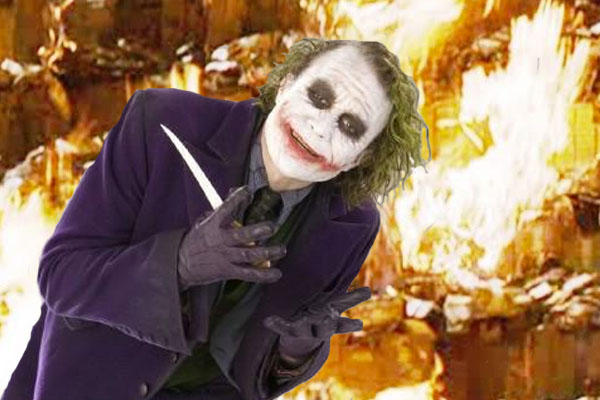
It's a long time since The Dark Knight took the world by storm and we still can't stop thinking about Heath Ledger's incredible performance as the Joker. Originally met with a fan backlash that makes Ben Affleck's Batman feel loved, as publicity stills and trailers were slowly released it became apparent that Ledger had delivered something incredibly special.
This is made all the more impressive as it was an accepted 'fact' amongst the fans that no one could ever do the character better than Jack Nicholson in Tim Burton's Batman. Now that sentiment feels laughable; next to The Dark Knight's version, Jack Napier could pass for a genuine children's entertainer.
One of the biggest elements of the character that Nolan's version trumped Burton's was in the origin, or lack thereof; unlike Nicholson, whose story provided the main arc, we learnt nothing about Ledger's origins. This is incredibly faithful to the source - throughout the majority of his appearances in the comics any backstory of the Joker has been kept vague or presented in a highly subjective manner - and helped make Joker an even more captivating screen presence.
But because we're gluttons for reading too much into things, that hasn't stopped us coming up with a few possibilities of where he came from.
Here are eight theories, using evidence from the films and other material, that try and crack the Joker's origins.
8. Hes A Former Soldier

One of the more common theories about the Joker's origins, this is primarily sparked by the throwaway line on chaos, "if, tomorrow, I tell the press that ... a truckload of soldiers will be blown up, nobody panics, because it's all part of the plan." Rather than an example plucked out of thin air (like the gang banger getting shot) this is actually a clue towards where Joker came from; he is a soldier with PTSD.
Obviously there's no real timeline, but it'd be believable he was a solider in one of America's middle-eastern conflicts who at some point became psychologically damaged by his experiences and grew to hate the futility of modern society (think of the opposite journey Bruce Wayne goes through in the opening of Batman Begins).
It really ties into the film's post-9/11 world view, having the toughest person Batman has gone up against become a product of the time. And, on a more basic level, it serves as a logical explanation of many facets of his character. How he's able to handle multiple types of weapons with ease makes a lot more sense, while it's easy to imagine the horrors of war leading towards his deranged psychological state. The only thing it doesn't really explain is the chelsea smile.
7. Arkham Asylum Escapee

There was a lot of auxiliary material unveiled in the months preceding The Dark Knight's release that fleshed out the I Believe In Harvey Dent campaign and some of the Joker's previous actions. One piece of this, a file from the Gotham City Police Department, serves as one of the few official musings on the character's origins, with three different possibilities put forward. One was the previously mentioned soldier history, but this one is rather more straight down the line.
Essentially Joker is a normal patient at Arkham Asylum (if there is such a thing) who's escaped in an even worse condition (perhaps something to do with Dr. Crane's terrible methods). It still leaves open many doors, not really getting to the root of his psychological issues, but it provides a nice piece of potential back story.
After Batman Begins, where Arkham serves as a central point in the action, the Asylum was barely mentioned again, but given that Joker spends a lot of time there in other media it's not a ridiculous idea. This theory falls down a little when you consider that there was no record of him before being caught by Gordon, but if the police can think it's a possibility we have to include it.
6. Haley Brothers Circus

The third possible origin raised by the GCPD is that Joker is a former employee at Haley Brothers Circus. Only seen on film in Batman Forever, the circus is best known as a central part of Robin's origin story - it's where the Flying Graysons made a name for themselves - but could easily be repurposed as something from the Joker's past in Nolan's Gotham.
Although the only initial connection seems to be that he has clown make-up, the information presented actually makes a convincing argument. The circus has always had some vague connection to the criminal underbelly of Gotham - it's a crime-related altercation that led to the death of Dick Grayson's parents - and the implication here is that the links to the mob are even more prominent in this universe.
It doesn't really provide much explanation for why Joker is like he is, really only filling in how the more general things - a life of crime, the clown make-up - came about. In fact, it's worth noting is that there's enough vagueness in each of the three ideas presented thus far that some mixture of them could have happened. For our money, picking from the GCPD options, the soldier one is the most believable.
5. Its All About His Father

In The Dark Knight Joker provides two different stories of how he got his scars, presenting them as a wholesale explanation for his psychotic nature. Even though audiences have no real reason to believe either version over the other, the first account given to Gambol tends to be the fan favourite, probably because it's concluded with that unforgettable line, "why so serious".
The gist is that Joker's father, a drunk, was equally as messed up as his son, killing his wife in front of their child before mutilating the future Clown Prince of Crime. In this (probably fictitious) scenario we don't know how far reaching the things went, meaning there could have been a whole childhood's worth of abuse.
The father connection is mentioned again at the Harvey Dent fundraiser. Unless it's an in-joke for the benefit of himself, that suggests at the very least a domineering patriarch had some impact in shaping Joker's personality.
4. He Doesnt Know

The confidence with which Joker extolls his various stories (and the desire we all have to have narrative gaps filled) distracts from one possibility; perhaps even the Joker himself doesn't know where he came from.
How it came about isn't really important, but him not having any knowledge of where he came from furthers his embodiment as an agent of chaos, helping explain his contradictory nature and total detachment from his worst crimes. He hasn't got life experiences to shape him, with the psychopathic elements stemming from not having any emotional grounding (at least to his knowledge). Maybe he tells various stories in an attempt to give himself a past. It's all very abstract, but as an idea helps to make Joker even more impenetrable.
As we've already said, The Joker as a character is renowned for not having a discernible past so this really only pushes Heath Ledger's version into an even more literal take on the very ideals of the character.
3. Its All About His Wife

The second of the scar-origin stories sees them repurposed as a sign of love; his gambling addict wife was attacked by loan sharks, so in an attempt to make her feel better he did the same to himself, to her utter horror. It's a sad tale that, once again, has a whiff of the fantastical to it, but could serve as an interesting alternate explanation.
Notice how after killing a Commissioner and a Judge, as well as trying to off a District Attorney and the Mayor, that Joker goes for Rachel. It's a bit of a step down in terms of public status, which could have been brought on by some sort of obsession with her. She's the only woman he really directly interacts with and he immediately makes her part of his plans; he puts a lot of effort into using her as a weapon against both Batman and Harvey Dent. At the very least there's distinct sense of some sexual repression in there.
What makes this interesting is that unlike the father excuse there's a strong suggestion Joker was already in his descent; cutting yourself in an attempt to make someone feel better suggests a distinct lack of empathy.
2. He Didnt Exist Until Batman
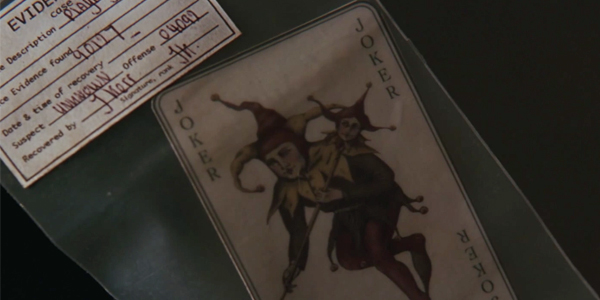
The first chronological appearance of the Joker in The Dark Knight Trilogy is the calling card revealed in the little tease at the end of Batman Begins. And that's really the extent of his pre-Dark Knight origin; he existed by the time the bat signal had become a permanent fixture on the skyline of Gotham. Well, what if he'd only just started existing; could Joker actually be a reaction to Batman.
It's very much possible - Gordon doesn't talk about him like he's a long-standing criminal - and thematically it strengthens the duo's relationship in The Dark Knight. One of the central themes with the Joker that has become more and more integral to the character as time's gone by is that he and Batman are dependent to some degree on the conflict between them. This pushes it even further; you essentially have a Joker who is obsessed with Batman
Gordon's line about escalation between the mob and the police, delivered just before the reveal, adds to this; Batman has cape-and-cowled up to take on the mob, and in direct reaction the criminals start to develop a taste for the theatrical themselves.
1. Hes The Fight Club Narrator
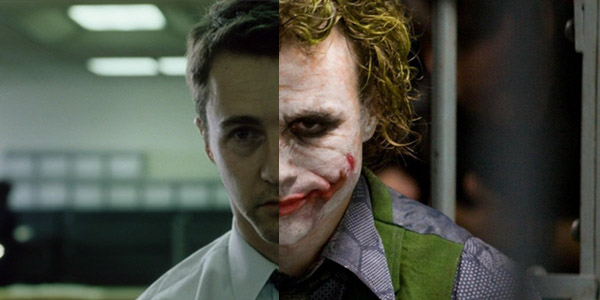
OK, so we've gone through ideas sprung up from various parts of the films themselves. Now let's end on something a little more bonkers.
Fight Club, which has just turned the ripe-old age of fifteen, is one of those films whose twist you're still wary about stating lest some uncultured individual hasn't seen David Fincher's cult classic. Said twist is the reveal that Tyler Durden, the anarchic soap salesman with Brad Pitt's face is actually an idealised figment of Edward Norton's imagination, giving the emotionally dulled insomniac a new lease of life. The film ends with the Narrator getting rid of Tyler by shooting himself in the cheek (it does sound pretty stupid when you write it down), but this theory that's been recently doing the rounds suggests that after destroying all the credit card companies Norton becomes Jack's facial scars.
Beyond serving as a very detailed account of a sink into psychosis, there's many distinct similarities between Tyler Durden and the Joker. Both have a tricky relationship with their fathers, harbour a taste for home-made destruction targeted at the comforts of modern life and command an army of ridiculously loyal followers who will happily die for the crazed cause. It even maintains the mystery over the Joker's name; in Fight Club Norton's character is never named.
Best of all? This explains how he got those scars; in the book the gun shot that removes Tyler leaves the Narrator with a big scar across both cheeks.
Where do you think Heath Ledger's Joker came from? Or would you rather we never figured it out? Let us know what you think down in the comments.