8 Things Learned From Re-Watching Star Wars: The Phantom Menace

Is it as bad as you remember?

The only time you can really compare the anticipation for the Force Awakens to anything was when, in 1999, sixteen years after Return Of The Jedi, George Lucas dropped a seismic pop-culture bomb on the world with The Phantom Menace, the first film in a trilogy of prequels to the original Star Wars saga. Reactions were mixed at best, with most detractors citing the overused and not wholly impressive CGI of the picture as the chief reason for its failings. Elsewhere there were the standard aversions to George Lucas' directing style (or lack thereof) and his baffling approach to standard English usage. There was also a certain character who seemed so far-removed from what Star Wars was all about that it had to be a joke, right? The Phantom Menace did of course have advocates, though, and rewatching it certainly unearths admirable aspects of the film, which is now commonly bracketed in the cliché so-bad-it's-good category of film history. That might be a little unfair, and while it's certainly the worst of the prequels (and worst overall Star Wars film), it's still an important movie in the pantheon of popular culture. Moreover, those (like myself) approaching their mid-twenties now will have been around eight or nine when the Phantom Menace was released, meaning that any modern-day rewatch is bound to be a completely different experience than it was back then. Here's a collection of thoughts accrued while rewatching Star Wars Episode I: The Phantom Menace for the first time in a long time.


8. Jar Jar Binks Is As Bad As You Remember

Surely one of the most ill-conceived major characters in any movie ever, Jar Jar Binks represents for many the nadir of the whole Star Wars franchise, let alone the prequels. Comic fodder of the lowest common denominator, it beggars belief that Lucas would grant such a pivotal part to a catchphrase spouting fool, and while it's probably a stretch to say that Binks is eminently hateable, you'd be hard-pressed to find a fan who would keep him in the franchise if the opportunity so arose to oust him. What's bizarre is not only that Jar Jar sets in motion much of what will transpire in The Phantom Menace, but also that key scenes cut to his slapdash antics like we care - the end battle on Naboo for instance, which shows us a whole segment of the character accidentally killing droids by being a totally incompetent idiot. There's a new theory going around, started by this in-depth article which did the proverbial rounds on reddit, that Jar Jar Binks is actually a genius Sith collaborator. While it's an interesting and well developed take, it's also a pointless one; hipster fanboy-ism created only to arouse controversy. Make no mistake, Jar Jar Binks is a pop-culture disaster.

7. Liam Neeson Was A Great Choice For Qui-Gon Jinn
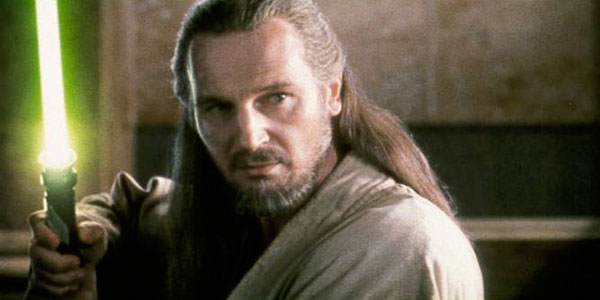
An actor still in his serious phase when he was cast as Qui-Gon Jinn, Liam Neeson brings some welcome gravitas to the role, gifting us the only truly good performance in the film in the process (Ewan McGregor would grow nicely into the role of Obi-Wan Kenobi, but he's a little shaky in his first outing) despite being lumbered with some of the worst lines of dialogue ever produced by a major director or screenwriter (see later). In a decade which saw him play Oskar Schindler, Rob Roy, Michael Collins, Valjean in Les Misérables, and Adolf Hitler (in the TV mini-series 1914-1918), The Phantom Menace represented Neeson's first real action role since Darkman in 1990, and while much of it is spent walking-and-talking and delivering exposition, it remains a fine bit of work, the actor fully believable as a wise Jedi Master who can still swing a lightsaber when he needs to.

6. The Pod Race Is An Overlong Centrepiece
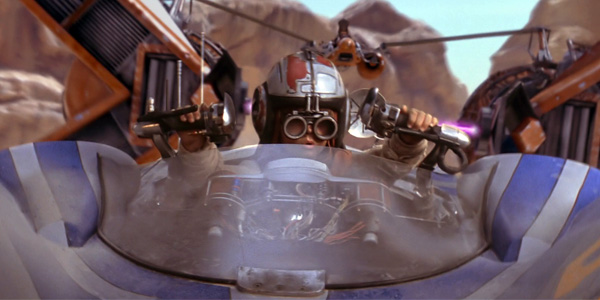
One of the most polarising aspects of The Phantom Menace was the ten-minute Pod Race sequence which served as the film's centrepiece. While some praised it as an impressive, detailed set-piece, for the most part it was derided: an overlong, somewhat unnecessary insertion, one which takes us away from the intergalactic spacehopping to deliver us a pretty bog-standard F1 style race (anyone remember the Pod Race game on N64, by the way?). Lucas was clearly invested in the sequence, so it's a shame then that it's so - to use a term I hate and often find reductive when discussing film but can't help but employ here - boring. There is nothing at stake, and if there is (the vague notion of Anakin's freedom, perhaps) then it isn't mirrored in the race's execution, which Lucas intercuts with off-hand sight gags that rarely land - the two-headed American-style commentator only adds to the the idea of a sequence unsure of which tone it wants to adopt. The race never feels close, there is no will-they-won't-they aspect, it's not a photo-finish and Anakin's main rival (the completely computer-generated Sebulba) is destroyed a good stretch before the finish line. Why not have them both cross at the same time? Why not make Sebulba look like an actual champion racer rather than a sneaky one? Why not cut the whole thing in half and save us all some precious time?

5. The Young-Anakin/Padmé Relationship Feels Strange In Hindsight
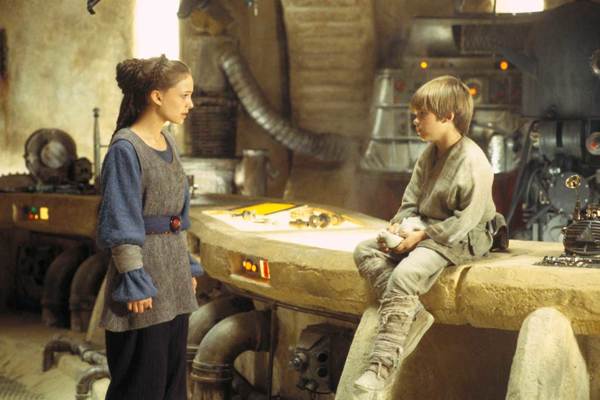
Knowing what we know about Anakin and Padmé, it feels strange to see Lucas setting their love story in motion when the former is a nine-year-old boy. I'm in no way suggesting anything heinous in that regard, but if the director already knew where he was going to take the couple, he might've been better off not alluding to anything in The Phantom Menace, no matter how minor it may have seemed at the time ("Ani" asks her if she's an angel and it comes of as quite sweet, but when he mentions something similar in Attack of the Clones one is reminded of the initial reference and it just feels uncomfortable). That's not to suggest that Anakin and Padmé's affections weren't genuine from the get-go, but rather that their initial meeting here later plays too prominent a role in their all-encompassing love for one another. For example, the necklace Anakin gives her in this film is the same one seen wrapped around the hands of her dead body in Revenge of the Sith. Earlier she tells him that she has kept it safe since then - the necklace no longer an innocent gift from a child, but a memento of a supposedly irrevocable love.

4. Darth Maul Is An Effective Villain

From his dual-lightsaber to his now iconic face-paint-and-horn combo, Darth Maul is a haunting, enigmatic presence throughout The Phantom Menace, and though many felt he was an inferior villain to the likes of Darth Vader (who wasn't going to be, really?), it remains that the character (played by stuntman Ray park) is neatly effective as a near-mute Sith warrior who imbues the film with an eerie sense of disquiet. Not one for words, Maul's lack of dialogue adds to his sinister appeal, and you get the sense that he'd genuinely rather slice a Jedi to bits than try and convert them to the Dark Side. His flicker of a smile during the end lightsaber battle (see later) is a nice, absurd touch and nicer still is Lucas' decision to have Maul only use one half of his two-beam weapon in his first fight (the brief battle with Qui-Gon on Tatooine), saving the reveal of the other half for the great moment in which Darth stops the Jedi in their path in the aircraft hangar on Naboo. These days that would've been leaked and analysed to bits, the subject of articles and spoilers about What Darth Maul's Double-Edged Lightsaber Tells Us About So and So. But back in '99 - and I do promise to keep my own personal Star Wars experiences out of these lists for the most part. Everybody will have their own, and most people are not going to care about what The Phantom Menace meant to an eight-year-old - it was a genuine surprise, and I distinctly remember an audible excitement fill the cinema's air when that familiar swoosh of the lightsaber's deployment was heard twice in quick succession.

3. Lucas' Dialogue Is As Clunky As Ever
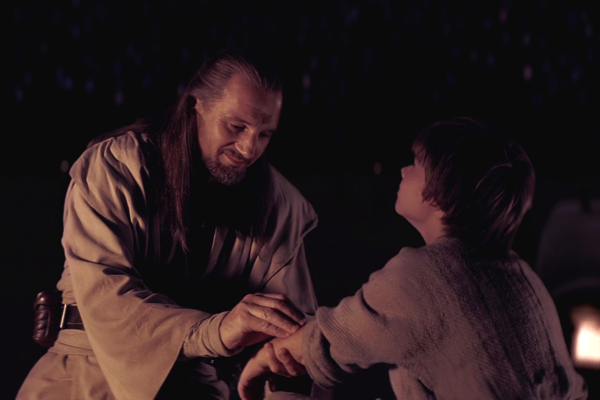
I was tempted to just put the word "midi-chlorian" here and move on. If ever there was an element of a film which didn't need expository explanation, it's The Force. The Force, one of the most ethereal, transcendent ideas in the history of the movies. The Force, a phrase known to most anyone who's ever seen a film. The Force, an otherworldly essence floating in the ether. The Force, reduced by one stupid hyphenated word to something physical that exists in the bloodstream (or something). Midi-chlorian, something apparently so vital to the Jedi makeup that it's not mentioned once in the eight hours or so of the original trilogy. Elsewhere, there's still Lucas' odd usage and strange grasp of how the English language actually works, presenting itself mostly via fortune cookie snippets uttered by a Liam Neeson doing his best to look serious: "Our meeting was not a coincidence - nothing happens by accident." Worst of all, though, is this much maligned Yoda speech, which manages to make no sense and disregard the whole original Jedi Code - which allows for "Emotion Yet Peace", and "Chaos Yet Harmony" - in just a few misjudged words: "Fear is the path to the Dark Side. Fear leads to anger. Angers leads to hate. Hate leads to suffering".

2. The Galactic Senate Scenes Aren't As Bad As You Remember

It inspired one of the Simpsons' greatest gags - in which the Galactic Senate sequence is mocked up as one never-ending roll-call - and it isn't really what you want from the first Star Wars film in nearly two decades, but the scenes of trade-talk and legislation which angered so many really aren't as bad - or even as prominent - as you might remember. Yes they're pretty tedious, and it's true that kids especially are likely to lose interest within seconds, let alone know what's going on, but if we take the the scenes on a purely aesthetic basis, they look particularly impressive, especially when a near overhead shot of the arena shows just how vast and populated the meetings are. That's likely not enough to save the scenes from most peoples' derision, but nor is this segment necessarily trying to do so. What it is trying to do, however, is suggest that these are minor parts of a major film, easily ignored if that's what you want to do, but also interesting and striking in their own kind of way - and nowhere near as annoying as something like the Three Stooges-esque pit droids or the shoehorning of C-3PO into the story for the sake of nostalgia.

1. The Three-Way Lightsaber Battle Is Outstanding

What all Star Wars fans really want of course is a lightsaber battle, and, after various droids being dispatched with the famous beams of light - and after one brief, aforementioned duel between Qui-Gon and Darth Maul - fans were granted their wish with the first saber battle proper since the dénouement of Return of the Jedi some sixteen years earlier. And it's a great one. Choreographed brilliantly and featuring the three key swordsman of the picture, the three-way battle is iridescent in its distinctive use of red, green and blue, and made all the better by that innovative use of Maul's double-edged weapon. Intercut with Anakin's and R2's inferior battle in space, the saber fight is the film's highlight, starting out in the hangar and ending above the gaping chasm into which Darth Maul will plummet. Best of all is the lull the battle sets into when a series of red door-shields prevent the trio from actually fighting. Instead, Darth Maul stalks behind his shield - smirking, waiting - while Obi-Wan stands with his arms set and his legs shoulder-width apart, breathing heavily and eager for his own shield to open. Then there's Qui-Gon who, in one of the series' most serene moments, puts his lightsaber away and drops to his knees to pray, his eyes closed, his mind focused. It is the same stance he will adopt a few minutes later when Maul kills him, the helpless Obi-Wan looking on through his shield, which is yet to open.

Contributor
Contributor

No-one I think is in my tree, I mean it must be high or low?