9 Famous Movie Scenes Only Made Possible By Deceiving Actors

9. Nick Spits In Michael's Face - The Deer Hunter
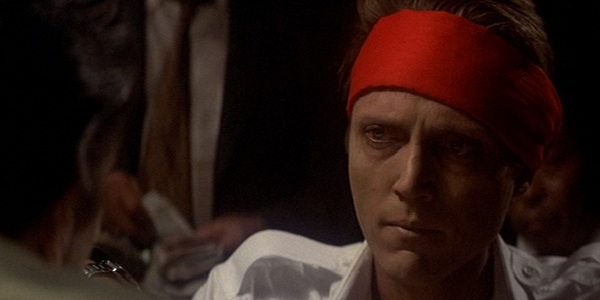 The Deer Hunter is a film of almost unbearable emotional intensity, dealing with the traumas of the Vietnam War in an arresting, imaginative and utterly heart-wrenching manner. No stronger is this felt than in the latter portion of the film, when Michael (Robert De Niro) returns to the country to try and talk sense into psychologically scarred veteran Nick (Christopher Walken), who has become a mere shell of his former self, partaking in games of Russian roulette without much of a care about his own well-being. The scene culminates with Nick spitting in Michael's face, but this moment was not included in the script; rather, director Michael Cimino instructed Walken to do it, and De Niro's resulting enraged look is 100% legitimate. According to reports, the actor also almost stormed off the set as a result; even so, risky as it was, it adds immeasurably to the fraught nature of the scene and Nick's final moments. Splendid.
8. Kes's Death - Kes

7. Joe 'Loses' His Hand - Roman Holiday
 One of the all-time great movie tricks occurs in William Wyler's Roman Holiday, as American journalist Joe (Gregory Peck) and Princess Ann (Audrey Hepburn) visit The Mouth of Truth. Peck decided to have some fun with Hepburn, placing his hand inside the mouth and pretending that it had been bitten off. The second that Peck begins to struggle, Hepburn hurriedly tries to assist him and when Peck's seen enough of her hysteria, he reveals his hand to her, at which point she bursts into laughter and the two playfully hug. It's a brilliant scene because it's so simple yet so effective; Hepburn's reaction is incredibly genuine precisely because it is. Few actresses would be able to perform so well under pressure, whereas operating under pure instinct generates the truest - and in the case of an effervescent personality like Hepburn's, the funniest - moments.
6. The Chestburster Scene - Alien

5. Hans Gruber's Death - Die Hard
 Though to many Alan Rickman will forever be thought of as Snape in the Harry Potter series, to me he's always going to be Hans Gruber, the immaculate, slick villain he played in Die Hard. Brilliant though Rickman's performance was, it's his epic, excessive death scene that's perhaps most memorable of all, as he falls to his grisly demise from the Nakatomi Tower. Though Rickman was good enough to do the scene himself without a double (allowing for the convincing shot we see in the final movie), director John McTiernan didn't think that this was good enough, and so added an element of surprise into the mix... McTiernan told Rickman that he would be dropped onto a safety net 40 feet below on a count of three, but instead dropped him on a count of two, hence the shocked expression you can see above is completely genuine, as Rickman presumably suspected that the rigging equipment had failed and he was therefore toast.
4. Don Vito Slaps Johnny Fontane - The Godfather
 One of the most memorable moments from The Godfather is when Vito Corleone (Marlon Brando) slaps Johnny Fontaine (Al Martino) around the face and tells him, "You can act like a man!" after he starts whinging about not getting a movie part that he desperately wants. This was all on Brando; the famously eccentric actor decided that he wanted to bring a little more life out in Martino's performance, and so completely out of the blue, slapped him around the face. Watch Martino's face carefully; he clearly doesn't know how to react, but well aware the cameras are rolling, at least maintains a measure of shocked composure that transpires quite hilariously into one of the movie's best scenes.
3. "Funny How?" - Goodfellas
 Easily the best and most-parodied scene of Martin Scorsese's masterful Goodfellas is the hilarious "Funny how?" scene, in which Ray Liotta's Henry Hill tells Joe Pesci's Tommy DeVito that he's a funny guy, causing DeVito to go off on a seemingly serious, ball-busting tirade before revealing that the whole thing was a lampoon. The joke is really on the various mobster extras in the scene, though, who were completely oblivious to what was largely an improvised dialogue between Pesci and Liotta. Remember those nervous laughs in the background? They were completely real, because the extras really had no idea how long this scene was going to drag on. It's a genius call by Scorsese and the two actors, because it essentially replicates the awkward feeling the brown-nosing gangsters would have within the actors themselves.
2. "I Want You To Hit Me As Hard As You Can" - Fight Club
 It makes sense that David Fincher's mischievous film was spearheaded by a very mischievous director, given the lengths he went to enhance the weird, hilarious, violent vibe the film gave out. The scene in which Tyler Durden (Brad Pitt) asks Jack (Edward Norton) to hit him as hard as he can was scripted as Jack merely punching Tyler in the face, but at the last minute, Fincher whispered to Norton to actually punch Pitt in the ear, thinking it would be a hilarious, quirky take on what audiences were expecting. Norton was hesitant but went along with it, and Pitt's resulting response - craning his neck around and shouting, "You hit me in the ear?" - is, again, totally genuine. That Pitt managed to keep his cool long enough for a complete, useable take is a testament to his professionalism and/or immediate understanding of what just happened. Fincher took what could have been a totally serious moment and managed to improve it by injecting some literally stinging humour.
1. Messala & Ben-Hur's Relationship - Ben-Hur
 And yet, arguably the ultimate cinematic instance of an actor being duly deceived is in William Wyler's classic Ben-Hur. Gore Vidal wrote the film's screenplay, and feeling that the source material was not substantial enough for an epic film such as this, decided to flesh the characters and story out, including adding in a gay subtext that cut throughout the picture, between Charlton Heston's titular character and Messala, played by Stephen Boyd. Wyler liked the idea, and felt that Heston's near-sighted Conservative attitude would mean that he would not cotton onto the ruse during production. Boyd also agreed to take part, and so the con was on; the actor was advised to play the role as if completely in love with Heston, whereas Heston would naturally play his part as though they were merely two male heterosexual friends, suggesting that his character was closeted and trying to forget. Naturally, when Heston later found out, he wasn't best pleased, and flat-out denied that reading of the film. Which act of actor deception was most successful? Let us know in the comments below.