9 Films That Made Terrible Things Looks Awesome
 Films don't have to be morality plays, but they do tend to abide by certain rules. Namely, that certain stuff is bad, you shouldn't do it, and if you do, bad things will happen to you. We all know of certain flicks that look to be glorifying something suspect, but when push comes to shove, things end up going slightly slightly down the tubes. Whether that be drugs, alcohol, crime, infidelity or even simple laziness, films usually end up chastising those who indulged too much in something they shouldn't have. Yet this doesn't happen all the time, and nor should it. Film is a complex medium with all sorts of avenues for story-telling, but just keeping things stuck on the same moral record can be something of a bore. So certain films attempt to shake things up somewhat, giving us scenarios where the characters who wallow in vices and character defects actually come out on top through sheer balls and gumption. And you know what? That''s fine occasionally it's nice to root for the underdog, even when they're offering terrible life lessons. It's to these films that this article is dedicated. The films that know certain characters are absolutely riven with faults, but still proceeds to stick them atop the podium regardless. Obviously, it goes without saying that a SPOILER WARNING is in effect, so read on at your own peril.
9. Jumper Theft
 It's a weird one, this. You see, the problem with Jumper isn't that we're supposed to like Hayden Christensen (although lord knows, that's hard enough by itself), it's just that as our protagonist, we're supposed to root for him, and by extension, is actions. Usually, this isn't a problem unless the narrative is concerned with a character's descent, a protagonist tends to be a hero who commits virtuous deeds. Yet Jumper's hero isn't really a nice man at all in fact, he's a bit of dick. But that's fine, right? I mean, plenty of people in this world are dicks. Well yes, that may be true, but not all people are super-powered dicks, or at least not to the level Christensen is here. Simply put, the man discovered he could teleport, and abused the absolute sh*t out of it with trespassing and thievery galore. Obviously, this has repercussions, and this particular comeuppance comes in the form of a white-haired Samuel L. Jackson. Jackson's complaints are perfectly valid, even if he does go beyond what can be called a reasonable response. But the movie makes a big show of the fact we're supposed to like Christensen, and by making all his thievery and jumping look so damn cool, we can't help but put his massive displays of stealing to one side, and actually admire them from afar. Because lets face it, if you had the ability to teleport, I'm willing to bet that at one point, the thought of stealing stuff crossed your mind. We absolve him because even though this was a terrible movie, you can at least sympathise with the bloke.
8. Thank You For Smoking Smoking
 Ok, perhaps calling smoking terrible is a little strong. But still, it's hardly good for you, so perhaps it applies. Anyway, beyond that, I give you Thank You For Smoking, and the magnificent bastard that is Nick Naylor. The man prides himself on being able to speak and shamlessly publicise even the worst things, and god, does he do it here. I don't know if it was Jason Reitman's intention, but such was Aaron Eckhart's magnificent charisma that for a while, he has you thinking that smoking is awesome. Not good for you, mind, but hot damn, such is the power of Naylor's oratory that you'd buy volcano insurance from him if it came to it. The worst thing is that he's very up front with you in the tremendous prologue he tells you he's brilliant at bullsh*t, but he's just so magnetic in this film that you don't care. Granted, the film makes it clear that Naylor is the puppet behind some pretty shady people (B.R, for one) but still, when he gives his speech to the senators about why smoking shouldn't be so demonised, that it's all our own choice, and that if we're banning all health risks Vermont's cheeses should go to that you start to soften just that little bit on the whole smoking deal. Sure, maybe you wouldn't go out and smoke yourself because of this film, but I'm willing to bet that such was the power and coherent points of his diatribe that a good many people became a good deal less dismissive about this 'filthy habit.' Hell, it's their choice, right? ...Right?
7. Accepted Dishonesty
 Accepted is probably one of the greatest no-comeuppance films ever. Just tor a recap, it's about an underachieving Justin Long who rightly has life slap him in the face for constantly phoning it in all the time. Namely, he doesn't get accepted into any college, anywhere. Now, I'm not American, but I think that operates as some sort of death knell for career prospects across the pond. One might've thought this would inspire Justin to get his life together and perhaps leave his life of blagging stuff behind, but of course, this wouldn't make for a good film, and it certainly wouldn't have the pre-requesite hi-jinks needed to make a comedy fly. So instead, Justin uses his bullsh*t powers to create a fake college. This being a comedy, it gets a blown out of all proportion and the fake college ends up being anything but. Hilarity ensues, and eventually our hero triumphs. Basically, what this film tells us is that getting rejected from college is just a momentary setback, if you happen to have some ingenuity, the brain of a con-artist and a breathtaking re-decoration budget. Hell, even when the inevitable happens to our brave hero he gets drummed up on massive fraud charges for his little scheme he still wriggles out of it with an impassioned speech, and ends up in a much better place because of it. Sure, the speech is fantastic and all that, but be dishonest but have a fine line in oratory might not be the best message to pass on, right?
6. We're The Millers Drug Dealing
 Now, I really liked We're The Millers. A strange propensity for showing swollen testicles aside, it was stuffed with compelling characters, a couple of decent set-pieces and above all, it had heart. Anchoring all this down was Jason Sudiekis's David, a drug dealer and all around nice guy. Now, I don't buy into these dichotomies that if you sell drugs, you're automatically evil while it's obviously illegal, dismissing everyone regardless of circumstance is essentialist and narrow-minded. So it was nice to see a film portray someone doing illegal things as the exact opposite of a monster. But still, with actions come consequences, and David knows everything he's doing is wildly illegal even before he hops the border with enough marijuana to, as he put it, kill Willie Nelson. Much like Accepted before it, everything can't go according to plan otherwise this wouldn't be a comedy. So we get plenty of hi-jinks and caper-y involving a stripping Jennifer Aniston, All Saints and a Mexican drug cartel. Hey, I've heard worse. But things take a trip into the ridiculous when David and his quasi-family get rumbled by DEA Agent Ron Swanson (yes, I know he's not Ron in this, but I just can't help myself). Being a smart fellow, David manages to transform his potential you're-going-to-jail-forever sentence into an opportunity to turn in the film's two drug kingpins, and bundles himself and his accomplices into witness protection. Yet in the film's epilogue, it implies that he's bored with the whole new-identity charade, so is now growing marijuana in the back garden. What this ending effectively says is not only will David experience no comeuppance for his many years of drug dealing or his wildly illegal drive over the border, but he's not even learnt any lessons about getting back on the straight and narrow. Granted, it's a comedy so you probably shouldn't take it so seriously, but still, this man makes drug dealing look like an awesome, consequence-free enterprise, and I'm unsure whether that's a good thing. Maybe I've been watching too much Breaking Bad.
5. About A Boy Chronic Irresponsibility
 I was going to stick George Clooney's Up In The Air in here, because the man's so damn awesome at being utterly charming while being utterly alone. But then Vera Famiga kicked him in the balls so hard he had to re-assess his life choices, and that didn't turn out well for him. So, as one lone wolf gets downed, another rises in this case Will, from About A Boy. Created by acclaimed British novelist Nick Hornby, Will is something of a man-child. He doesn't have to work a day in his life (his father wrote a highly successful Christmas jingle), so spends his days getting his hair carefully dishevelled and getting drunk watching old movies. It sounds like a fantastic, albeit empty, life, and sure enough, Will does feel like there's something missing until a young Nicholas Hoult and his bonkers mother pop up. Eventually, he ends up with Rachel Weisz, a step-son and an adopted family, and life's pretty swell. The kicker is that Will didn't have to do much to get this, aside from let a pre-teen boy hang around at his house, chase off some bullies and embarrass himself playing guitar in front of a school. Sure, he grows up a bit and realises no man is an island, but he doesn't get a job, he continues to live off his royalties and his bachelor pad is still as bitchingly sweet as ever. If this movie teaches anything, it's that irresponsibility can indeed pay the bills, and absolutely everything falls into your lap if you've got a charming English accent.
4. Quantum Of Solace Alcoholism
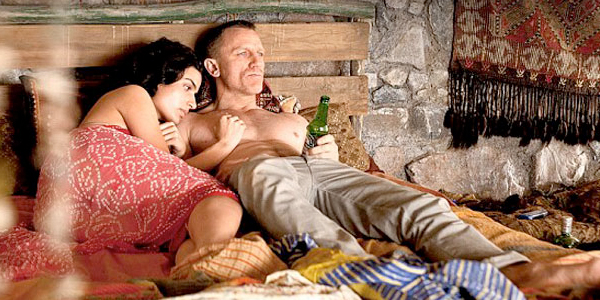
 If there's a universal truth to take from the James Bond films, it's that Britain's favourite amoral super-spy hits his martinis with all the subtlety and force of a truck, and is probably sh*tfaced pretty most of the time. And that's fine Ian Fleming superimposed many of his own characteristics onto his creation, and that included a legendary tolerance and proclivity for alcohol. Yet for my money, this little tic gets all sorts of ridiculous around the time of Quantum Of Solace. Up until now in the franchise, we've seen Bond down a few tipples, but never enough to break his suave charm. Yet under Daniel Craig's aegis, Bond became a rougher sort more suited to the on-page hero something we began to see in Casino Royale where he downed his drink before attempting to charge Le Chiffre. Yet it was only in Quatum Of Solace that we began to see just how bad Bond's drinking got. Namely, he got sh*tfaced on a plane to Bolivia, and didn't care who knew it. It was something of a crystallising moment for naïve fans, knowing that under the surface our hero was possibly running on little more than cocktail olives and alcohol. Yet still, he's all sorts of awesome, pulling off amazing feats with martini-soaked bombast. He's a great advert for alcoholism while you or I would struggle to walk in a straight line under liquor's influence, Bond proved later that he could shoot up a Bolivian hotel with a hangover, before graduating to juggling scorpions and sucking down Heinekens come sequel time. I guess the moral here is that no matter how brilliant it looks, I don't think you should try this at home I don't you'll make it look half as awesome as Bond.
3. The Royal Tenenbaums Terrible Parenting
 In my opinion, The Royal Tenenbaums is Wes Anderson's best film, and most of the credit for that can be laid at the door of one man Gene Hackman. Hackman plays the eponymous Royal Tenenbaum, a former malpractice lawyer and terrible father to the child prodigies, and he does it with gusto By all rights, he should be a terrible character he shot his son with a BB rifle, goes out of his way to crush his adoptive daughter's spirits and pretends he's dying to re-establish relations with his estranged wife. These are not good things, and would certainly be something from which a lesser character would struggle to come back. But still, come back Royal does, and not just in our eyes he actually achieves all he set out to do, despite the unimaginable trauma he's put his family through. I mean seriously, he's been such a dick all his life, and he even manages the seemingly impossible task of going down further in the cast's estimation when they rumble him faking stomach cancer. Yet two saved grandchildren later and Royal's back in amongst it able to take his grandchildren out on the back of a garbage truck and watch his (adopted) daughter's plays, as if nothing had even happened. Really, as much as I love the film and it is my favourite film, by the way it gives off a really weird message about family breakups. It seems to say that the whole heartbreak isn't too much bother really, especially after one jerk-aside manouevre. Mind you, Royal is magnificently awful, so I don't blame them for taking him back.
2. Full Metal Jacket Psychological Torture
 Full Metal Jacket backfired somewhat. Originally intended as Stanley Kubrick's war-is-hell flick, it actually managed to increase job applications to the army after its release. You know how it did that? R. Lee Ermey, that's how. It's a well-known fact now that Ermey is possibly the only person Kubrick let improvise entirely because everything which came out of his mouth was so authentically drill-sergeant-esque that it would've been a shame to stifle him with a script. Of course, it helped that Ermey had been a drill sergeant in real life, but what didn't help was that he was also goddamned hilarious. Look, I know he was supposed to be some sort of terrifying figure, and sure, he was. But much like the characters in the movie itself, you found him hilarious, even when he was mentally breaking Private Pyle. I never knew psychological torture could be so... funny. Whether he was saying that it was impossible they could stack sh*t that high, whether someone sucked dick, or that that Pyle climbed like old people f*cked, Ermey's delivery was just so awesome it completely distracted away from the horror being put on screen, instead letting it take a back seat to the guy's greatest hits. I'm willing to guess that probably wasn't the point, but when a man's this creative with insults, I guess it can't be helped.
1. Limitless Drug Addiction
 Limitless started out like any other 'drugs are bad' parable. Namely, Bradley Cooper's Eddie Mora finds a wonder-drug that lets him use his whole brain, and abuses it to the point where he can speak a ton of languages, write a best-selling book, take Wall Street for millions and just be an all-round better person, really. Yet of course, in any story like this, there's some comeuppance, and that comeuppance involves your early death, constant blackouts and being drawn into a murder underworld of deceit. Hey, everything's got to have a downside, right? But this is where the similarities to a clichéd drug story end. You see, unlike in other drugs-and-crime-don't-pay stories, Eddie doesn't go cold turkey and realise that his life is much better without his wonderful pills. Instead, he does the exact opposite in the most confusing advice ever, he takes more drugs to beat his drug problem, becoming smart to an extent that he can figure out a way to beat necking pills and taper out the side-effects. Lo and behold, he does, remains omniscient and looks as if he's in a position to sweep the political board all the way up to the White House. It's amazingly ballsy, I'll give it that after all, not many films end with the moral that drugs are in fact a perfectly viable solution to all your problems, and that drug addiction can easily be licked with more drugs. It's a bit mad, but strangely, I sort of like it. So that's what I think. What do you think? Feel free to comment!