9 Plot Holes That Totally Ruined Jurassic World

"Plot holes, uh, find a way..."

After setting an all-time box office record in its opening weekend, grossing an astonishing $511 million dollars, it's clear that Jurassic World is a huge financial success (not that anybody assumed it wouldn't be, though). And whilst it's clearly made an impact at the box office, critics have been generally warm towards the film with most proclaiming the long-awaited sequel to be big, dumb fun - less science-y than the original, but worth the wait. So, though Jurassic World lacks the "intelligence" of Jurassic Park, it does succeed in the thrills department, whilst also managing to walk the fine line between rehash and reboot with an admirable amount of skill. That's to say, Jurassic World embraces its origins but does not attempt to simply repeat what has already been done; as both a tribute and a continuation to a blockbuster behemoth with an insurmountable legacy, it does very well. But where Jurassic World succeeds in sheer action, it lacks in the logic department. That's to say, there are quite a lot of moments scattered throughout Jurassic World with the power to make you say: "What the hell?" Moments in which characters act in the exact opposite way than you'd expect them to; moments where the theme park itself seems to make no sense; moments where the established logic of the Jurassic Park universe disappears. Here, then, are 9 plot holes that - when you look closely at them - let the movie down...

9. Why Doesn't Claire Just Call Control About The Escaped Indominus Rex From Its Enclosure?

The first sign that something has gone horribly wrong with Jurassic World's newly-rendered genetic monster, the Indominus Rex, occurs towards the end of the movie's first act. Claire Dearing, park operations manager, and Owen Grady, velociraptor trainer/park ranger, suddenly realise that the dinosaur isn't showing up on the thermal scanners inside her enclosure. So they think she's missing, of course. Thing is, the Indominus Rex has a tracker inside her body - inserted as a precaution just in case of emergencies like this! But then something really dumb happens for absolutely no reason: Claire jumps in her car and heads back to control, whilst Owen goes inside the enclosure to take a look. On route, Claire calls control and asks them to check where in Jurassic World the Indominus has gotten to, only for the control room to tell her that the dinosaur is, in fact, still in the enclosure and has lowered its temperature to avoid detection so it can escape. Why didn't Claire just call control from the enclosure to check the whereabouts of the creature? You know, before Owen went inside and a bunch of people died? Duh!

8. The Gyrospheres Can't Be Controlled Remotely?
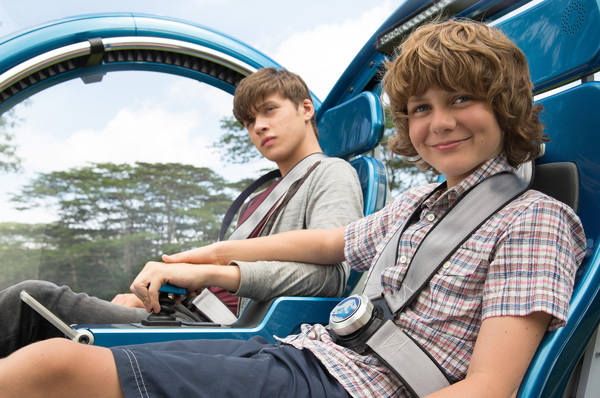
Next up: the memorable scene in which Zach and Gray take a ride on what is arguably Jurassic World's most impressive attraction. It's the Gyrospheres, of course, those hi-tech ball-like things that allow visitors to drive around a large, open plain and experience the larger, kinder dinosaurs up close. This all goes wrong, you'll remember, when Zach takes the vehicle off-road, and the kids are attacked by the ferocious Indominus Rex. At this point, Claire - after shutting down the ride due to the escaped Indominus - realises that there's a Gyrosphere still out there. For some reason, though, the Gyrospheres can't be controlled remotely, which seems so unlikely that it has to qualify as a plot hole. Why wouldn't the tech team have designed the Gyrospheres so they can be steered remotely in the case of an emergency? Surely that would be a totally essential safety feature? And yet there's no such feature in place; park visitors are allowed to take complete control of their Gyrospheres for as long as they want, apparently, which makes no sense no matter how you try to justify it. It's a lazy conceit, essentially - and completely unbelievable.

7. The Indominus Rex's Ability To Smell Constantly Changes

All throughout Jurassic World, it's drummed into the audiences' subconscious that the Indominus Rex has an incredible sense of smell - none of that "don't move and it can't see you" schtick now infamously linked to the T-Rex from the first film (and Jeff Goldblum's Dr. Ian Malcolm wielding a flare and distracting the beast like a total badass). Despite that, though, the Indominus Rex constantly loses its ability to smell out human beings whenever the plot decides that it shouldn't have the power to do so. At first, Owen covers himself in petrol to cover his scent, and the Indominus loses track of him. Fine. But later on in the movie there are points where the characters are hiding and the Indominus can't smell them out - like when Owen and Claire hide behind the old Wrangler. So does the Indominus Rex have a great sense of smell or not? You wouldn't really know an answer from watching the movie.

6. That 22-Year-Old Jeep Still Works, Apparently

Though one of the most inherently giddy sequences in Jurassic World features a scene in which the kids stumble upon the ruins of John Hammond's original Jurassic Park visitor's centre, there is an annoying logical jump which occurs at the same time that kind of borders on the insane - so much so, in fact, that it qualifies as a plot hole. That's to say, the moment in which the kids resurrect a 22-year-old Jurassic Park jeep Wrangler seems entirely implausible, especially with a ham-fisted explanation thrown in on the fly that, oh, their grandfather taught them to, uh, "fix" cars - just in general. Firstly, after 22 years sitting in an old shed in the middle of nowhere, the tires would have been flat - not to mention the fact that the battery would have died, too. Then there's the general wear and tear that comes with leaving a vehicle abandoned in a tropical climate for well over two decades - surely the vehicle would have been beyond the point of repair?

5. The Characters Traverse The Span Of The Island Far Too Quickly

The general impression of Jurassic World is that it takes place on a relatively huge island; vehicles are necessary for the visitors and staff to travel to different sections, and the first half of the picture does well to depict the distance between these sections, with characters having to make long and often inconvenient journeys. But during the second half of Jurassic World, this detail goes out of the window, and characters are seemingly moving between different parts of the island at an insane speed - one that doesn't hold up to close scrunity. Take the transitional period between the Pterodactyl cage and the centre of the park during the sequence where Owen, Claire and the kids escape from one to the other. What should have been at least an hour's walk - or a lengthy drive, going by the maps audiences have glimpsed throughout - is depicted as being a relatively short distance; they all just pop up at the centre of the park in time for the attack. Thus the timeframe of the movie is off, as characters are shown to be near-on "teleporting."

4. The Raptors Change Their Allegiance On A Whim

One of the coolest aspects in Jurassic World can be found in the notion that, having raised them from birth, Owen is considered to be the Alpha raptor. Across the span of the movie, it's established that Owen is in charge and that the raptors obey him to a relatively fair degree. He's known them for a long time - years and years - and trust has been built. And then it takes literally two seconds for them to change their mind about Owen when they come into contact with the Indominus? That's not how pack animals work! For Owen to shift from his position as group alpha, he'd have to find himself defeated or killed by an animal - the raptors would technically have to perceive a major loss of power, which they don't. Not only that, but the raptors change sides again when they meet Owen later - and for what reason? He doesn't "appear" to be stronger than the Indominus, so the logic remains inconsistent. There's no science to it; just whatever the plot needs at that specific time. Not to mention the fact that even later on, Blue, the final raptor, briefly teams up with a T-Rex, and later decides to be friends with said T-Rex (and vice versa) for no reason at all. It's all a bit of a mess when you approach it from a logical perspective, and one that grows increasingly irksome with each subsequent viewing of the movie.

3. Claire Does Everything (Including Outrun A T-Rex) Wearing High Heels

There's creative license, and then there's things so illogical that they cements themselves as a plot hole. And that's where this complaint lies: with Claire's footwear. That's to say, the park manager spends the entirety of Jurassic World wearing high heels. She doesn't abandon them partway through the movie when things get rough - she continues to wear them. In one remarkable scene, Claire even outruns a T-Rex wearing high heels, and it doesn't seem to slow down her progress for even a second (despite the fact that the same T-Rex has been clocked at 32 miles per hour). How does that make sense? Well, it doesn't, and it's somewhat off-putting to watch as a result. Are those super high heels, Claire? What gives? How did you manage to run in them?!

2. The Mosasaurus Can Escape From Its Enclosure At Anytime, Apparently

The explosive, action-packed climax of Jurassic World pits the beloved T-Rex from the original movie and the "main" raptor, Blue, against the evil Indominus Rex in an epic battle sequence that is undeniably awesome in scale, but not quite "Jurassic Park" in execution (it's almost like something out of Godzilla by way of Peter Jackson's King Kong). Anyhow, said battle ends when - cornered by the T-Rex and Blue - the Indominus Rex backs onto the pool where the Mosasaurus - a great sea creature housed in a Sea World-like tank - lives, only for said sea creature to leap out of its pool and gobble her whole. And it makes no sense, because for that to happen the Mosasaurus enclosure would have had to have been unsafe the entire time - and why only now (after 10 years at the park) would the creature have decided it was time to leap out of its pool? Surely it would have tried to eat a bunch of tourists prior to this final battle, if such a thing were possible? No expense spared? When it comes to safety, it sure doesn't appears that way.

1. The T-Rex Just Gives Up & Leaves After The Final Battle

Just like at the end of the original Jurassic Park, the infamous and beloved T-Rex is positioned as something of a hero at the end of Jurassic World. After the final battle, Blue - one of Owen's raptors - appears to communicate with the ol' girl to the point where she actually wanders off and stops trying to eat Claire, Owen and the kids, which is definitely not what would have occurred given the established canon. Why, all of a sudden, can the T-Rex and the raptors communicate with one another? How does that even happen, going on what audiences already know about the end of the first movie? It just doesn't fit with the logic of the established dinosaurs that they can suddenly "talk" to one another. Does it really ring true that, after a brief battle, Blue would be able to communicate with a different species of dinosaur and stop said dinosaur from giving into its instincts? Even if the T-Rex was weak, chances are that she wouldn't just "retreat." It's a moment of madness that seems a lot less forgivable the more you consider it. Were there any more plot holes that we missed? Share then down below.

Contributor

Sam Hill is an ardent cinephile and has been writing about film professionally since 2008. He harbours a particular fondness for western and sci-fi movies.