9 REAL Acting Moments Created By Deception
Sometimes producers need to give the talent a little push toward acting perfection...
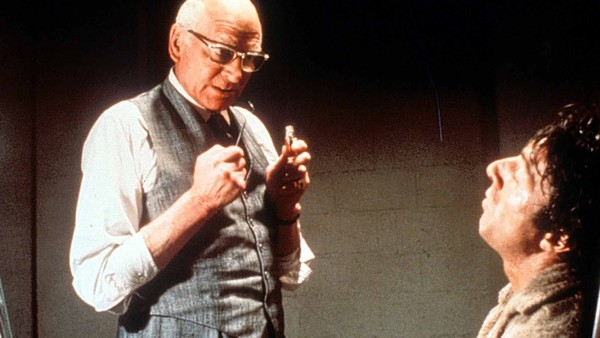
Every once in a while, a director decides that there’s no point relying on actors to do their job and play professional pretend when the production could always just blindside them with an unexpected dash of real life danger or surprise, or just fail to inform them of something vital in order to provoke a more "authentic" performance from them onscreen.
Whilst some actors decide to utilize method acting and stay in character between takes in order to make their performances more believable, others are… less enthusiastic about the technique and need a little extra encouragement. Famously, Hamlet actor and Shakespearean hero Laurence Olivier once told Dustin Hoffman on the set of Marathon Man, when the star had stayed up for three days to play a sleep-deprived character, that he ought to “try acting, my boy.”
In cases like this, directors have been known on occasion to use a little deception in order to provoke the reaction that they’re after. In some cases it’s a little white lie, in others outright deceit, but in every case listed here, the results speak for themselves.
9. Hank Azaria Flashed Simon Pegg For Real - Run Fatboy Run

Poor Simon Pegg. As if it wasn’t bad enough to be given the title role in a movie titled Run Fatboy Run, the former Spaced star went on to be doubly humiliated thanks to a wardrobe malfunction onset and co-star Hank Azaria deciding to leave him in the dark.
Playing the love-to-hate-him Gordon, who takes Pegg’s place as a father to his son and lover to his former fiancée, the Simpsons star has a great time as the sleazy, too-good-to-be-true antagonist. However for one of the film’s more memorable scenes, Azaria opted to go au naturale and, befitting the villains he’s accustomed to playing, decided against informing Pegg beforehand.
So that locker-room scene where Pegg stares in shock as a nude Gordon towels off in front of him, displaying his manhood? Yeah, that’s Pegg’s real reaction—when Azaria’s prosthetic cover-up wouldn’t work he tossed it aside and declined to inform his co-star, resulting in Pegg’s very authentic surprise.
8. Slim Pickens Thought He Was The Hero - Doctor Strangelove

Befitting Stanley Kubrick’s iconic Cold War satire, this entry is a strange one which nonetheless turned out for the best for the actor, director, and film involved.
Needing a famous screen cowboy face for the role of the overzealous bomber pilot Major T Kong, the director was unable to secure the services of any of Hollywood’s best-known gunslingers. Desperate, Kubrick hired Slim Pickens, told him nothing about the film outside of his part, and left the patriotic actor thinking his role was to save the world by personally detonating a nuclear bomb on a populated area.
The actor was forced to forgive Kubrick when the role resulted in a string of stellar offers for him.
7. Dennis Greene Wasn't Expecting The Spanish Inquisition - Bad Boys 2

There’s very little Michael Bay won’t do to force what he wants out of an actor. This approach is epitomized in an admittedly pretty hilarious fashion by the scene in Bad Boys II depicting the arrival of a prospective date for Marcus Burnett’s (Martin Lawrence) daughter. Bay decided to keep actor Dennis Greene, who played the unfortunate paramour, on his toes to ensure he was sufficiently afraid of Will Smith and Martin Lawrence’s eponymous rule-flouting cops.
This meant Lawrence’s bodyguard telling Greene not to look in the actor’s eyes or speak unless spoken to, as well as no one warning Greene that Smith would pull a gun on him during the pre-date interrogation. The resultant scene produced one shook actor and probably the movie’s funniest moment.
6. The Writers Told Messala (But Not Charlon Heston) That He Was In Love With Judah - Ben Hur

Unfortunately, this one remains in the realm of unverifiable myth as most of the major players involved took the secret of whether or not this rumour is true to their grave.
Apparently, screenwriter Gore Vidal (of Myra Breckenridge fame, as well as many non-embarrassing critically-adored other works) convinced one of Charlton Heston’s co-stars to play his character as a gay man enamoured with the titular hero—without anyone informing the extremely conservative Heston.
Now admittedly the story is impossible to prove, but the next time you find yourself landing on this Biblical epic whilst channel-hopping on a Sunday afternoon, watch Stephen Boyd’s portrayal of Messala closely. There’s a tenderness to the role which implies there may be some truth to the rumour, and deepens the relationship with the pair despite Heston’s supposed cluelessness.
5. The First Victim Was Pulled Under Without Warning - Jaws

In Jaws' iconic opening sequence, actress Susan Backlinie ventures out far from the shore for a night-time dip, only to become shark chum as the score’s scare chords begin and she’s turned to the first victim of the eponymous great white during gales of screaming. Now initially, the then-young director Steven Spielberg wasn’t quite satisfied with said screams, prompting him to take a novel approach.
On the next take, a stagehand yanked Backlinie beneath the water’s surface without any prior warning, with the actor’s understandable shock in the moment resulting in the iconic ear-splitting scream scene we all recall.
4. Ken Loach Located A Dead Bird To Guarantee Real Tears - Kes

Not content with merely depressing audiences with his output, veteran British helmer Ken Loach also took it upon himself to leave a literal child feeling hopeless and despondent early on in his film career.
Okay yeah fine, we all know and are willing to admit that The Wind That Shakes the Barley and I, Daniel Blake are two of the most moving and fearless films of the new millennium, and that the director’s career at large is a life-affirming testament to the power of cinema for affecting social change against all odds.
But man, can his flicks be a slog to get through.
And yes, don’t worry, Loach did tell his inexperienced young star that he was fooling him after the cameras stopped rolling. But for the closing scene of 1966’s brutal, brilliant Kes, Loach initially informed the actor that the bird playing his titular best mate was actually dead and, anticipating cynical teenage disbelief, went so far as to procure a replacement kestrel corpse from a local bird sanctuary (don't worry, the stand-in bird was already dead from natural causes before Loach got his hands on it).
Ice cold, Kenneth.
3. Jackie Coogan Was Threatened With A Workhouse - The Kid

The Kid was one of the first real dramedies in Hollywood history and a fine dramedy it is, drawing inspiration from a then-recent tragedy in Charlie Chaplin’s real life to create a moving, poignant but still funny film which has gone on to inspire both official and unofficial remakes. In large part the flick’s success centres around junior actor/future Uncle Fester Jackie Coogan’s debut performance as the eponymous kid, and the star not only went on to an illustrious career but also successfully campaigned for the rights of child actors to be protected.
Which is pretty understandable when you consider the fact that, in order to evoke an emotional response, the filmmakers told Coogan he would be sent to a workhouse like the one depicted in the film if he couldn’t cry on cue.
2. Robert De Niro Made Sure Jerry Lewis Hated Him For Real - The King Of Comedy

As far as we’re aware, there’s not an anti-Semitic bone in Mean Streets’ star/ screen legend Robert De Niro’s body. So why would we even feel the need to write such a specific clarification?
Well, whilst filming one of Martin Scorsese’s string of underrated eighties flicks, most of which inexplicably flopped upon release (shout out to the brilliant After Hours and The Last Temptation of Christ), Robert De Niro took an, er, risky route to improving his chemistry with co-star Jerry Lewis.
As Robert Pupkin, a wannabe stand-up/ successful sociopath, De Niro must have felt he was far too likeable for comedy icon Lewis to act frustrated and freaked out by his persistent and aggressive stalking of him. At least that’s the only explanation for why De Niro opted to make anti-Semitic comments around Lewis, ensuring the actor would harbour a genuine dislike for him by the time cameras were rolling.
Here’s hoping he had a chance to explain his logic later on, mind you.
1. The Director Filmed Laurence Olivier's Rehearsals - Marathon Man

You already knew we had to cap off this list with another appearance for Shakespearean legend/ anti-method acting advocate Laurence Olivier. The actor’s infamous distaste for the method resulted in some impressively bombastic performances over the years, and many directors prized his explosive screen presence as much as, say, Marlon Brando’s expressive unsubtlety.
However, Midnight Cowboy helmer John Schlesinger was reluctant to criticize, well, one of cinema’s most famous and critically beloved talents… not to mention one of the industry’s most infamous egos. As a result, he opted to shoot a scene with Olivier’s dodgy over-acting, thanked him for his service, then later told him the production needed coverage for Hoffman’s half of the conversation, meaning Olivier could simply reel off his lines for the take without any emotional input.
Olivier saw through the gambit but played along nonetheless, thankful for the director’s tact. The humility paid off, with his performance being singled out as a superb turn in an already impressive film and adding to his long lists of lauded roles.