Alfred Hitchcock: Ranking His Movies From Worst To Best
 Ranking Alfred Hitchcock's famous movies from Best to Worst is always going to be a highly controversial endeavour. His filmography is so vast and he has many many popular pictures - not just the big ones like Vertigo and Rear Window, but he has cult followings for films such as Rope, Marnie and Life Boat. It is an impossible task to satisfy all of his fans. I have tried in this feature to represent a wide range of Hitchcock pictures from his oeuvre. I have not ranked them according to my personal preference, but to a preference that I think will satisfy the majority of his fans. I have also decided to keep it to just ten movies. It has not been an easy task and I doubt that it will please everyone but you can add your comments and dissent into the box below.
10. Topaz (1969)
 Topaz is based on the best selling book by Leon Uris and concerns a French Intelligence agent who becomes enmeshed in the drama of the Cold war. First through the events of the Cuban Missile Crisis and then through trying to break an international Soviet spy ring. Some consider Topaz underrated, some consider it just bad, it is certainly an atypical Hitchcock film in that it doesn't go with his major themes and motifs. It is extremely complex in its plotting and the viewer would need to have knowledge of the Cuban Missile crisis for the film to make proper sense. Apparently Hitchcock was in a bad mood and ill whenever he made it as a studio had nixed a project of his. The film is well directed but not well paced - being too talky at times. Interesting as a Cold War thriller, it is not likely to end upon Hitchcock fans' Top 10 lists.
9. Marnie (1964)
 Everyone seems to hate Marnie. I don't - it is my favourite Hitchcock film but if I had put it at number one I don't think it would have gone down well. Marnie has a reputation as a bad Hitchcock film. Starring Tippi Hedren as a troubled young woman who is a serial thief and who hates men, the colour red and thunderstorms, Sean Connery knows about her thieving and blackmails her into marrying him. Unfortunately, she is also frigid and the film must unravel the terrible childhood events that left Marnie so psychologically traumatised in the first place. There are many instances of silliness in the film - such as the zooming in and out of money in the safe, the horse riding scenes, and obvious painted backdrops. The fade to red sequences leave a lot to be desired. The editing is amateurish and a lot of the dialogue very stilted. However, this is one of Hitchcock's better psychological dramas. Tippi Hedren doesn't put a foot wrong in her role and Sean Connery does his best in a confusing role that demands he go to and fro from nasty rough handed bastard to Mr Kindness and consideration. Bernard Hermann's score is thrilling and captures the different tones of the movie perfectly.
8. Frenzy (1972)
 "Mr Rusk, you're not wearing your tie". Hitchcock's penultimate film, considered the last of his great films, Frenzy is an absolute riot from beginning to end. The action is set in Covent Garden in London, where fruit seller Robert Rusk is going around raping women and strangling them with a necktie. A lot of circumstantial evidence has built up around his friend Richard Blaney who is jailed after several murders involving women close to him. Detective Oxford, the investigating Officer soon realises the wrong man has been jailed and the race is on to catch the killer before he murders anyone else. The Master of Suspense is back in action with full force. The scene with Rusk in a truck full of potatoes trying to rescue his tie pin from a dead woman's hand is gripping and darkly humorous. There were no major stars in the film and therefore no narrative compromises. There is nudity, violence and swearing which Hitchcock had never really bothered with before. At the beginning of the movie there is a violent rape and strangulation scene. But Hitchcock does not over play the violence. The second murder scene shows Rusk escorting a young woman to his flat and remarking "You know, you're just my type". When the door closes, the camera pans away and floats down the stairs, out the door and across the street where we see busy people just doing their every day thing. Hitchcock does not need to go graphic to chill you to your marrow.
7. Rebecca (1940)
 Hitchcock's first American film based on the eponymous book by Daphne du Maurier, Rebecca is a dramatic psychological film starring Laurence Olivier and Joan Fontaine. The pair fall in love in Monte Carlo and Maxim de Winter takes his young bride back to Manderley - his large Cornish manor and estate. The estate is dominated by the tyrannical housekeeper Mrs Danvers, who moans and bitches about everything the new Mrs de Winter does. Danvers is obsessed with the memory of Maxim's first wife Rebecca and harps on about how great and wonderful she was to the new Mrs de Winter who gradually begins to doubt her husband's feelings for her. However, whenever a boat comes in with Rebecca's corpse on it, Maxim has a lot of confessing to do to his young wife and she becomes entangled in a web of lies and intrigue, having to use her loaf to save her husband and herself. What is striking about Rebecca is not so much the directorial presence of Hitchcock, but the standard of the acting. The roles in Rebecca demand that the actors act their socks off, and indeed, the film is flawlessly performed. In Joan Fontaine we see a timid, nervous wreck of a woman grow strong and confident. The actress who plays Mrs Danvers - Judith Anderson - embodies perversion and malice in the extreme. The film is stylishly filmed and photographed. It is no accident that the film won Best Picture Oscar as well as Best Cinematography. And all of the major players were nominated for acting Oscars.
6. Rope (1948)
 Two brilliant young students - Phillip and Brandon - decide to murder a fellow student - David as an 'intellectual exercise', to confirm their superiority by committing the perfect murder. They hide the body in a large wooden chest and host a party - inviting the victim' father and aunt, fiancee and good friend. Also among the attendees is their old prep school master Rupert Cadell (James Stewart) whose talk on Nietzche's ubermensch and the art of perfect murder was the inspiration behind Phillip and Brandon committing this deed. The guests are all worried about David and his absence. Phillip is beginning to crack. The guests leave in a disturbed state. Rupert, when he is given David's hat by mistake when leaving, twigs on that something isn't right and questions the two killers. Brandon seems eager to have the crime discovered. Rupert opens the chest and finds the dead body. He is very perturbed to realise his own rhetoric inspired the killing. The police are on their way. This is Hitchcock at his most experimental, and it is one of the most experimental films to feature major actors. Hitchcock filmed the film like it was one long shot, panning away to dark objects when he needed a new reel of film. It is filmed in real time and the backdrop of New York in the apartment was the largest ever used on a sound stage - featuring models of the Empire State and Chrysler buildings and moving clouds and neon lights. A shocking and horrifying film, which does not require blood or guts to chill you, Rope is an amazing film when you consider the film making restraints Hitchcock had back in the 1940s. Hitchcock called it 'an experiment that failed' but I think the director was unnecessarily harsh on himself. It is a thrilling film which coaxes excellent performances out of all of the actors. Unfairly underrated and never in people's Top Ten Hitchcock films, I am putting Rope out there as one of Hitchcock's best.
5. North by Northwest (1959)
 One of Hitchcock's more exciting films, Cary Grant is Roger Thornhill, a man who has somehow gotten himself mistook for a secret Government agent and now he is being chased cross country by a shadowy group of international spies. The film is a good, exciting caper from beginning to end. Hitchcock managed to create the Spy genre with this film. James Bond was based on the debonair Cary Grant. There is terrific dialogue and sexual tension between Cary Grant and female lead Eva Marie Saint. It manages to have some pretty amazing action sequences at Mount Rushmore. In fact the whole affair has a little bit for everyone - sizzling dialogue, comedy, romance, action, suspense. Hitchcock puts you firmly in Cary Grant's place - a non entity Mummy's boy who suddenly becomes an action hero and we willingly swallow this from the start, such is Cary Grant's charm. Hitchcock at his most entertaining but not at his greatest.
4. The Birds (1963)
 A love bird carrying beautiful blonde socialite Melanie (Tippi Hedren) pursues a potential romance with Mitch (Rod Taylor) in a small island - Bodega Bay. However the local birds strangely turn nasty and begin savage attacks on civilians. Principally entertaining for me because whenever the birds start squawking my poor little budgies and cockatiels go bananas, The Birds has been creeping people out for 50 years now. Hitchcock built up a lot of tension in the viewer when it came to predicting when the bird attacks would occur. A lot of the time they are gathered in a menacing crowd and the viewer thinks "Oh crap! When is hell going to break loose?". It is also pretty scary in taking the premise of an ordinary object - like a bird and turning it into something horrific. The film is also unusual in that it doesn't have a score which definitely makes the film more atmospheric. There are numerous moments of nail biting tension and if the viewer feels the first part of the film is slow, it is because Hitchcock is concentrating on building up characterisation. Surely ranks as one of the great director's most well known and loved masterpieces.
3. Psycho (1960)
 Marion Crane (Janet Leigh) is a very naughty secretary who has stolen money from her employers. She shacks up at a secluded motel to figure out what to do next. Unfortunately, this is the Bates Motel and Norman is ready with a big knife to slash her to ribbons in the shower. Some people come sniffing by the motel to try and find the missing Marion, but this just leads to more murder with Norman parading around in his mother's clothes. Some psychoanalysing follows ending with Norman sitting in a cell, his mind dominated by his Mother. Psycho would doubtless have been very shocking to audiences in 1960 and it still packs a punch today. The murder of the assumed heroine half an hour into the film would have been unprecedented as would the savagery of the shower kill scene. Hitchcock's contribution to the horror movie through Psycho was considerable - it can be seen as the grand daddy of stalk and slash films and horror films with psychotic human killers. Initial reviews of the film were excoriating - "a blot on an honourable career" and "a gimmick". It broke all box office records in Japan (surprise surprise) and it made Hitchcock a multimillionaire. Modern reviewers have revised their opinion of the film, calling it "superlative" and "masterly". Probably the most suspenseful horror film ever made.
2. Rear Window (1954)
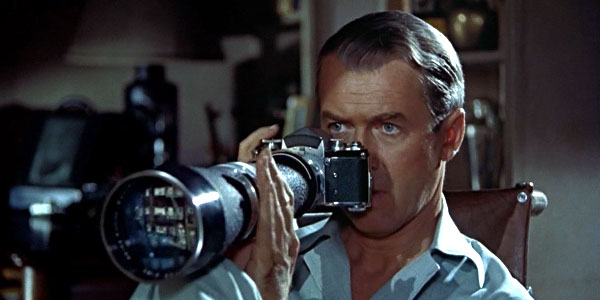 After breaking his leg, Jeff (James Stewart) whiles away a hot summer spying on his neighbours to the amusement of his wealthy socialite girlfriend Lisa (Grace Kelly). He becomes obsessed with his neighbour Mr Thorwald, who he believes is guilty of murdering his wife. A dead dog shows up in the courtyard and Jeff is convinced the dog was murdered by Thorwald to stop it from digging up something incriminating. His obsession with Thorwald intensifies and he and Lisa become involved in a deadly game of cat and mouse with the neighbour. In Rear Window, Hitchcock invites us to become voyeurs along side Jeff and it is quite absorbing, spying on the neighbours, however, it is firmly Hitchcock's lens we are looking through, not Jeff's. Hitchcock also places limitations on himself with a limited set which makes us really empathise with Jeff's experience of confinement. The closed apartment is also effective at creating Hitchcock's trademark suspense. We don't know what is happening outside except through the lens of his telescope. The film is funny and warm as well as being suspenseful. Stewart's and Kelly's characters are well developed and we care for them. A Hitchcock masterpiece.
1. Vertigo (1958)
 John "Scottie" Ferguson (James Stewart) is retired from the force due to vertigo and clinical depression (a rooftop chase and his fear of heights resulted in the death of another officer). He is asked by an acquaintance to tail his wife Madeline, whom he claims is possessed. This sparks a strange turn of events whereby he becomes obsessed with Madeline and exorcising his personal demons. A bit of a departure from his romantic thriller past, Vertigo had a lukewarm reception by the critics who felt it was too long and bogged down in detail. The French were responsible for the rehabilitation of the film's reputation. The French have always taken Hitchcock very very seriously and when the film was rereleased in cinemas and home video in 1983 it was a great commercial success and received exemplary reviews. Now sitting on Sight and Sound's No. 1 position of the greatest films of all time, some people feel the adulation is growing excessive. My two cents: I would much rather be watching Rope or Marnie but Hitchcock did succeed with Vertigo in making a unique movie which is dreamlike and lavish. The score by Bernard Hermann is a definite bonus.