David Cronenberg: All 21 Films Ranked From Worst To Best

"I've often thought there should be beauty contests for the insides of bodies."

David Cronenberg is one of the most fascinating film-makers in the world, and he is undoubtedly Canada's most influential and critically-lauded director. His work has covered a remarkably wide range of styles, drawing on gangster movies, psychological dramas, historical biopics, cyberpunk thrillers and, of course, his trademark: body horror. Few directors nowadays merit the label of "auteur", but he is absolutely one of them. Of course, in his many years as a director (45, to be exact) he hasn't always hit the lofty heights that is so frequently expected of him. Some of his films just don't match up to his very best work. His 21 films vary just as much in terms of consistency as they do in genre. There's probably, actually, a fair number of his weaker films that few other than the most diehard Cronenberg fan has seen. There's his bizarre foray into a racing movie, his biopic of Freud and Jung, an outstanding performance by Jeremy Irons and an utterly forgettable one, and critically-acclaimed pieces like A History Of Violence and The Fly. Which film in this masterful director's vast oeuvre represents his talents and themes best? Here are all 21 of his feature films, ranked from worst to best...

21. Fast Company

It's telling that Cronenberg's weakest film is also the one that stands out probably more than any other in his filmography as un-Cronenbergian. Fast Company is effectively a sports film, a fairly straight-laced story about a drag racer with a screenplay written by Phil Savath, Courtney Smith and Alan Treen. Cronenberg is a hug petrolhead, and that may explain why he looks back on Fast Company with a certain degree of fondness. The fact is, though, it's not actually very good. It's a fairly generic film that doesn't even feature particularly exciting cinematography. If you weren't otherwise informed, you certainly wouldn't associate it with the mercurial Canadian.

20. Stereo

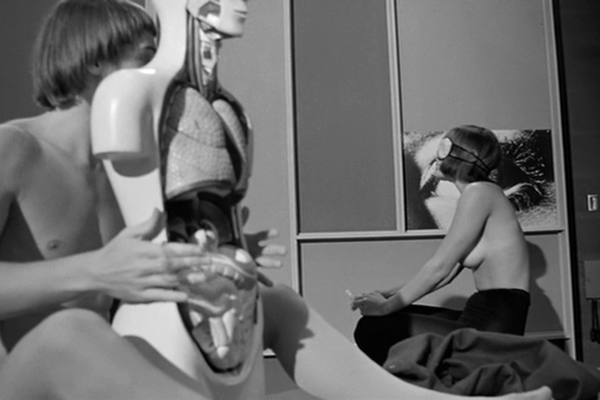
Cronenberg's debut, Stereo, doesn't fare much better than Fast Company. Admittedly, it looks pretty good. The black and white visuals are gorgeous, and are actually fairly anomalous in a filmography that is defined by colours. Many of the themes that would dominate the director's later work are also evinced here, with the story revolving around telepathic sexual experiments. The problem with the film is its abstract nature. It was filmed silently, due to the noisy camera that Cronenberg used, and instead features odd, dry commentary over the top of it. It's like watching a fictional documentary. There's no doubt that some of the shots are lovely, and films such as Scanners certainly reveal the influence of this early work, but it's far from the exciting output that Cronenberg would come to produce.

19. Maps To The Stars

It's a shame that Cronenberg's latest film is so low down the list, but the fact is that it just isn't very good. There's no question that it explores some fairly pertinent themes, but it fails to do so in ways that haven't been done in undoubtedly superior films like David Lynch's Mulholland Drive. Maps To The Stars is basically a poisoned love letter to Hollywood. It's Cronenberg's satirical take on identity and the mainstream film industry. Your eyes should be rolling already - these aren't new themes. To be fair, Cronenberg is entitled to cover this subject matter. It's just that he doesn't do a very good job, and is severely inhibited by a wooden script by Bruce Wagner. Julianne Moore isn't too bad at the film's core, but only Mia Wasikowska provides a truly moving performance here. With a script as average as this, more actors had to be on their A-games to match up. They just aren't. Arguably the hollowest film in Cronenberg's oeuvre. Here's hoping his next is a step up.

18. Crimes Of The Future

Similarly to Stereo, Crimes Of The Future was filmed silently and had a commentary dubbed onto it. Even though it's arguably not as beautiful as the black and white Stereo, the director's second film finishes above it because its themes are enough to make even the most avid body horror fan sit up and take notice. COTF studies a world in which women have been wholly wiped out. The remaining men turn to cannibalism and, most disturbingly, paedophilia in order to survive and procreate. The film doesn't pull any punches, and it's incredible that the director was this brave in one of his earliest films. The film starts out very slowly, and is marred by its disembodied commentary, but it grows into something truly fascinating by its conclusion. Certainly worth a watch, even if it certainly isn't a classic.

17. Shivers

Shivers is actually a pretty great piece of film-making that, considering its Cronenberg's first film not to feature overdubbed commentary, is remarkably brave and experimental. The sole reason why it is placed so low on the list is simply because the themes developed in this film would be bettered in his later work. This is where the seeds were sown though. A chaotic, innovative narrative reflects the collapsing relationships and lives of the film's lead characters. Quite clearly a statement on STDs and sexual promiscuity, the characters spread a gruesome parasitic worm that infects and changes its hosts. Some of the effects are dated, certainly, but most of them hold up pretty well. This seems somewhat related to Cronenberg's ability to create such horrifying makeup; makeup that seems to breathe of its own accord.

16. M. Butterfly

Cronenberg has employed Jeremy Irons as his star twice: once in the utterly mesmeric Dead Ringers, and once in the fairly dire M. Butterfly. It looks exceptional, of course. Irons' performance is typically grandiose and wonderful. There are some truly stunning set-pieces. But the problem is, M. Butterfly (based on the play by David Henry Hwang) is supposed to be about the difficulties, awkwardness and tensions of the relationship between two people... And the script, cinematography and "chemistry" between the two leads are so stale that things never really get going. The film's revelation, that Irons' female lover is actually a man, is utterly anticlimactic. This film finishes above Shivers based on its visual beauty and Irons' performance, but it's far from a standout film by such an otherwise excellent director.

15. Rabid

Rabid, which followed Shivers, is one of Cronenberg's darkest and least "subtle" allegories for sexual promiscuity and parasitic STDs. Unlike its predecessor, though, it is more character-focused and displays a warmth and dramatic complexity that was lacking in Cronenberg's first few films. Essentially the story of a woman that develops a vaginal wound in her armpit, from which she is able to launch a phallic stinger, the story of infection progresses in much the same way as Shivers. However, Rabid's superior effects and eerie foregrounding of the "sexual" armpit, as well as its connotations of rape, make it a more shocking and interesting example of the director's themes at work.

14. A Dangerous Method

Another anomaly in Cronenberg's canon is the biopic A Dangerous Method, although there is no surprise in the fact that the director is intrigued by the ideas of psychoanalysts Freud and Jung (especially when one considers the hyper-sexuality that drives much of his body horror). His third film to star Viggo Mortensen, it's actually a fairly enjoyable and intriguing watch, though it suffers from not being particularly Cronenbergian. It's quite an interesting and innovative take on the biopic. A study of the relationship between Freud (Mortensen), Jung (Michael Fassbender) and Sabina Spielrein (Keira Knightley), Cronenberg weaves the two psychoanalysts' discussions of sexuality into the actual relationships depicted onscreen. Effectively, he uses a fictionalised account of the lives of Jung and Freud to identify and explore the themes of the two men. Cronenberg is renowned for layering the themes of his work, but to do it in a biopic is remarkably brave. Couple that with the fantastic lead performances (Mortensen and Fassbender are truly electric when onscreen together here) and you have a very, very good film. Just don't expect gaping orifices and exploding eyeballs...

13. Scanners

Speaking of exploding eyeballs, Scanners is the Cronenberg film that has provided perhaps the most recognisable images in the film-maker's canon. The now ubiquitous GIFs of heads and eyeballs exploding have spread to those that probably aren't even aware of the original source. Now, Scanners isn't actually all that good when compared with some of Cronenberg's masterpieces (particularly those in the Top 10 here). But it has to have a fairly high position on the list simply because of how recognisable its imagery is. Yes, it looks a bit rubbery and outdated... But the rubbery imagery is far more visceral and organic than the CGI that would doubtless have been used had the film been made today. For many, Scanners' explosive visuals ARE Cronenberg.

12. Cosmopolis

A few eyebrows were certainly raised when it emerged that Cronenberg was casting Twilight star and teenage heartthrob Robert Pattinson in his film Cosmopolis. He certainly didn't have the pedigree of a Mortenson, an Irons, a Fiennes, or a Walken. Yet it is probably Pattinson's performance that makes Cosmopolis such an interesting film, and prevents it from falling into the same stale emotionless state of M. Butterfly. Travelling around the city in a limo, Pattinson's Eric Packer is emotionally empty. He is cut off from the world, and seems to lack any real emotional response to anyone that he meets. In what amounts to a series of seemingly unconnected and often quite abstract set pieces, the viewer is treated to an incredibly restrained performance from an actor far more famous for melodramatic portrayals. On paper, Cosmopolis should be one of Cronenberg's more difficult films. It definitely runs the risk of favouring style and hyper-vivid coloration over substance. It is utterly unconventional in narrative. It doesn't have any crazy body horror sequences. It goes out of its way to be as soulless as possible. However, Pattinson does just enough to make the character - and the film - compelling, making this a strong entry into Cronenberg's filmography.

Contributor
Contributor

Articles published under the WhatCulture name denote collective efforts of a number of our writers, both past and present.