Andy Serkis: 5 Awesome Performances And 5 That Sucked

Five roles to rule them all and five which weren't so precious.

Dawn of the Planet of the Apes opens in the UK this weekend, following critical acclaim and a hugely successful opening weekend in the US. Picking up ten years after the events of Rise of the Planet of the Apes, this instalment finds the last vestiges of humanity sheltering in a tower in San Francisco. These humans are genetically immune to the virus that wiped out the rest of the world's population. After one of their number encounters a community of apes and shoots one in panic, the apes march on the city with an ultimatum: stay out of ape territory, or face an all-out war. This film sees Andy Serkis reprising his role as Caesar from the first film, and his performances in both efforts have been met with universal acclaim. It comes during a rich vein of form in Serkis' career, which began with his now-iconic performance as Gollum in The Lord of the Rings. As special effects and motion capture have advanced, Serkis has moved with them, lending his voice and physicality to the likes of Kong and Captain Haddock. In addition, he was a consultant on Godzilla, has been directing the second unit on Peter Jackson's ongoing Hobbit trilogy, and is slated to direct live-action adaptations of Animal Farm and The Jungle Book. All of which raises the question: is there anything that he can't do? But while he's turned in many fine performances over the years - some of them not involving motion capture - there are still some dark corners of Serkis' career which he's less proud of or which don't use his talents quite so wisely. Today we're taking you through both sides of Serkis' filmography, drawing out five roles to rule them all and five times which weren't so precious. We begin with a musical offering from Mike Leigh...

5 Awesome Performances...

5. John D'Auban - Topsy-Turvy (1999)

Mike Leigh has long carved out a reputation as the king of British realism. His films, derived from lengthy improvisation with a trusted group of regular collaborators, are brilliant at capturing the nuance and bittersweetness of everyday life. So when it was announced that he was making a film about Victorian opera writers Gilbert and Sullivan, many presumed he was mad. Fortunately, it turned out to be one of his most enjoyable films, with a good if brief supporting part for Serkis. Topsy-Turvy focusses on the creative partnership between librettist W. S. Gilbert (Jim Broadbent) and composer Arthur Sullivan (Allan Corduner) in 1884. Desperate to write more 'serious' music and ill with kidney disease, Sullivan rejects Gilbert's new libretto, causing a stand-off between the famous pairing. After attending an exhibition of Japanese crafts in Knightsbridge, Gilbert is inspired to write a new piece set in Japan, which Sullivan agrees to write since it revolves around "human interest" rather than a supernatural device. The rest of the film sees the production take shape at the Savoy Theatre in London and the various artistic conflicts among the cast and crew. Topsy-Turvy is a period drama that's both poignant and hilarious. It strips away the layers of Victorian society to show real social problems in stark detail, while giving us the chance to see Timothy Spall sing opera and dance around in a dress. Serkis plays John D'Auban, the long-suffering choreographer who struggles to implement Gilbert's wishes for more 'Japanese' dancing. A lesser actor would simply disappear under the ridiculous hair and costume, but Serkis brings a believable frustration and a charming eccentricity to the part. His big scene with Broadbent early on in rehearsals is very witty, and makes it all the sadder that the film failed at the box office.

4. Ian Dury - Sex & Drugs & Rock & Roll (2010)

Many British actors have made their name by playing famous rock stars. Gary Oldman got his first big break playing Sid Vicious in Sid and Nancy, a film which won widespread acclaim despite being denounced by fellow Sex Pistol John Lydon. Likewise, Sam Riley won all kinds of plaudits for his role as Ian Curtis in the Joy Division biopic Control. By the time Andy Serkis came to play Ian Dury, he was already an established star, but it's a fitting reminder of his ability to completely disappear into a role, capturing physical tics and mannerisms without letting them turn into gimmicks. Sex & Drugs & Rock & Roll is the story of Ian Dury, the rock star best known for 'Hit Me With Your Rhythm Stick', which topped the UK charts in 1979. The film follows Dury's rise to stardom in the punk and new wave movements in Britain, beginning with Kilburn and the High Roads and going through his peak work with The Blockheads. Throughout the film there is a focus on Dury's relationship with his errant son Baxter (Bill Milner), who seeks to emulate his father's outlandish behaviour. Mat Whitecross' film isn't by any means perfect: certainly its central relationship isn't quite as focussed as, say, its counterpart in Walk the Line. But whatever else may be true about it, Serkis is terrific as Dury. He does a great job of mimicking Dury's vocal mannerisms and unusual posture (caused by a bout of polio as a child), but he keeps the passions and determination of the character at the centre. His chemistry with Bill Milner, himself a fine young actor, is very good indeed, and his singing captures a lot of Dury's energy and spontaneity while still being a dead-on impression.

3. Martin Hannett - 24 Hour Party People (2002)

Michael Winterbottom is a very frustrating director. He's produced a huge number of films and TV series in a very short space of time - which is commendable, giving how long projects take to set up and shoot. But he works so quickly that he often doesn't develop projects as far as they could or should be, resulting in efforts like Trishna and The Look of Love which are frothy and frustratingly superficial. When it gets it right, however, you end up with great work like A Cock and Bull Story (Steve Coogan and Rob Brydon at their best), A Mighty Heart (Angelina Jolie's best performance) and 24 Hour Party People. 24 Hour Party People documents the music scene in Manchester between the height of punk in 1976 and the closing of the Hacienda nightclub in 1993. The action centres around the enigmatic Tony Wilson (Coogan), a Granada newsreporter who founds Factory Records, attracting the likes of Joy Division (later New Order) and The Happy Mondays. The film is a mixture of fact, rumour, urban myth and outright fabrication, with the characters regularly breaking the fourth wall to challenge the version of events that are playing out before them. 24 Hour Party People is a very heady film, which captures the increasingly drug-fuelled atmosphere of 'Madchester' and the increasing levels of incompetence that led to the downfall of Factory Records and the Hacienda. At the time of its release, Serkis' performance as Joy Division producer Martin Hammett was described as "the strangest of his career" - a sentiment which the real-life Tony Wilson shared. It's a bizarre but compelling performance, with Hannett's overbearing style and obsession with recording drums coming through clearly. However much or little you can discern from his performance, the film always seems emptier when he isn't on screen.

2. Kong - King Kong (2005)

As Peter Jackson's reputation has taken several hits, first with The Lovely Bones and more recently with The Hobbit, critics and commentators have been looking through his back catalogue to see where the rot had started. While some would point to the ending of The Return of the King as the point where he began to over-indulge himself, most would settle on King Kong, a remake which managed to be twice at long as the original while telling broadly the same story. But whatever you may think about the film as a whole, there can be little doubt that Serkis' performance as Kong is quite extraordinary. In case you've never seen any version of the story, King Kong is a monster movie set during the Great Depression in America. After vaudeville actress Ann Darrow (Naomi Watts) loses her job, she is recruited by filmmaker Carl Denham (Jack Black) to be in his new film. She joins a filming expedition to Skull Island, accompanied by Denham and playwright Jack Driscoll (Adrian Brody). Once at the island they encounter the giant gorilla Kong, whom Denham brings back to America with tragic results. Considering Serkis' involvement in the new Planet of the Apes films, you could joke that he's been typecast as a monkey. But while the technology used to create Kong was broadly similar to that used on Gollum in The Lord of the Rings, he has always brought a unique personality to each of the motion capture roles he has undertaken. He imbues the extraordinary special effect with genuine emotional range, lending weight to the elaborate CGI and making the quieter moments feel intimate. Certainly, he's a lot more life-like than his black-and-white counterpart.

1. Gollum - The Lord Of The Rings Trilogy (2001-03) & The Hobbit: An Unexpected Journey (2012)

I last talked about The Lord of the Rings in my article on Christopher Lee back in December, in which I commented that he was "simply born to play the part" of Saruman. Obviously it's now very easy to say the same of Andy Serkis as Gollum, but back in the 1990s when the film was being developed, it was still very hard to believe that digital effects could believably interact with real people. The fact that motion capture has become such an integral part of modern special effects is largely down to Serkis' performance, which is arguably the best or most consistent aspect of the entire trilogy. While The Lord of the Rings is nominally the story of Frodo and Sam's journey to Mordor, it could equally be argued that Gollum is the central character. His tragic story arc is a harbinger of what Frodo could become if he does not destroy the One Ring; Smeagol was once a hobbit before the Ring turned him into an emaciated, self-loathing recluse. Gollum's constant, obsessive search for the Ring conveys the novel's underlying themes about temptation and how material desires can corrupt us, turning us into a shadow of our former selves. Serkis' performance as Gollum is the one aspect that could have made or broken the entire trilogy; if we didn't believe in the character or the way in which he was presented, the scenes with Frodo and Sam would have dragged and had a lot less tension. Fortunately, Serkis does brilliantly, relishing in the physicality of the role and capturing the desperation of the character in every line of his dialogue. Serkis apparently based the voice of Gollum on the sound that his cats made when coughing up furballs. If that's true, the world of cinema is eternally grateful to those cats, for helping to create what remains his finest performance. Having been mesmerised by Serkis' work both in and out of the mo-cap suit, now let's turn our attention to five occasions when he wasn't so eye-catching...

And 5 That Sucked...

5. Spike - Flushed Away (2006)

The creative relationship between Aardman and Dreamworks was never destined to be a smooth one. While the partnership brought the great successes of Chicken Run and Wallace & Gromit: The Curse of the Were-Rabbit, there were rumblings behind the scenes on Flushed Away, suggesting that the American arm was trying to reshape the distinctly British product into something more mainstream and marketable. While Flushed Away isn't a bad film, it is among the weaker Aardman offerings, and among the lower points in Serkis' career. Flushed Away is a fish-(or perhaps rat-)out-of-water story involving pompous pet rat Roddy St. James (Hugh Jackman). When Roddy is flushed down the toilet into the sewers by sewer rat Sid (Shane Ritchie), he comes across a city resembling London but made entirely out of junk. Once there, he forms an unlikely partnership with sewer-smart scavenger Rita (Kate Winslet), and together they stop arch-villain Toad (Ian McKellen) from killing all the rats with liquid nitrogen. Considering how good he was in Burke & Hare just four years later, you'd think that Serkis wouldn't struggle with playing a comic criminal or henchman. But whether due to the generic script or the disruption behind the scenes, he is decidedly one-note as Spike. While the character design is in line with our expectations of Aardman, the character and his partner Whitey (Bill Nighy) feel like a lazy rehash of the Horace and Jasper dynamic in both versions of 101 Dalmatians. Put simply, Serkis doesn't do enough to lift the part above its conventional status, and that in turn makes the film less memorable.

4. Richard Kneeland - 13 Going On 30 (2004)

As we have seen, Serkis has dabbled in a number of genres throughout his career, balancing multi-million dollar action blockbusters with smaller, more dramatic efforts. One thing which definitely isn't his strong point is comedy dramas, especially those with a conscious 'chick flick' bent to them. All of which brings us onto 13 Going On 30, a perfectly workable comedy drama in which Serkis is utterly miscast. Directed by Gary Winick (Bride Wars, Charlotte's Web), 13 Going On 30 follows 13-year-old Jenna Rink (Christina Allen), who is bullied at school and wishes she could be "30, flirty and thriving". Through a magical plot contrivance, she wakes up one day to find herself aged 30 (now played by Jennifer Garner) with no memory of the intervening years. The rest of the film sees her struggling at her job at a fashion magazine, and dealing with the fact that her then-boyfriend (Mark Ruffalo) is now engaged to another woman. 13 Going On 30 isn't an awful film by any means. It's not up there with Big in the child-suddenly-becoming an-adult stakes, but it's nice to see that kind of story explored from a female perspective, and Garner acquits herself perfectly well in the lead. Serkis, on the other hand, feels completely ill at ease in a part much more suited to the likes of Martin Short. He simply doesn't seem comfortable with playing up the camper elements of the character, and looks for all the world like he's trying to give the part more heft that it really deserves. It doesn't derail the film by any means, but it is a missed opportunity.

3. Hoodwink - Sugarhouse (2007)

Andy Serkis Sugar House Few things are more depressing than a formulaic British gangster film. Where once the genre produced the likes of Get Carter and Gangster No. 1 (featuring career-best work from Paul Bettany), nowadays it's nothing more than a collection of meat-headed cliches, supplying the same old levels of violence and nudity but without the substance to justify them. Serkis found himself in one such film when he made Sugarhouse, a thankfully little-seen and thoroughly derivative offering. Sugarhouse is an urban thriller based loosely on the stage play Collision. It follows the middle-class Tom (Steven Macintosh), who is down on his luck and feeling suicidal. He attempts to buy a gun from homeless crack addict D (Ashley Walters), who attempts to extort Tom for more money to pay off his debt to local gangster Hoodwink (Serkis). Upon discovering that the gun actually belongs to Hoodwink, Tom and D become embroiled in a cat-and-mouse chase that could be lethal for them both. There's nothing in Sugarhouse that you haven't seen a hundred times before, and while it lacks the pretentiousness of Guy Ritchie's output, it's still pretty insufferable to watch. Serkis is one of its biggest problems: he brings no subtlety to the part of Hoodwink, playing him as a ruthless, angry hooligan with no redeeming features and nothing interesting about him. It's all well and good having a villain who is enigmatic and mysterious, but Serkis treats the character like a blunt instrument, bashing us repeatedly over the head until we've lost all patience.

2. David - The Cottage (2008)
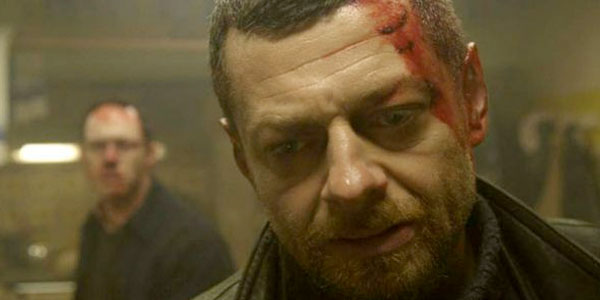
Making a successful horror-comedy is one of the hardest things to do in filmmaking. While the aesthetic sensibilities of horror and comedy are reasonably close, only a handful of films have ever achieved that rare feat of an audience simultaneously screaming in terror and laughing in mirth (or perhaps relief). For every Evil Dead, Shaun of the Dead or An American Werewolf in London, there are a hundred films like The Cottage - though one hopes this will be the one and only time that Serkis ventures into this territory. Written and directed by Paul Andrew Williams (who made the excellent London to Brighton), The Cottage stars Serkis and former League of Gentlemen member Reece Shearsmith as brothers David and Peter. At the beginning of the film, they have kidnapped Tracey (Jennifer Ellison), the daughter of crime boss Arnie (Steven Berkoff) and demanded a ransom. The characters end up at a disused farm house, which turns out to be the lair of a hideously deformed serial killer called The Farmer. While it comes with plenty of gore, The Cottage is neither funny nor scary enough to cut the mustard. Despite the presence of Shearsmith, it is much less a well-crafted black comedy than a lot of swearing, shouting and screaming intercut with bloody murder. Serkis, however, fails all the moreso by failing to make his character remotely emphatetic; while we pity Shearsmith, we couldn't care less about his brother. By depriving us from empathy, Serkis gives us nothing to root for, and the longer the film goes on the more mean-spirited and depressing both the story and his performance become.

1. Father Carlo - Blessed (2004)

Andy Serkis Blessed Horror filmmakers have been exploring the fear of children and pregnancy for decades. This trend of 'paedo-phobic' horror reached its peak in the 1960s and 1970s, with films like Village of the Damned, Rosemary's Baby, The Exorcist, The Omen and even Alien to some extent. Since then, horror films have struggled to bring anything new to the table on the subject of scary children. But few have failed quite so blatantly as Blessed, another film which thankfully few people have seen. Blessed is a British-Romanian co-production directed by Simon Fellows, who later helmed the Danny Dyer vehicle Malice in Wonderland. James Purefoy and Heather Graham play a couple who are desperately trying for a baby, but their hopes are dashed when Graham's character is diagnosed as being infertile. They are given hope by a new treatment available at the Spiritus Research Clinic, and the couple soon find themselves expecting twins. What follows is an increasingly stupid story involving priests, secret pacts and the Devil's DNA (I've lost you already). Blessed is essentially what you would get if you took Rosemary's Baby and stripped out all the subtext and atmosphere. It's a rubbish horror movie that's riddled with cliches, and unlike Drag Me To Hell it doesn't gain the audience's trust by poking fun at its own shortcomings. Serkis takes the cake, though, phoning in his performance as Father Carlo with a lack of commitment bordering on contempt for the material. He seems genuinely embarrassed to be there, barely making eye-contact with Graham in their scenes together. Serkis' best work has always come from total commitment to a role, making this a shoe-in for the worst performance of his career. Disagree with my choices? Drop me a comment below or visit Mumby at the Movies for more reviews.

Contributor
Contributor

Freelance copywriter, film buff, community radio presenter. Former host of The Movie Hour podcast (http://www.lionheartradio.com/ and click 'Interviews'), currently presenting on Phonic FM in Exeter (http://www.phonic.fm/). Other loves include theatre, music and test cricket.