Arrival Review: 10 Reasons It's An Instant Classic
Denis Villeneuve's first contact is heady, emotional, and one of the best films of the year.

Rating: ★★★★★
In the past few years, Autumn has become the prime place to release big budget sci-fi with starry casts and lofty ideas from proven auteurs with Oscar potential. Gravity kicked it off in 2013, followed by Interstellar and The Martian in 2014 and 2015, and while each of those was great in their own delightfully unique ways, 2016's entry is the best of the lot.
Arrival is, to put it simply, incredible. Having already put his own spin on the kidnapped child (Prisoner), cartel war (Sicario) and mind-f*ck doppelganger (Enemy) sub-genres, Denis Villeneuve has taken on well-worn area of first encounter movies and in the process delivered his best film to date, a tightly structure experience that leaves you at once stunned and desperate to watch it again straight away. Let's get the requisite Blade Runner 2 comment out of the way - it's in perfect hands.
There's so much to Arrival, so much brilliance on a story, direction and performance level. Here's ten reasons why Amy Adams' close encounter is a sci-fi classic for the ages.
10. It Takes Up A Unique Place In The Genre

There’s been stories about humanity’s first encounter with aliens as long as cinema, and the best films has worked as a representation of the attitudes of its contemporary society. In 2016, we’re a long way on from the care-free fascination of Close Encounters Of The Third Kind, but so too does the straight-out fear of Independence Day and War Of The World seems a little reductive by modern standards. As such, Arrival is an extension of the genre where the ultimate feeling is uncertainty; the sense of unknowing chokes the movie, both on a global and personal level.
There’s also a key comparison point to be made with Interstellar, autumn 2014’s idea-heavy sci-fi from Christopher Nolan. On a basic level, taking a look at lofty existential concepts from a singular, emotional position, the films have a lot in common, but Arrival’s execution is much more deftly handled.
Now don’t get me wrong, I liked Interstellar a lot, especially when it comes to the sheer scale of the undertaking, but from a story and character angle, Arrival is the superior film, with all of its plot strands and themes locking more tightly together.
9. It Has An Incredibly Strong Point Of View

Not to sound like a broken record (I think I've talked about this topic every week like clockwork), but 2016 has been a year dominated by post production meddling and shoddy editing. The main effect of this has been movies with no coherent pacing and a complete disregard of the three-act structure, but an underlying problem to all this has been confused perspective, with no clear relatable character and random, nonsensical flashbacks and dream sequences.
I'm unsublty referencing DC there not to kick the Snyderverse down any more, but because the erratic structure of Batman V Superman is a perfect comparison point for Arrival. It too enters into copious flashbacks and unclear dream sequences, often at random, but there's a clear and rather pertinent reason presented within the narrative for it to do so.
What could have been a global, multi-stranded narrative is told almost exclusively from the perspective of Louise, with every timeline divergence occurring within her psyche, which further allows the film to come together into an extremely personal finale.
8. Amy Adams Gives One Of Her Best Performances

Once Leonardo DiCaprio finally won his Oscar, many stated Amy Adams was the next in the "how the heck have they not won" queue, and based on her fall 2016 it won't be long until that really catches on. I've not seen Nocturnal Animals yet, although by all accounts it's a tense turn, but I can attest for Arrival.
In a film that could so easily have been dominated by the spectacle of its visuals and its ideas, she is the most captivating element. It's actually rather similar to DiCaprio's turn in Inception - on the face of it a conduit, yet every thread leads right back to them. She's a strong, intelligent presence, but there's a stress and torture underscoring an initial confidence, and an instant relatability through some heartbreaking early turns. As an actor Adams has always been skilled at conveying how massive highs come hand-in-hand with crushing lows, and here she's given a role that pushes that to the extreme.
The rest of the cast do excellent jobs with their limited roles, especially Jeremy Renner, who out of nowhere gets the film's most emotional scene, but it's all there to boost Louise's journey.
7. The Aliens Are Ingeniously Designed And Even Better Presented

The marketing for Arrival has really upped the mystery of the alien's design and purpose, letting the sight of a floating spheroid do most of the talking. This makes for a nice end-of-first-act reveal, one that could have easily been ruined by overzealous trailer editors. This isn't just refreshing compared to big blockbusters, however, but also further allows the movie to put the onus on the discovery of the extra-terrestrials.
So while they are (without spoilers) pretty ingeniously designed, completely unknown with a wholly unique biology, yet sharing some essential facets of lifeforms from Earth, they're not just cool creations that defy expectations; the exploration of them their culture - is threaded through the movie, the specifics of their entire being slowly expanding alongside our understanding of their primary purpose.
Their communication, their movement, their empathy, which feels so strange, but over the film it becomes subtly more accessible.heir primary purpose. It's
6. The Tightness Of The Script

I've not seen a movie with a script as tight as Arrival in a very long time. Every moment is essential, effective in its own right and building towards the finale in the most subtle ways. Throughout the first act there were countless little observations - clues, thematic points, or confusion over presentation - that by the end all looped back to be essential building blocks for later narrative turns.
The basic plot comes straight from the source short story, Story Of Your Life, but Villeneuve and screenwriter Eric Heisserer have really elevated it, creating a movie that can't be watched in the same way after first viewing. It's not obvious setup either, and even the bits the more astute viewer may pick up on early are still vague enough it's frankly impossible to piece together where we're heading.
That's incredibly clever writing, and the kind that shows great faith in the audience.
5. The Sound Design Really Accentuates The Rest Of The Film
The sound categories at the Oscars are usually the driest (read: hardest to predict) of the lot, but based on the past few months there’s some really strong contenders. Even its biggest detractors found it hard to take down Blair Witch’s oppressive, picture-painting audio design, although in terms of sheer overall effectiveness the king has to be Arrival.
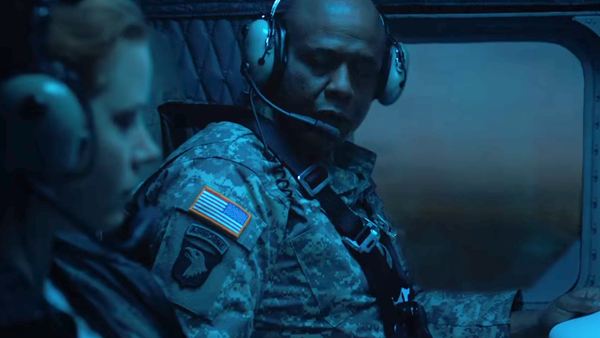
It's not just highly evocative, further immersing us a world on the brink and making the aliens believable - the effects of that are suitably strange - but keeps pushing us back to Louise's perspective. Scenes in a military helicopter or the alien ship are dominated by background chatter until Adams puts on earphones or removes her hazmat suit. The result is a rich and diverse sound-scape that is as spectacular and alien as it is deeply personal.
4. The Emotion Within A Unique Story

Sci-fi is at its best when its telling a story that simply couldn’t be done without its out-there elements. While of course there's merit to be had in taking a classic genre and transplanting it to the far-flung future or deep space, the movies that really resonate are those where the character arcs and the narrative logic are completely relatable.
Looking at the recent rise of smart sci-fi, we’ve seen examples that go both ways – Gravity’s the story could work in any remote situation, making the film purely about the experience, while Interstellar needs wormholes, time dilation and the power of love to function coherently – and Arrival is just a perfect example of how it can be done right.
You couldn't show Louise's journey without the hovering aliens and life-changing linguistics. But equally the more corporeal elements wouldn't be as compelling without her familiar grounding.
3. The Cinematography Is Beautiful (And Has Real Purpose)

Cinematography master Roger Deakins didn’t reunite with Villeneuve for Arrival (the pair worked together on Prisoners and Sicario, and will reunite for Blade Runner 2), with the younger Bradford Young (who’s most prominent work is on Selma and A Most Violent Year) taking control of the visuals. And while there’s not quite the astounding beauty-within-the-unexpected you get with Deakins, he does an impeccable job of conveying the wonder at the alien’s arrival.
There’s a striking majesty to the scenes showing the worldwide reaction to the vistors, which is juxtaposed perfectly with the careful placement of Amy Adams within group shots, once again keeping the movie tightly on her. The standout scene from a construction point of view is the first entry to the ship. Through some undefined alien tech, the saucer is able to create its own gravity, so as they ascend the crew pull an Inception and flip ninety degrees. It’s mind-melting, and Young presents it with dizzying simplicity.
2. The Representation Of Linguistics Is Astoundingly Complex

What makes Arrival so fresh in the first contact genre is its approach to the method of contacting aliens. Safe to say, Villeneuve's made Close Encounters' Simon Says looks painfully naive.
Amy Adams plays a linguistics professor who becomes America's chief alien translator, trying to decipher their strange glyphs and grunts to ascertain their purpose. The first part of the movie is breaking down and reassembling the understanding of the question "What is your purpose on Earth?"
This isn't just a plot element to enter the story from a new angle, however, but an essential part of the film's discussion: How much is language a cultural construct and how much does it actually affect the way we think? There's a haunting suggestion here we see in our own world with how different languages approach things like colour, pushed to the extreme, and it's incredibly thought-provoking.
1. It’s Not Just About Linguistics Though

I have a real thing for a movie that’s actually about something more than it first sees. Her seemed to be a commentary on where our obsession with technology could take us, yet unfolded to be an affectionate, offbeat love story, while Birdman bombed through it’s superhero commentary to flip onto a pondering on ego.
Arrival is, to a degree, the same; while the film’s exploration of linguistics provides essential narrative background, it’s not what the movie’s about. This becomes apparent when the process of … learning how to communicate with the extra-terrestrials is covered mostly in a single, multi-month spanning montage; the mechanics of the two species communication isn’t what’s important, it’s the journey it leads to.
And the destination of that journey is a musing on life. We get a nice undercurrent about frayed political states, but like several recent standout movies – Green Room and Bone Tomahawk specifically – Arrival is about the insurmountable fear of the inevitability of life, but injects a sense of optimism in there, an appreciation of the joy inherent in the simple nature of life.