Before The Dark Knight Rises: 10 Baffling Decisions By Batman Directors
Ahead of Nolan's trilogy-ending epic, we look back at some of the most astonishingly ill-conceived decisions made by Batman movie directors.
 As if we needed reminding, it hasn't all been plain sailing for the Batman since Tim Burton launched the first modern Bat-flick in 1989 (Adam West's spin-off doesn't count here), and in truth the franchise has been openly abused from the inside thanks to some seriously baffling decisions made by their directors. Since that first film, fans have traded opinions on just what the worst parts of the Batman film canon has been, and somewhat predictably the answers to the three main qestions - worst film, worst director and worst Batman - are all inspired by the overly-camp attrocity that was Batman & Robin. But that doesn't mean Joel Schumacher is the only director to have done wrong by Batman, with some head-scratching moments coming from both Tim Burton and Chris Nolan (the latter including making Bane's voice apparently impenetrable to a good portion of the English-speaking world). They might not be quite as baffling as almost every creative decision behind Batman & Robin (though actually, there are So Tim Burton, Joel Schumacher and even Chris Nolan hang your heads in shame... Well, maybe not Nolan so much, as these things are all relative, but the other two, definitely.
1. The Joker's Death (Batman)
 Fans of comic books will know that the practice of killing super-villains or superheroes isn't ever as final as it might seem, especially when it's one of the biggest properties, because the concept of linear continuity isn't particularly important to the medium. Story-arcs are better considered as comic book vignettes, that roughly fit together in a tapestry, but that is obviously a more difficult concept to translate across to film-making, unless the film-makers are particularly confident of establishing an ongoing franchise. But then, why would that have not occurred to Tim Burton and the script-writers of Batman '89 when it came to deciding the ultimate fate of Batman's chief antagonist the Joker? It all boils down to the preference of continuity over closure, and rather unfortunately, the latter issue won, with Burton's Joker meeting a grizzly end well before he should have, and robbing fans of the opportunity to see him again before Nolan's reboot. Why didn't he just capture him and send him for a stretch in Arkham? Of course, we did almost get to see Joker return, thanks to Scarecrow's fear gas, which would have resurrected the villain as a hallucination in the ultimately scrapped Batman Triumpant, but to be honest, after Batman & Robin, I'm glad it never came to that. Click next to view our next abominable choice...
2. Vicki Vale in the Batcave (Batman)
 For a discreet character whose duel existence relies upon the preservation of his secret identity, prior to Nolan Batman was pretty blase about keeping a lid on his biggest secret. Not only did Bruce Wayne encourage the use of a Bat-symbol that shone indiscreetly into Wayne Manor, alerting everyone to Batman's presence on the estate, and presumably hoping they'd just assume he just happened to be a guest of the local millionaire with a tragic backstory and ample room for a cave of some sort below his house, his butler also allowed a journalist into the Batcave. Fair enough she was engaged in a physical relationship with Mr Wayne at the time, but if that was the only requirement to gain civilian access to the base, you'd have thought one of Gotham's various super-villains (especially the ones with the higher IQs) would have considered some sort of entrapment plan. Perhaps involving the shape-shifting Clayface or something... Why Alfred thought it was appropriate to let Vale into the Batcave will probably never be known, considering his master's infamously fickle affections (it was never going to be a long relationship) and the fact that Vale was an investigative journalist who came to Gotham with the express intention to investigate Batman. Shoddy story-telling to say the least, especially since by Batman Returns she has disappeared back to her own life, safe in the knowledge that she knows the biggest secret Gotham has ever seen, and will definitely never be hunted down and tortured by one of Batman's various enemies...
3. Casting Katie Holmes (Batman Begins)
 What could go wrong with casting a beautiful young actress fresh out of teen sensation Dawson's Creek with eye-catching credits such as Muppets From Space and Teaching Miss Tingle as hugely important love interest Rachel Dawes? All sardony aside, Nolan's casting picks are usually spot on, with a mix of highest level industry talent and fan and critic-pleasing revivalist cameos, but Holmes was a disaster. Inciting fan rage for her stolid performance as Dawes, the actress who has gone on to some reasonable performance in good films and some downright flops was made to look all the worse thanks to her proximity to Bale, Murphy, Neeson and co. Looking back now, the performance was dull and unremarkable, lacking the emotional balance for Bale's Bruce Wayne or the presence to carry the human responsibilities in perilous scenes when Wayne is behind the cowl. She just didn't fit, and fan clamour apparently played a massive part in her not returning for The Dark Knight despite reports that she pulled out herself due to scheduling conflicts. Not only that, Nolan also cruelly under-estimated the influence of Holmes' now ex-husband Tom Cruise, who reportedly also pressurised her into pulling out of The Dark Knight to the collected relief of fans everywhere and Chris Nolan himself. And people say Cruise is bad.
4. Not Bringing Back Catwoman
 In contrast to the fate of the Joker in Batman 1989, Tim Burton's follow-up left an open-ended finale for Catwoman, implying at first that she kills herself in order to take out Max Shreck, but then seemingly flipping that end on its head with the tantalising silhouette of the anti-heroine right at the end of the film. So presumably, we were going to see more of this charismatic temptress - in sequels perhaps, when we thought she'd never return, right? Well, no. Catwoman was just left to disappear into the ether, despite Schumacher's films carrying on from where Burton left off, in a snub of gigantic proportions. We were left to ponder Catwoman's fate - had she simply decided to revert back to her life as a secretary, never to take to the streets at night ever again, or had Batman simply thrown her in kitty jail between movies? Whatever the reasoning - probably over-population of villains with two in Forever and three in Batman & Robin - the decision not to bring Catwoman back before the reboot was a glaring one - even if I'm not wholly taken on the idea of her appearing in The Dark Knight Rises...
5. Making Two Face The Joker #2 (Batman Forever)
 Super-villains require certain identifying characteristics - they are fundamentally supposed to be super-natural, or exaggerated in other terms, but they are also, rather crucially supposed to be wholly individual. If any new villain appears who is too obviously a reprint of an older classic, fans tend to be somewhat unforgiving - after all, what is the point of copying if the objective is to create an unforgettable character? Unfortunately for Joel Schumacher's Batman Forever - which was otherwise quite enjoyable (particularly the cruelly underrated Riddler performance offered by Jim Carrey) - neither the director nor Tommy Lee Jones seemed to understand the importance of that individuality, and the version of Two Face that made it onto the screen was little more than a Joker variant in a funny suit. Crucial for Two Face's character development is the idea that he is completely at the mercy of his coin-flipping, and cannot make any decisions counter to those chosen by the coin. That is his part of his idiosyncracy, and the other is his split personality - one side reasonable, the other insane, but Jones' Two Face ignored both of those key foundations completely. In Batman Forever, Two Face is an irredeemable lunatic, wholly insane and wholly ridiculous (in the same way Batman 89's Joker was), and even worse, at one point he flips his coin until it brings the result he wants. Way to completely misunderstand the character there.
6. The Bat Nipples (Batman & Robin)
 I could just as easily have suggested the Bat Credit Card in this position, but there are easy targets, and then there are Bat Credit Cards... So instead, I'm looking at something as equally ridiculed, which was symptomatic of Joel Schumacher's complete lack of creative restraint, coupled with his horrifying sense of humour that almost completely ruined Mr Freeze (more of which soon), and which slapped some nipples on the Batman suit. Because it isn't just that the sight of the nipples on the suit was downright ludicrous (what purpose were they to serve exactly?), it's that Schumacher took a cool, sleek and functional batsuit design used in the first two movies (with admittedly very little neck movement), and turned it first into a shiny, showy but still reasonably cool new version in Forever, and then into a ridiculous silver-embellished monstrosity in Batman & Robin. Why would any caped crusader taken with hiding in the shadows to inspire fear among his enemies have big silver ornamental pieces on his uniform exactly? And equally, why the hell would Schumacher want to draw so much attention to his cod-piece area? Without making crude accusations, at the very least the preoccupation with Batman's vulnerable human parts (his nipples and genitals) would made him seem a fallible opponent. And that's just plain wrong for the whole Batman image.
7. The Statue of Liberty (Batman Forever)
 Now I can understand the presence of the massive gothic statues in Gotham, because they're an iconic part of the architecture, but what the hell was the Statue of Liberty doing in Batman Forever exactly? What the film-makers were trying to attempt is up for debate, but presumably, as fans will no doubt point out in the comments, it was actually Lady Gotham in the film, so there is actually no link to the New York landmark other than a similar look (and no geographical proximity since Schumacher's Batman & Robin suggests Gotham is close to Maine). But that isn't strictly true, because adding "Gotham" to the statue's head-dress is no way to convince that she is in fact Lady Gotham. Because Lady Gotham holds a sword and shield, and not a torch and book, as she clearly does in Batman Forever (certainly in terms of the book, and what you can see of the torch it is identical to Liberty's). Crucially, the presence of the Statue of Liberty (or something looking so much like her) fundamentally undermines the importance of Gotham as an identity all of its own (regardless of the fact that the DC universe is different to our own). Especially since the similarity to the Statue of Liberty is just too strong, and the intention in the film too unclear to not inspire a million fans asking the exact same question that opened this page.
8. Destroying Mr Freeze (Batman & Robin)
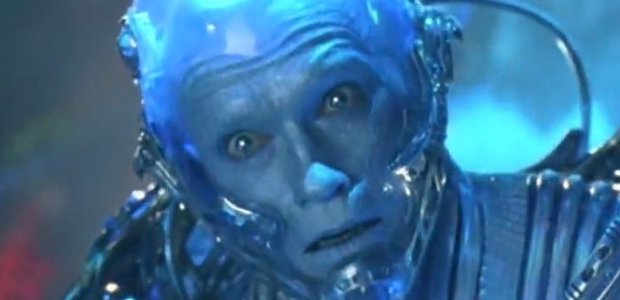 Let's be honest, we could all devote tens of thousands of words to running through the problems with the film that almost killed Batman, before Chris Nolan's revision revitalised the property, but all it boils down to is that Batman & Robin was a fundamentally broken film, lacking discipline, finesse and intellect to a frankly shocking degree. One thing that fans will particularly never forgive Schumacher for is the treatment of Mr Freeze, a previously popular member of the Rogue's Gallery who for some reason was portrayed by walking muscle machine Arnold Schwarzenegger, as opposed to a thinner, more Bat-universe appropriate actor who would have brought brains, rather than just brawn to the role. It wasn't just that Arnie was miscast, it was also the horrendous script, which clearly thought it was hilarious to shoe-horn in as many cringe-worthy puns as possible, turning a genius-level scientist with a tragic back-story into a completely unwelcome fool with sparkly silver skin that in no way looked like ice. And because we're all gluttons for punishment, here are those awful puns: http://youtu.be/SRH-Ywpz1_I Schumacher did an equally painful job on Bane, who should have been one of Batman's greatest foes, but who was relegated to a gruesome, mindless brute with big big green veiny muscles. Still not as rubbish as the transformation of Mr Freeze though.
9. Schumacher's Day-Glo Gotham Gangs (Batman Forever)
 Gotham's crime-rate is notoriously high, extending beyond the Super-villains and their collected goon-squads to the street gangs of the city who presumably represent enough of a threat to make night patrols by the Dark Knight and his super-hero companions a necessity. But Schumacher's Batman Forever painted an image of rampaging gangs with a penchant for day-glo face and body paint, closer to bad-tempered circus clowns than genuinely menacing hoodlums. But it's not just that the characters look terrible and are badly acted, it's that they represent something that was fundamentally broken with the art direction of Batman Forever. Because Schumacher took all of the artful work done to build Burton's Bat-universe, which typically of Burton looked great (even now there's no doubting his imagination, just his execution), and pushed it through a God-awful neon filter as some sort of statement. There's a theory that Schumacher was in some way motivated by a desire to preserve some of the cool Gothic tone of Burton's pair of films, but that he fundamentally misjudged Burton's vision, replacing artfully crafted environments with provocatively bad CGI, and that certain unquantifiable gothic essence with dark alleyways, expendable goons and luminous paint. Judging by Schumacher's subsequent artistic decisions (like the Batman & Robin costumes), he was probably just out of his creative depth.
10. Nolan's Scarecrow Snub (The Dark Knight)
 As good as Nolan's Bat-trilogy has been (so far), the films haven't been unblemished by any means, and the second Nolan mistake to make this list concerns the director's treatment of Cillian Murphy's Scarecrow in The Dark Knight. Despite a great finale in Batman Begins (aside from the taser to the face), and subsequently being announced as still at large, by the time Batman Begins comes around, Jonathan Crane has become little more than a drug peddlar almost thwarted by a group of Batman impostors, before ultimately being captured by the Dark Knight himself. Because of the presence of the bigger draw villain - the Joker - Scarecrow is seemingly relegated from super-villain status, with the final indignity of being left tied together with the other criminals Batman takes down. Where is the villain who escaped not once but twice in Batman Begins? Hopefully, The Dark Knight Rises will give Scarecrow a more fitting end (especially with the likely return of former employee Ra's Al Ghul). And then of course there's the small matter of the five murders pinned on Batman at the end of The Dark Knight... Five? Damn you, Nolan, that one's been bugging me for the best part of four years now! Baffling isn't the word. Let's hope that there won't be more decisions to add to this list when The Dark Knight Rises hits cinemas later this month.
