David Lynch’s 22 Strangest ‘Otherworld’ Characters

3. The Rabbits: Inland Empire/Rabbits

€˜I am going to find out one day.€™ €˜When will you tell it?€™ There are many bizarre and surreal characters on this list, but none come close to Lynch€™s infamous Rabbits. First appearing in an online €˜sitcom€™ of the same name, Lynch ultimately re-employed them as otherworldly figures in the complex shape shifting narratives of Inland Empire. The sitcom, comprised of eight episodes, takes place entirely in one living room inhabited by three humanoid rabbits: Jack (voiced by Scott Coffey), Jane (voiced by Laura Elena Harring) and Suzie (voiced by Naomi Watts). Occasionally Rebekah Del Rio sings, taking Harring€™s place as Jane. The Rabbits converse in disjointed abstract phrases, often referring to a mysterious past and future that are never revealed: €˜Were you blonde?€™; €˜I am going to find out one day€™; €˜I wonder who I will be€™. The entire atmosphere, soundtracked by Lynch at his dark ambient best, is eerie, enhanced by the fact that every time a character refers to time (€˜what time is it?€™) the soundtrack is flooded with canned audience laughter. The €˜audience€™ also applauds as each character enters the room. There are many creepy one-off occurrences, including knocks and screams from the unseen space beyond the room€™s only door. In Inland Empire, these sequences are interspersed with elements of the film€™s actual story €“ as if The Rabbits are somehow connected to the predicament of Nikki/Sue. Their €˜jokes€™ about time take on greater significance when placed in the context of the film€™s disconnected narrative. It is as if The Rabbits €“ whose presence naturally evokes the surreal €˜rabbit hole€™ narratives of Alice In Wonderland and Donnie Darko €“ are mocking the characters€™ and audience€™s attempts to locate temporal/spatial consistency in the film. Genuinely creepy.

2. The Lady In The Radiator: Eraserhead

€˜In Heaven, everything is fine€€™ The top two entries on the list are from opposite sides of Lynch€™s morality spectrum, with Eraserhead€™s The Lady In The Radiator (Laurel Near) providing the ultimate example of wondrous, unexplainable angelic beauty in his work. Henry, the film€™s protagonist, is overwhelmed by the pressures of domestic life €“ fatherhood, marriage, intrusive in-laws, forbidden sexual urges for his neighbour €“ when he begins to drift into a dreamlike state while staring at the radiator in his room. On a tiny platform jutting out from the radiator stands a lady in a white dress with bouffant blonde hair and alarmingly bloated cheeks. She smiles, clasps her hands and dances from side-to-side. She provides an escape from the realities of the world, and Henry is instantly smitten. His love for her only increases as, in later visions, she is depicted stamping on sperm-like creatures that remind him of his troublesome child. She is the ultimate beacon of happiness and freedom; a release from the pressures of fatherhood and marriage that were somewhat reflective of Lynch€™s biographical life at the time. She is the archetype of the angels of Lynch€™s films (Glinda, Merrick€™s Mother, The Grandmother, Laura€™s Guardian Angel€), and Henry ultimately gains his gloriously happy ending when he submits to her charms, holds her close and disappears into Lynch€™s blissful lights. Yet this is not an ending without its ambiguities: in order to be with the Lady of his dreams, Henry has been forced to murder his child.

1. Killer BOB: Twin Peaks/Fire Walk With Me
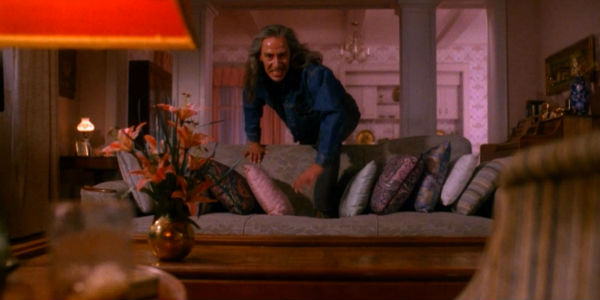
€˜Maybe that€™s all BOB is. The evil that men do. Maybe it doesn€™t matter what we call it.€™ The top entry on this list should be of little surprise. If The Lady In The Radiator is Lynch€™s ultimate angel, then Twin Peaks€™ Killer BOB (Frank Silva) is his most evil and demonic being. Noteworthy for being one of television€™s most horrifying villains, BOB is without a doubt the most ingenious otherworldly character created by Lynch. It is impossible to erase mental images of him crawling in through Laura Palmer€™s bedroom window in Fire Walk With Me, screaming and laughing at Ronette Pulaski in the second series€™ first episode, killing Maddy Ferguson (Sheryl Lee) in Twin Peaks€™ most climactic scene or, indeed, climbing slowly over the Palmers€™ sofa straight towards the camera lens in one of the most terrifying sequences in television history€ The story of BOB€™s accidental creation is well known. The character, and Frank Silva, entered into the Twin Peaks narrative when Silva inadvertently got in the way of several shots Lynch was filming at the Palmers€™ house. But what is more interesting is the question that is posed on a number of occasions by Twin Peaks€™ residents: is BOB real? Is there really a creature out there that inhabits the bodies of €˜real€™ people and forces them to do evil deeds? Or is he merely the personification of evil, a schizophrenic €˜other side€™ of those that do wrong? Given the prominence of actual otherworld characters in Twin Peaks and Lynch€™s work more generally, the answer seems clear. BOB is real. As Phillip Gerard reminds Agent Cooper, €˜He is BOB, eager for fun. He wears a smile. Everybody run.€™

In this post: 
David Lynch
 
Posted On: 
Contributor
Contributor

Articles published under the WhatCulture name denote collective efforts of a number of our writers, both past and present.