Edgar Wright: The Definitive Guide To Homages, Influences And References
 Actor Paddy Considine who also collaborates with Wright on The Worlds End played the moustachioed Detective Sergeant in Hot Fuzz and managed to sneak in a couple of references to Robert De Niro in the course of the film without the director even knowing about it. Apparently, the Dead Mans Shoes actor is well-known for his De Niro impression, something you can see for yourself at two points in the film. He firstly adopts a De Niro-esque face during Angels rant about Lesley Tillers death after the line Am I going completely mad and then again when he asks Frank to give himself up in the pub.
 When a dejected Nicholas is walking through the centre of Sandford after his theories about Simon Skinner being a singular killer fail, he walks through a flock of pigeons who all fly away in his wake. This is a reference to John Woo, who employs the technique in Face/Off and Mission Impossible II.
 The NWAs reveal as a group of murderers comes from Agatha Christies twist that the murderer doesnt have to be just one person. It was later adapted to a film in 1974. However, the coolest reference on this slide and indeed the whole list (and thats saying a lot for Wright films) is when Nicholas is creeping toward the NWAs clandestine castle meeting and Joyce Cooper announces that the pregnant Janet Barker who was spoken about at the first NWA meeting in the films first act has given birth to her twins. They are called Roger and Martin, a clear homage to Lethal Weapons Roger Murtagh and Martin Riggs.
 As well as taking inspiration from Roger Ebert, Wrights shooting of Dannys long drive out of Sandford has multiple shots adapted from other films. Firstly, the long drive is mirrored by Maxs in the first Mad Max, and when Danny pops the boot the shot is bathed in red light, highlighting a similar scene in Goodfellas which features similar light as Joe Pesci, Ray Liotta and Robert De Niros mobsters dispose of a body. Similarly, the in-the-boot-looking-out-shot is reminiscent of a signature shot of Quentin Tarantinos, which was also used in Kill Bill and Pulp Fiction. It the goes to mimic another Tarantino film this time Reservoir Dogs by tranisitioning from the boot to the perspective of the person looking into it, with Danny taking the place of Mr. White. Its also interesting to note that in both films its a cop in boot Marvin Nash and Nicholas Angel and they are positioned in the exact same way.
 As befitting its status as a Police procedural absolutely stacked with inspirations from everywhere, Hot Fuzz is also influenced by the gritty world of cop dramas and film noir for example, one of Angels many arguments with the Andes results in the line youre a detective, detect! being yelled at the moustachioed duo. This is a reference to John Sturges 1974 crime drama McQ, starring John Wayne the Duke uses the exact same line during a bust-up in his office. However, a more recognisable reference would be that of Roman Polanskis Chinatown, occurring when Angel has been driven out of Sandford by Danny to save his life. When he offers to bring back the blue fury of the Metropolitan Police coincidentally Blue Fury was debated titles for Hot Fuzz Danny responds with a twist on the line Joe Mantell delvers to Jack Nicholson after the death of Faye Dunaways Evelyn forget it Nicholas, its Sandford, highlighting the futility of fighting something much larger than you.
 The strait-laced Angels transformation into a bullet-spitting supercop is foreshadowed by the sign foe Heston Services when Angel is driving Dannys car to the service station this is a reference to known gun-nut Charlton Heston and symbolises his transformation from staunch pacifist to walking armory. The spray paint he picks up in the services as part of his tooling-up strategy are labelled Zito Colour, a homage to Joseph Zito, the director of 1985s Chuck Norris preposterousness vehicle Invasion USA.
 There are two references to the It's Man from the opening sequence of Monty Python's Flying Circus, as two characters are interrupted just after saying It's ... at different moments in the movie. Kenneth Cranham s Reaper gets one when he encounters Angel the cop revs his car up with Mad Max-esque glee before plowing into the farmers vehicle, disabling the walkie talkie before he get beyond his first word. Frank Butterman gets to enact one later, interrupting Tom Weaver with his impression of Tuco from The Good, The Bad and The Ugly impersonation and proving that Jim Broadbent can be awesome with the best of them
 As Angel transforms in the Heston Services and when he later arms himself in the Sandford Police Station the music playing in the background is entitled Avenging Angel it was composed by director Robert Rodriguez as a personal favour to Wright. Interestingly, he didnt see any of the arming-up scenes even while he composed the piece.
 At the time when Hot Fuzz came out, The Departed had won the Best Picture Oscar the year before, giving Martin Scorcese the Oscar he deserved for at three decades. It was wildly popular and featured a police force. Wright got a reference to this modern great in there, albeit in a subtle way. The reference point is when Billy Costigan walks past Colin Sullivans window-fronted office while the villain is oblivious to him, If you swap out Nic Angel for Leo Di Caprio and Jim Broadbent for Matt Damon, you get the same effect, adding a cool in-joke to this already-awesome scene. Angel and Franks dynamic is also informed by classic neo-noirs LA Confidential (Dudley Smith) and Magnum Force (Neil Briggs), where the seemingly benign good-hearted guy turns out to be a cold hearted villain in one of Eberts clichés.
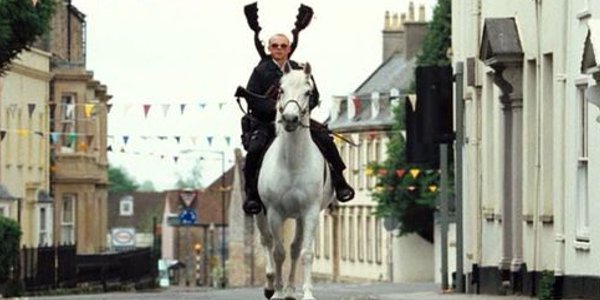 The scene when Angel comes into Sandford on horseback is also chock-full of Western references. Not only does he ask the kids whether they want to do something useful a line taken from Clint Eastwoods Man With No Name in1964 classic A Fistful Of Dollars he also chews a toothpick like Clint in the Outlaw Josey Wales and his strut into town on horseback punctuated by shocked villager faces is reminiscent of 1952s High Noon. The Western reference trifecta is completed when Jim Broadbent says Angel in the same way Eli Wallachs Tuco refers to Lee Van Cleefs Angel Eyes in The Good, The Bad and The Ugly, leading us into some shootout-like tension before all hell well and truly breaks loose.
 The shootout between Danny, Nicholas and the couple who were speaking to Reverend Shooter employs similar technical flourishes to Tony Scotts Man On Fire. Namely, when the two sides trade shots the action is often sped up or slowed down this is made possible by a hand-cranked camera, which Scott also used with aplomb. When Angel is shot by the aptly-named Reverend Shooter who uses slide-out pistols in a homage Martin Scorceses Taxi Driver Danny fears for the worst before running over to see his friend has been saved by the stab vest he spoke about earlier. This is a direct nod to the mithril coat from Lord of the Rings: The Fellowship of the Ring when Frodo is saved from being gored by a cave troll by his armour. In fact, the discovery that the armour has saved the respective character is played in the same in both movies. While its usually worn as an undergarment, it becomes visible on the chest and everyone looks at it in relief and wonderment. In this scene, the Reverend also calls Nicholas Grasshopper I wont say how, its a family list the nickname for Kwai Chang Caine in popular TV series Kung Fu.