What Does The Ending Of Nightcrawler Really Mean?

Did Lou Bloom earn enough to buy a lottery ticket?
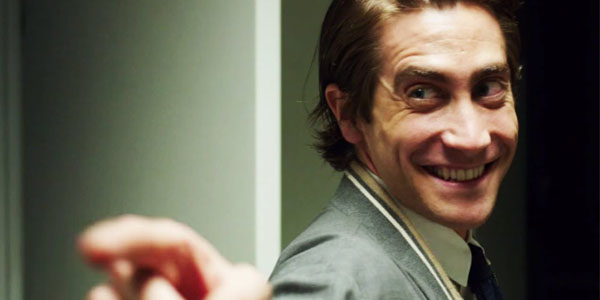
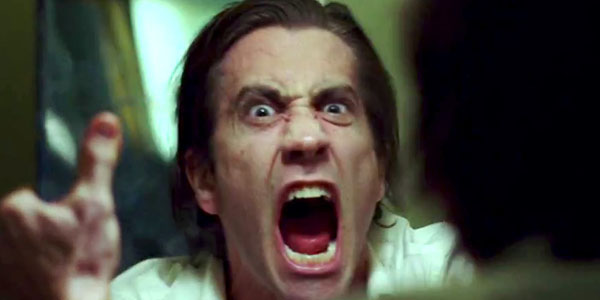
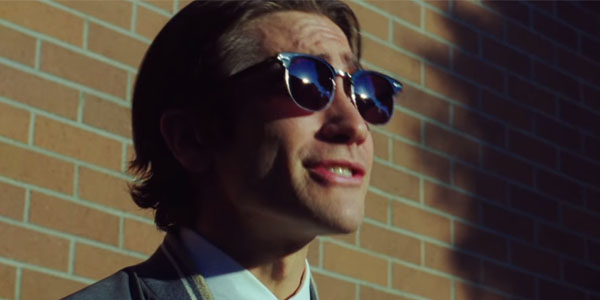
This week sees the release of Nightcrawler, Jake Gyllenhaal's latest that sees him even further show his impressive range as an actor. First unveiled at the Toronto International Film Festival back in September, the film has been riding a massive wave of hype, with many 5 star reviews labelling it one of the best films of the year. Now it's in cinemas, it appears the critical praise was indeed justified; Nightcrawler is a tense, unrelenting movie that, like the horrible accidents our anti-hero makes a living from filming, is both inherently captivating and eye-coveringly repulsive. Lou Bloom, Gyllenhaal's most psychotic role yet, is an incredibly captivating character, clear from the first scene a dangerous sociopath, and will no doubt in time stand shoulder to shoulder with the likes of Travis Bickle and Patrick Bateman. First time director Dan Gilroy may not have the most prominent track record, with his most recent scripts being for The Bourne Legacy and Real Steel, but he's managed to deliver something incredibly competent that offers plenty to chew over. Which is exactly what we're going to be doing today, looking at the themes integral to the film with an eye towards what the ending really means. Naturally, this analysis is going to cover all aspects of the movie, so there's a spoiler warning present throughout.

What Exactly Happens?

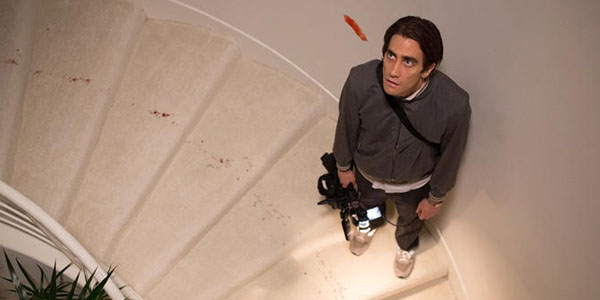
Nightcrawler sees Jack Gyllenhaal become Lou Bloom, a Patricia Highsmith-esque sociopath who ekes a living from petty theft. Discovering the world of stringers, ambulance-chasing journalists who film horrific accidents and hawk their wares to the highest bidding news channel, he crafts a new career direction. Over time, recording striking images of breaking brutal crimes, Lou builds himself a reputation, getting an assistant, and manipulating his way into favour with news controller Nina. As things progress, Lou begins to push the boundaries of journalistic ethics more and more, messing with crime scenes in a bid to get the best shot possible. Soon the moral ambiguity is removed when he, beating the police to a crime in progress, films a horrifying triple murder with no thought for the victims. Hiding information from the police, he endeavours to solve the murder himself, setting up a situation where he can get some career-making footage. This plan is pulled off without a hitch, with Lou getting footage of a deadly shootout and subsequent car chase, as well as orchestrating the death of his assistant, now beginning to challenge his authority. Lying his way out of police suspicion, he is now a superstar name at the news station. The film ends with Lou expanding his company, Video News, bringing in a pair of kitted out vans, a group of interns and a previously unfounded air of absolute legitimacy. The ending is one of those minor gut-punches where a detestable character not only completely gets away with his crimes, but becomes a star in the process (no wonder the film's getting compared to Taxi Driver). But what exactly is the film saying? Time for us to find out.

The News Is Amoral

Let's get the basics out of the way first. Obviously in dealing with crime journalism and the ethics involved in glorifying such material Nightcrawler makes some points about the modern role news plays in our lives and its general legitimacy. It's not as probing as some of its other points, but any dissection of the film would be incomplete without looking at it. We all know the news is as much a ratings game as any other area of television, over the past few decades leading to increased sensationalisation and a misrepresentation of facts. Nightcrawler takes this all a step further, having it slowly unmasked to the point where any justification is so warped it's invalid. Throughout the film Nina develops an increasing lack of shyness around her lack of journalistic ethics. She initially tries to deter Lou's suggestions of chasing gore, but come the end she's not only hyping up a spate of killings in a bid to boost ratings and refusing help to the police, but is actually hiding the true story, refusing to report the drug angle to the thriple-murder. It's something lying just under the surface of this ambulance-chasing style news coverage that only gets fully embraced when someone as morally skewed as Lou steps into the fray.

Lou Never Sleeps

By night Lou stalks the streets of L.A. looking for potential video footage. By day he, by his own admission, spends his time on the internet, learning whatever can help him in his journey. Between all that, there's little time for him to sleep, something we never actually see him do in the film. Living in a studio apartment with seemingly no space for a bed and busy at both day and night, there's a real purpose in showing him never hitting the hay, helping further his unfaltering drive and the unnerving nature of his character. It's one of the more abstract elements of a film that is for the most part pretty naturalistic. This doesn't add much to the film as whole by itself, but plays into some of the things we'll be looking at in a minute. Due to the shooting schedule (and no doubt a bit of effort put into characterisation) Gyllenhaal himself didn't sleep much during the shooting of the film, helping further Lou's gaunt look (which was primarily achieved by losing a good amount of weight).

Looking Real

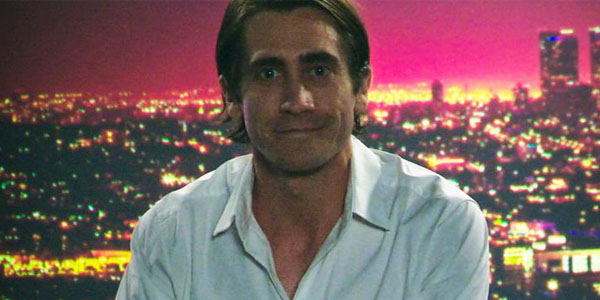
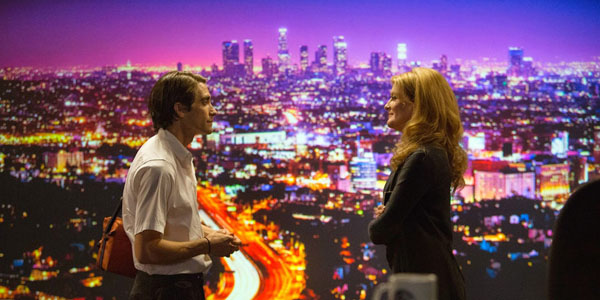
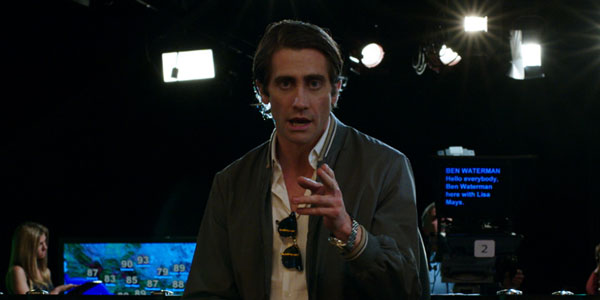
When the film opens with shots of L.A. (Lou would approve of the wide lens) there's something almost unreal about it, with what is almost an out-of-place heat haze making the whole city look like a mirage. Thus kicks off one of the film's central themes; the perception of reality. It gets a proper callout when Lou, stood in news studio, pauses suddenly, shocked at how fake-looking the background skyline on the news looks up close. The whole news industry, feeding us a version of our reality that isn't quite our own, ties into this, but beyond that it's emblematic of Lou, with him presenting the illusion of an ordinary man, spouting realistic ideals and putting across a false sheen of professionalism. The only ones who ever see beyond that exterior are those who explicitly challenge the image he's creating; Joe Loder mocks his lack of professional equipment and ends up in an accident of Lou's orchestration; Nina discovers his dark aspirations when she tries to restrict him; although Rick believe he was killed because he challenged Lou, the fact he claimed his boss didn't understand people will have played a part. By the end, when delivering the motivational speech to his new interns Lou looks 100% genuine, despite spouting the same empty ideals he did to the late Rick. Nothing has actually changed about him, aside from that his mirage of being "real" is harder to break.

The Usual Suspects

There's a fair few movies that serve as touchstones for Nightcrawler. Lou Bloom is a more world-aware (and therefore more unnerving) version of Taxi Driver's Travis Bickle, while the stylish structure, bright lights and music choices have led to various comparisons to Drive. But the film that Nightcrawler directly references in its final moments is The Usual Suspects (so naturally spoilers for that film abound in the section). Think about how Nightcrawler's final act run-in with the police goes. Lou is held and questioned by a police officer who goes to great pains to make themselves seem physically imposing, to whom he spins an elaborate fake story that manages to name-check all the true elements. He then is freed, walking away from the station removing the façade of an honest. It's similar to the ending of Bryan Singer's crime masterpiece in basic idea, but in execution it's almost identical. The framing (and we know that's important as he explicitly states it) of Lou leaving the prison exactly copies the Keyser Söze reveal, with the focus on the watch recalling one of the more subtle clues about the identity of The Usual Suspect's crime lord. These parallels are far from incidental, turning the films into mirrors of each other. In The Usual Suspects, leaving the police station is a massive rug-pull, throwing the whole movie into question. In Nightcrawler, having known the score with Lou from the off (the first scene shows him murder a guy after all), we know that just because he's crafted this massive hoax doesn't make him anything more than a disturbed person. It prompts a reconsideration of the projected image of Söze as the prince of darkness, extrapolating to the general idea of things looking, rather than being, real.

The Flawed Ideology Works

What Nightcrawler's ultimately looking at, and really hits home with its ending, is the notion of work ethic. In a twist on the usual in-it-to-win-it ideal, Lou's personal mantra (or so he says) is that "if you want to win the lottery, you have to make the money to buy a ticket." It seems like a rather healthy thought, reminding that success isn't just based on luck, but hard work as well. But when you actually look at its application in the film it becomes a pretty sick joke. At no point does Bloom actually make the money to buy his way into the lottery of the TV news business; from the off his professional life is built around stealing. Whether he's aware of this contradiction, making it part of his false exterior, or actually believes it is unclear, but either way it's central to Lou's character. His warped idea of what it takes to get ahead in life is so skewed from the norm, and yet it's that very trait, uninhibited by morality, that ultimately leads to his happy ending. Throughout the film Lou spouts textbook phrases about working hard to achieve, which once he's illegally got his foot in the door he does, but at the compromise of any sense of moral code. It isn't his knowledge of framing (which the film's cinematography mirrors) or cutthroat management technique, but the breaking of the law that gets him ahead; he understands that to win all you need is the will to do what the other guy wouldn't. Which is actually a quote about Keyser Söze from The Usual Suspects. Things aren't always as they seem. What did you make of Nightcrawler? Did we miss any key elements about the film in this discussion? Let us know in the comments below.

Contributor
Contributor

Film Editor (2014-2016). Loves The Usual Suspects. Hates Transformers 2. Everything else lies somewhere in the middle. Once met the Chuckle Brothers.