Every Oliver Stone Movie Ranked Worst To Best
His long-running filmography laid out in order of quality.

Directors often have a tricky proposition when entering the Hollywood system. They can either go their own way and pursue their own ideas at risk of financial failure, or they can take the studio approved route. American director Oliver Stone has straddled the line between the two.
While Stone may have written Scarface and contributed heavily to 1978's Midnight Express, this list will focus purely on his directorial efforts. Oliver Stone has made many varied films throughout his extensive career and some fare better than others.
His releases are often based in politics and real world events, adapting them for the screen. Some productions are some of the best in their genre, while others stand out as misguided experiments that didn't sit well with critics or audiences. Be that as it may, he's been in the business far longer than most and that kind of longevity has created many different experiences for the man.
As of 2020, Stone has directed a total of twenty flicks; now it's time to rank all them by quality. It's a longer list than usual so get settled in...
20. The Hand

At the bottom of the director's barrel, it's The Hand, released in 1981 to a critical lashing. As the second release of Oliver's directing career, it represents an experiment that really didn't pay off.
The film stars Michael Caine and Andrea Marcovicci with the former playing a comic book illustrator who loses his hand in an accident. As the artist struggles to adjust, his lost hand makes an unexpected appearance and forms a sadistic mind of its own. It's the most widely panned of the director's filmography, sitting at 11% on Rotten Tomatoes.
Stone has never had an affinity for the horror genre and this film is proof positive of that; it attempts to squeeze a serious tone out a simplistic fright formula that belongs squarely in the days of campy B-movies. At the very least, it was incredibly cheap to produce, coming in at a budget of 6.5 million Canadian dollars.
Even with this reduced cost however, The Hand struggled to gain ground. In a decade loaded with brilliant horror flicks, it only managed to scrape back 2.4 million US dollars at the box office. As a result of both the film's poor critical and commercial reception, Oliver Stone has never returned to the genre since.
19. Alexander

Back in 2000, Ridley Scott's Gladiator was released to positive reception and commercial success. It ended up crafting a definitive formula for all historical efforts to follow in the high-budget blockbuster scene. Long length, an all-star cast and large-scale production were the key ingredients to use.
In the first half of that decade, several imitators came and went including Wolfgang Peterson's Troy in 2004. That same year, Stone decided he would have a crack at it and created Alexander. Based on the famous Greek general who conquered much of the known world, the film looked to join the pantheon of the historical epic.
Unfortunately, it was not to be as Alexander was struck down by a bland narrative that dedicated too much of its bloated run-time to characters talking and discussing their situations. It's talented cast including Colin Farrel, Angelina Jolie, Anthony Hopkins and Rosario Dawson was wasted on such a third-rate production. It ended up being a box office bomb for Stone, barely managing to break its 155 million dollar budget.
A small minority may claim the director's cut and ultimate cut fare far better, but there's no denying how much of a misfire Alexander was. Interested in adapting history he may be, but Oliver Stone's other efforts in this field have proven far better.
18. Seizure

Seizure is a 1974 horror-comedy that offered appropriately small beginnings for its director. It's the first release to come out of Oliver Stone's directorial work and remains very unremarkable. He also wrote the screenplay which appears to take inspiration from the works of Stephen King.
Horror writer Edmund Blackstone (Jonathon Frid) finds himself in quite the odd predicament. He watches in fear as his recurring nightmares come to life and start killing off his family and friends one by one. These spectres are comprised of three demons; the queen of evil (Martine Beswick), a strongman named Jackal (Henry Judd Baker) and a dwarf going by the name of Spider (Hervé Villechaize).
All three antagonists may have their unique characteristics, but Seizure's weak story and characters ultimately send it reeling. It merely blends in with other low-budget films of the time. Its attempts at humour often clashes with the violence in a jarring way. Despite its small scale, it all feels rather muddled.
In keeping with Stone's early days as a filmmaker, Seizure was released in a very limited fashion and didn't garner a big audience. When measured up to horror titans like The Texas Chainsaw Massacre and Black Christmas, it didn't have much of a leg to stand on that year.
17. Wall Street: Money Never Sleeps

In another film that marked new territory for Oliver, Wall Street: Money Never Sleeps was the first direct sequel made by the director. Coming over two decades after the far superior original, it was initially pitched by writer Stephen Schiff and greenlit by 20th Century Fox.
Stone was not keen to direct at first, but after pressure from the returning Michael Douglas and the overall impact of the 2008 financial crash, the director signed on. A follow-up based on current events certainly had some potential; Wall Street bankers were once again in the spotlight across the US at the time.
The end result is a plot that appears to seamlessly pick up where the original left off. Investment banker Gordon Gecko (Michael Douglas) has been released from prison and seeks to reconnect with his estranged daughter Winnie (Carey Mulligan) and her new partner Jacob Moore (Shia LaBeouf).
It was met with an initially positive reception at the Cannes Film Festival, but when it came time for general release, most were not so enthused. The biggest complaints were levelled at the film's overly complex tone and Shia LaBeouf's performance, which wasn't well suited to a more sophisticated genre. Much like The Hand before it, its director has stayed away from sequels over the last decade.
16. Heaven And Earth
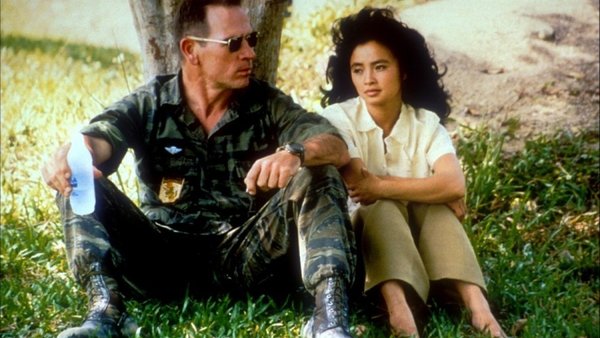
Heaven And Earth is the third film Oliver Stone made on the Vietnam War, but the last to be released. It arrived in 1993 to a significantly lessened critical reception than its contemporaries. It's a more humanistic focus that looks at the Vietnamese side of the conflict on a closer level.
It's an adaptation of two biographies; "When Heaven and Earth Changed Places" and "Child of War: Women of Peace". To cover both books, two main characters make up the film's narrative; American Gunnery Sargent Steve Butler (Tommy Lee Jones) and Vietnamese civilian Le Ly (Hiep Thi Le). Both are irrecevably changed by war and the film swaps between the two perspectives for much of its runtime.
It's an incredibly dark production that isn't afraid to show the horrors of war committed against civilians. Le Ly in particular is savagely brutalised by both the South Vietnamese and Viet Cong. Simultaneously, Butler grows more disillusioned with the battle and their individual journeys eventually interweave.
While it had its components in the right place, the end result is less than impressive, especially when it comes to the performance of its lead actress and overall tone. Stone's filmmaking style doesn't quite allow for the kind of emotion you'd expect from the story it tries to tell.
15. The Doors

Next up is the The Doors, a biography chronicling one of the most popular rock bands of the 1960s and 1970s. While it follows the band collectively for the most part, the spotlight is often placed on Val Kilmer's Jim Morrison. This lead singer had quite the colourful career, mixed with alcoholism and drugs that was fuelled by the counter culture of the time.
An off kilter character needed an actor who embraced that crazy side; unfortunately it didn't turn out that way with Kilmer. The film was somewhat of a passion project for Stone. As a solider in Vietnam, he had listened to the titular band through the 1960s.
Other directors like Brian De Palma and Martin Scorsese had wanted to make it themselves, but found themselves struggling with negotiating production rights. Stone had the same issue, having to constantly consult The Doors; they had many strict instructions on their portrayal.
Despite revolving around a highly successful band, The Doors was not very successful at the box office. It only managed to gross $2.4 million above its initial budget. Stone's attempt at a musical biopic falls somewhat flat; maybe it was down to The Doors having an impact on the storytelling? Or perhaps the more dramatised elements took things in the wrong direction? In any case, there are far superior biopics in modern cinema.
14. W.

This modern political drama homes in on the life and times of George W. Bush and like Nixon and JFK before it, W. goes for full authenticity. It takes the audience from the 43rd President's education at Yale University, all the way up to his decision to invade Iraq in 2003.
The man in question is played by Josh Brolin and he joins an all-star cast featuring Elizabeth Banks, James Cromwell, Ellen Burstyn and Richard Dreyfuss. Oliver Stone chose Bush because he found his story fascinating, saying: "I want a fair, true portrait of the man. How did Bush go from an alcoholic bum to the most powerful figure in the world? It's like Frank Capra territory on one hand, but I'll also cover the demons in his private life."
Released in the aftermath of Bush's tenure in 2008, the film's broad coverage of both the personal and political does hit some high notes. Though in a curious omission, George's controversial second term was left out; this could have added more dynamism to the film's narrative.
Much like previous entries on the list, W. fell short commercially. Moreover, if you compare it to Oliver's previous coverage in Nixon and JFK, there's no denying it stands in their shadows.
13. Savages

Moving into the current decade, we have Savages; an action thriller set in a modern context. The film is based on the novel by Don Winslow and the adaptation released very promptly, a mere two years after the book.
It all starts when two stoner friends Chon (Taylor Kitsch) and Ben (Aaron Taylor-Johnson) strike it rich through marijuana sales while doing their best to hide their illicit trade through charity work in Africa and Asia. However, they soon find themselves unwitting aides to a Mexican drug cartel and their personal situations start to get dicey.
The film has a large cast and this ultimately hurts its overall cohesiveness as the audience has to keep track of many factions and motivations as it once. Yet Savages still makes solid use of its darker tone to create a grotty drug war that runs rampant over everyone caught up in it.
Where Savages stands out the most is with the steps Oliver Stone takes outside of his typical historical adaptations. Rather than going for full authenticity, it instead aims for a more intense barrage of action sequences. Critical reception was split on the film's context and portrayal of the drug trade, but Savages still has a respectable portion of audiences who enjoyed it.
12. U Turn

We've reached the middle of the road in Oliver Stone's work and the 1997 release U Turn is very much a film of two halves. It's a crime thriller with heavy trappings in the neo-noir style and based on the novel: "Stray Dogs" by John Ridley.
In the run-down areas of Arizona, the lone wanderer Bobby Cooper (Sean Penn) is running from his debt to a ruthless gangster when he stumbles across a married couple. Jake and Grace McKenna (played by Nick Nolte and Jennifer Lopez respectively). From here, a cycle of violence and assassination attempts ensues.
To create a more coarse and unflinching backdrop, Stone and the production team shot the film entirely with reversal stock 5239. The film's violent nature is also personified by actors like Billy Bob Thornton and Joaquin Phoenix. Despite these elements, U Turn was still met with a mixed reception on release, not to mention a lowered box office taking.
U Turn offers a brutal take on the neo-noir genre and through its smaller, more contained narrative, the harsh and unforgiving tone is stamped onto the audience effortlessly. It can be enjoyed as a straightforward thriller by general audiences. Simultaneously though, it also lacks the more thought-provoking content of Stone's other productions.
11. Snowden

Oliver Stone's most recent release as of 2020 once again homes in on a real life figure. Edward Snowden has made waves in the United States for much of the last decade for blowing the whistle on government-approved surveillance across the nation. He has since fled to Russia to seek asylum.
Some call him a traitor, others a hero who exposed corruption in US leadership. Such a timely and contemporary topic has laid the groundwork for several works of media. Documentaries and smaller scale productions have proven somewhat successful, but Oliver Stone's "Snowden" went for a more big budget approach when it arrived in 2016.
Snowden chronicles the titular operative's (played by Joseph Gordon-Levitt) crucial meeting with journalists Laura Poitras and Glenn Greenwald. From here, we follow the revelations that occured contrasted against the protaganist's past. The film's strengths lie in its deeply political undertones, which generates a thought-provoking look at real life events.
With that said, its position as a larger scale Hollywood film means it had to take some liberties with what had happened. As a result, things feel a tad watered down, especially when compared to the far superior CitizenFour. Stone clearly wanted to tell the story well, but other books and documentaries have done it better.
10. Any Given Sunday

Getting into the top ten, Any Given Sunday enters the realm of sports documentaries. This genre typically involves a team's rise to glory or fall from grace. Stone teamed up with fellow auteur Richard Donner and an array of talented actors to tell the tale of a fictional American football team.
The Miami Sharks are a struggling group who have fallen far from their high status. In their bid to enter Associated Football Franchises of America (AFFA) play-offs, they look to craft a new strategy as their current manager Tony D'Amato (Al Pacino) has come up short.
Similar to the likes of Moneyball and Remember the Titans, Any Given Sunday gets the audience invested by seeing a team come together and achieve more as a result. The cast is incredibly talented and diverse. Cameron Diaz, Dennis Quaid, James Woods and Jamie Fox are just some of the actors that got involved.
It was the film Oliver Stone had wanted to make for some time, having developed a script called "Monday Night" in the nineties. It took some negotiating with the writer's guild of America to claim credit, but production started after that. Any Given Sunday's only major issue is its extended length that pushes over two and a half hours.
9. Natural Born Killers

The next entry on the list is a cult favourite; generally Oliver Stone hasn't managed to reach this status with most of his films, but Natural Born Killers is the exception. It was certainly very controversial as well, with many crying foul at its graphic violence and the real crimes that were said to be inspired by the film.
It was released in 1994 and quickly garnered a reputation for itself which was heavily fuelled by a screenplay written by Quentin Tarantino. It features the characters Mickey and Mallory Knox (played by Woody Harrelson and Juliette Lewis) as they embark on a sudden and gruesome rampage of murders, drug use and abusive behaviour.
Natural Born Killers is a truly insane production, chock full of nasty moments and sadism. Yet there's something so mesmerising about the entire thing; it's the kind of film you can't look away from.
Of all the films made by Stone, Natural Born Killers is by far the most trashy and uninhibited. It doesn't hold back on its approach to violence and why it is committed. This is also emphasised by its hazy and manic cinematography which highlights the unhinged nature of its characters. It continues to be one of the director's most underrated films.
8. World Trade Centre

Next, we come to World Trade Center; alongside United 93 from Paul Greengrass, it's one of the best known productions that delves into the events of September 11th, 2001.
The terror attack on New York City remains etched in the minds of millions almost two decades later. Of the many people who were caught up in the day's tragic events, WTC focuses on police officers John McCloughlin (Nicolas Cage) and Will Jimeno (Michel Pena). Like many over squads assigned to the towers, their job was to get as many people out as possible.
The two end up trapped under the rubble of tower 2 and their desperate struggle for survival begins. Cutting back and forth between their plight and the efforts of rescue teams, their perspective on 9/11 is powerfully captured. Oliver Stone heavily involved the real life people in the film's production; they wanted World Trade Center to serve a memorial to the fallen.
Thanks to great performances from Cage and Pena alongside the other cast members, World Trade Center stands out as a deeply moving tale that comprises both the horror of 9/11 and the courage of those who aided in rescue efforts. It's both moving and respectful in its presentation, putting it in the top ten.
7. Nixon

Few events in American history have been so scandalous as Watergate. When it came time for the 1972 election, Republican incumbent Richard Nixon had a sure-fire lead to his second term in officer. Against his opponent George McGovern, he had little chance of losing.
Yet he decided to cheat regardless, ordering "the White House Plumbers" to break into The Watergate Building to spy on the democrat party. This immensely controversial event is the topic of Oliver Stone's second political adaptation. The man at the centre is played with great gusto by Anthony Hopkins.
The director was fascinated by the impact of the Watergate Scandal and how the public felt towards their president. The film's story uses the event as a starting point, venturing further in exploring the 37th President's life story. In this way, it goes for a more humanistic tone, rather than levelling further criticism at the man.
It may not have drawn audiences into theatres, but its critical reception was still strong, putting Nixon among the best work Oliver Stone has done. It was generally enjoyed, but the Nixon family expressed great distaste towards the film, saying it was designed to defame and denigrate the former president. Considering the use of real-life footage of his 1994 funeral, these complaints ended up carrying more weight.
6. Born On The Fourth Of July

Before Tom Cruise started pulling off all kinds of insane stunts in the Mission Impossible series, "Born on the Fourth of July gave him some early momentum. It was the second of three films Oliver Stone directed on the Vietnam War and for this one he focused more on the homefront.
Cruise plays the real-life figure Sargent Ron Kovic, a teenager inspired to join the conflict, only to grow bitter and disillusioned. After he is paralysed from the chest down in battle, Kovic returns to the United States and soon finds himself joining the anti-war movement. It's a two-sided approach that really sells the director's vision and tone.
Stone had been planning his 1986 classic Platoon when the real events were unfolding, but once Ron started making appearances in the media, a screenplay came together with Stone's input. Due to other projects, Born on The Fourth of July would arrive belatedly in 1989.
The psychological trauma Kovic goes through is incredibly well-presented on screen and because of Tom Cruise's high marketability as an actor, the film was very successful, sliding into the top ten highest grossing releases of that year. If nothing else, it proved that Stone still had a shrewd mind for recreating the Vietnam conflict on-screen.
5. Talk Radio

A more underrated effort from Oliver Stone finds its way to the number five spot. Talk Radio heads into the drama genre to tell the story of a radio personality with some contentious views put on the air. The film's story was originally the topic of the book: "Talked to Death: The Life and Murder of Alan Berg".
For the film, they changed the lead to Barry Champlain. He is played by Eric Bogosian, who truly embodies the uninhibited, far right tendencies of the host. Bogosian takes things one step further by portraying the fragile life the protagonist shares with his ex-wife Ellen (Ellen Greene) and the depression he begins to suffer from.
The film's main paradox shows through Barry's questionable views; his insults towards gays, drug addicts and other tactics draw both approval and ire of listeners. And yet his show manages to garner some of the highest ratings on the radio network. Talk Radio was released in 1988 and yet its themes could easily applied to modern day commentators.
Making the most of its low budget, Oliver Stone puts the film's main character front and centre; the result is a deeply personal narrative that has a lot to say about where political commentary can lead.
4. Wall Street

Now we come to the films Oliver Stone is best known for. Wall Street is the tale of rich New York bankers running amok with risk and competition. They spy on their rivals, engage in illicit trade and put their wealth on the line in a recreation of the real-life stock broker trade.
Stone made the film based on his father's role as a stock broker during the Great Depression. This also carries through to Wall Street's main characters Bud Fox (Charlie Sheen) and Gordon Gecko (Michael Douglas). The former is a young trader who aspires to be like the latter; but the deeper Fox dives into the business, the more tense things become.
What makes Wall Street so memorable is its commitment to authenticity alongside its ability to take a complicated topic and explain it to a wider audience. It was also a very timely release; the 1980s were a time of the "Yuppie Culture" and the motto of "greed is good" was widespread following the interventions of President Ronald Reagan.
In the years since its release, Wall Street has become an archetype for that era. Thanks to great direction by Stone and solid performances, it ranks close to the top of his filmography.
3. Salvador

The third-best flick from Oliver Stone is another war film; one that covers the often overlooked Salvadoran Civil War. While not as large as other proxy conflicts in the greater Cold War, Salvador's conflict raged for twelve bloody years with the likes of the United States, Soviet Union and China all throwing their influence into the ring.
Smack dab in the middle of the fighting, the director decided to make a film about it. Taking a similar perspective to "The Killing Fields" from 1984, it follows American journalist Richard Boyle (James Woods). Caught up in the battles, Boyle attempts to rescue his girlfriend and her children as the FMLN rebels and government military clash.
Stone directed heavy criticism towards the US-supported military forces, who murdered four American Churchwomen during the conflict and committed other atrocities with death squads. This manifests itself with Boyle going to the US Embassy to press them to withdraw support for the war, only to be denied.
Thanks to its capable presentation and political trappings, Salvador earned three Oscar nominations; best actor in a leading role, best writing and best screenplay written directly for the screen. It takes a more obscure conflict and successfully brings it to life in a detailed and often visceral way.
2. JFK

Just missing out on the top spot, JFK is the first and best of the Oliver Stone political biopics. Like the title implies, it's all about John F. Kennedy, his tenure as US president and the abrupt conclusion it came to through assassination. Yet it accomplishes this with no actor playing the titular person.
Instead, JFK focuses on James "Jim" Garrison, the man who investigated the president's death. As Lee Harvey Oswald's crime is slowly reconstructed, the film analyses the conspiracies, actors and motives that led to the murder. Stone himself believes that Kennedy was killed for standing against the build-up of the military industrial complex.
Putting the production together certainly wasn't easy for Stone. Initially, he was affected greatly by Kennedy's death, saying: "The Kennedy murder was one of the signal events of the postwar generation, my generation". He was able to meet with Jim Garrison himself and while the former investigator left angrily based on the Oliver's questions, the project still came together.
What makes JFK far better than both W. and Nixon is its use of intrigue to create a well crafted portrait of political tension. The deep controversy around both Kennedy's death and the film's production further fuelled its eventual success. It remains deeply fascinating to this day.
1. Platoon

The very best film Oliver Stone has ever made is Platoon, a 1986 war movie that stands alongside the likes of Apocalypse Now, Full Metal Jacket and The Deer Hunter as the greatest windows into the Vietnam war. Why? Because it came from an individual who experienced the conflict first-hand.
Before he became a movie director, Oliver Stone enlisted in the US Army in 1967 and requested to serve in the far-off Asian country. He would fight from September 1967 through April 1968, earning several commendations and moreover, an intimate experience of how hellish the Vietnam war really was.
From here, he put together ideas for a film, one that would recreate his own experience and pay respect to the comrades he had lost. In order to maintain authenticity, the director put the cast through a gruelling training course to get them into the mindset of touring the inferno. The end result features Charlie Sheen as Chris, a soldier who finds himself struggling with his conscience while the two Sargents Barnes (Tom Berenger) and Elias (Willem Dafoe) watch over him.
Even more than three decades after its release, Platoon is a powerful and harrowing production that perfectly captures the tragic and pointless war that America waged in Vietnam. It's best known for the use of "Adagio for Strings", which stamps a solemn tone on the entire experience.
Do you agree with the list? Which Oliver Stone film is your favourite? Let us know in the comments below...