Every Sam Mendes Movie Ranked From Worst To Best
How does 1917 stack up?

There's no doubting that Sam Mendes is one of the greatest filmmakers working today, a uniquely talented director who made a shockingly smooth transition from the world of theater to film, even winning a Best Director Oscar for his screen debut, American Beauty.
And since then, Mendes has been a reliable purveyor of achingly humanistic tales both historic and contemporary, while taking more ambitious steps into big-budget blockbuster filmmaking in recent years.
With Mendes' new war epic 1917 picking up enormous buzz on the way to the Oscars - where it's nominated in 10 categories including Best Picture and Best Director - it only bolsters the case that there are few active filmmakers on his level today.
There's an impressive consistency to the ambitious and diverse work that defines the eight films he's made during his 20 years in Hollywood, and though not all of them were quite great, the overwhelming majority have nevertheless maintained a shockingly high standard of quality.
And so, revisiting all of Mendes' narrative features to date, let's separate the wheat from the chaff and see where 1917 stands among the pile...
8. Spectre

Mendes' most expensive film to date is also his most problematic, and in honesty, can anyone blame him for struggling to live up to the brilliance of his first Bond film, Skyfall?
Spectre certainly had a lot going for it on paper, namely an ensemble cast including Lea Seydoux, Dave Bautista, Andrew Scott, Monica Bellucci, and especially Christoph Waltz, yet the end result was ultimately a bloated, disappointingly generic greatest hits travelogue of tired Bond tropes.
One suspects Mendes felt the pressure to reincorporate "classical" Bond elements after Skyfall more closely resembled a Christopher Nolan film than a traditional Bond flick.
But between its rather suspect treatment of its female characters, its wildly convoluted plot, and how thoroughly it wastes Waltz as Blofeld, the whole film just feels like a bit of a missed opportunity.
Is it a bad film? Not quite: it's certainly watchable despite clocking in at an agonisingly distended 148 minutes, and the marvelous opening "single take" sequence was clearly a try-out for 1917 in retrospect, but it's an undeniable disappointment following one of 007's best-ever outings.
7. Away We Go
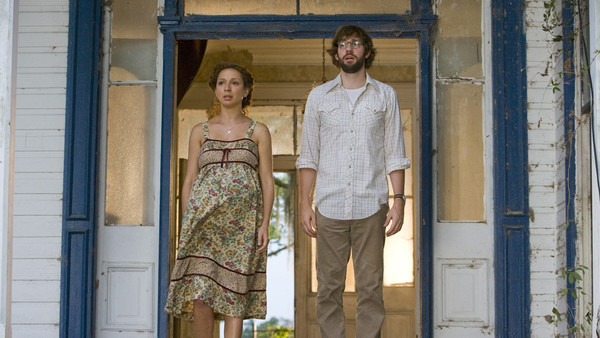
Away We Go is unquestionably the black sheep of Mendes' filmography, a low-key indie drama without A-list leads that bombed at the box office and received mixed-positive reviews from critics.
Maya Rudolph and John Krasinski turn in strong work as an expecting couple trying to figure out where they want to settle down, and what kind of parents they actually want to be.
A fresh spin on the typical road movie that's alternately charming and offputtingly twee, it's an odd, unnatural pick of material for Mendes, and at times the end result suggests that he struggled to find the right tone for the project.
Still, the supporting cast is great - especially Allison Janney, Maggie Gyllenhaal, and Chris Messina - and it's certainly a solid enough dramedy, if hardly up to the high standard that defines most of Mendes' filmography.
6. Jarhead

Mendes' first foray into the war film couldn't be more different to 1917, a character-driven drama about the existential malaise of war, eschewing bombastic set-pieces in favour of extensive scenes of soldiers stewing in their own boredom.
It's a unique hook and one which Mendes executes terrifically, aided by a remarkable ensemble cast led by Jake Gyllenhaal, who gives one of his best and most underrated performances here.
It's easy to see how critics and audiences alike were heavily polarised by the film upon release, given that Universal opted to market it as a more action-heavy war film. Purely its own merits, though, it offers up a potent and deceptively smart commentary on modern masculinity.
That's not to ignore Roger Deakins' eye-wateringly beautiful cinematography, marking the first of the DP's four collaborations with Mendes to date, two of which resulted in Best Cinematography Oscar nominations for Deakins.
5. Revolutionary Road

If some critics dinged this sumptuous adaptation of Richard Yates' novel for being something of a thematic retread of Mendes' own American Beauty, it was tough to argue with the magnificent, Oscar-worthy performances from Leonardo DiCaprio and Cate Blanchett - neither of who were nominated, bafflingly - as a couple struggling to work through intense suburban ennui.
Kathy Bates and Michael Shannon are also very good here - the latter receiving a Best Supporting Oscar nomination for his work - in a stately, pared-down drama that might be a little too stagey for its own good, but sings on the strength of its intense emotions and sheer relatability.
And above all else, how ingenious was it to make Leo and Kate's long-awaited Titanic reunion such a bitter and depressing anti-romance?
4. Road To Perdition

Road to Perdition was a bold choice of second feature for Mendes, and couldn't have been further from his debut American Beauty.
This haunting, searing period gangster film ingeniously casts Tom Hanks against-type as an enforcer for the Irish mob, in a film that while unapologetically pulpy and thematically familiar - adapted from Max Allan Collins' graphic novel as it is - is both stylish and richly affecting.
Hanks typically brings plenty of humanity to his role, while the supporting cast is played with gusto by Daniel Craig, Jude Law, and especially Paul Newman, in his final major live-action role and one which rightly netted him a Best Supporting Actor Oscar nomination.
The real star of the show, though, is legendary cinematographer Conrad L. Hall, who passed away two months before posthumously winning a well-earned Best Cinematography Oscar for his majestic work on the film.
3. American Beauty

Mendes' cinematic directorial debut ended up winning five Oscars, including Best Picture and also Best Director for Mendes, telling a devilishly witty tale of contemporary middle-class discontent topped by fantastic performances from Kevin Spacey (who won the Best Actor Oscar), Annette Bening, Chris Cooper, and Thora Birch.
Though the film has been undeniably and unfortunately recontextualised by Spacey's real-life behaviours, it's one that's nevertheless fascinating to return to at different stages in your life and consider how differently you relate to it - to the younger characters and then the older ones.
While some of its more flowery observations perhaps haven't aged spectacularly - in part due to being so widely parodied in pop culture - it's still a wonderful character piece bolstered by Conrad L. Hall's gorgeous, Oscar-winning lensing, and Thomas Newman's iconic musical score (which somehow didn't win an Oscar).
2. Skyfall

Mendes was certainly a surprising choice to helm a Bond film, and one which paid off spectacularly with one of the iconic spy's most stylish, elegant, and emotionally resonant efforts to date.
Mendes has spoken much about how Christopher Nolan's The Dark Knight inspired Skyfall, as is evident throughout not only its operatic, huge-scale visuals, but also its twisty, feeling-over-thought narrative, brought to life in particular by a wonderfully villainous turn from Javier Bardem.
Everyone's fantastic here, though: Daniel Craig nails the weathered, world-weary 007, and Judi Dench gets a tremendously poignant send-off for her M.
Boasting a self-aware tone and some of the series' most technically precise and visually stunning set-pieces - thanks again, Roger Deakins - Skyfall appeared to usher in a new era for Bond, albeit one which was unfortunately walked-back with Spectre.
But we can all agree that Adele's Oscar-winning title track was a timeless banger, right?
1. 1917

But as especially terrific American Beauty and Skyfall might be, Mendes' most recent film just barely squeaks past them.
It would've been easy for 1917, a war film shot and edited to resemble a near-continuous take, to be a beautiful but emotionally hollow spectacle, yet to Mendes' immense credit, he wrings every possible drop of visceral anguish out of this fantastically efficient tale of wartime survival.
Mendes clearly has an over-the-odds emotional investment in the film, which he adapted from stories told to him by his late grandfather, and the result is a technically astonishing, gruelling endurance trial that's both stylistically exuberant and tremendously affecting.
Roger Deakins' sure-to-be-Oscar-winning cinematography in many ways makes him the MVP here, but it works in perfect concert with cracking central performances from George MacKay and Dean-Charles Chapman, not to mention a superb ensemble cast, and also Thomas Newman's glorious musical score.
Whether it ends up winning Best Picture and/or Best Director Oscars as it's widely tipped to, it's easily the most persuasive and intoxicatingly overwhelming work of Mendes' entire filmmaking career.