Film Theory: Collateral Is A Grand Theft Auto Movie
The best video game movie ever?
The Grand Theft Auto franchise is a pop-culture monolith beyond compare, but the impossibly successful video game series also owes a great debt to entertainment itself, especially Hollywood.
The series has always worn its biggest influences on its sleeve: Vice City was of course heavily inspired by Scarface and Miami Vice, while San Andreas tipped the hat to both Menace II Society and Boyz N The Hood, and GTA V's Michael was a not-so-subtle stand-in for The Sopranos' Tony Soprano.
It would also be criminal to ignore the clear impact that director Michael Mann has had on Rockstar's crime franchise, especially with Vice City being influenced by the TV show he executive-produced and later adapted to the big screen, Miami Vice, not to forget his crime masterpiece Heat, which inspired several distinctive heist missions in both GTA IV and GTA V.
But with Mann's 2004 crime thriller Collateral, the inspiration seemed to venture in the other direction, and while the film is in no way an official collaboration with Rockstar, it nevertheless feels like Mann's own off-the-record love letter to the GTA franchise.
Collateral could effortlessly slot into the continuity and aesthetic of the GTA games, especially when it comes to San Andreas and GTA V, which of course feature a fictionalised version of Los Angeles - Los Santos.
Mann's film also includes what could be interpreted as stylistic nods to the earlier top-down GTA games, yet for the sake of this theory, Mann's intent ultimately doesn't really matter.
Without any fudged logic whatsoever, Collateral is the GTA movie everyone wanted, and it's been hiding in plain sight for the last 15 years...
5. The Narrative Structure

Collateral's plot of course follows a down-and-out cab driver, Max (an Oscar-nominated Jamie Foxx), who is unlucky enough to find himself driving an assassin, Vincent (Tom Cruise), around Los Angeles as he carries out five hits.
The entire film is focused on Vincent's assignments in a manner not dissimilar to a video game, with a list of objectives the "player character" must follow, and each mission leading to a climactic confrontation with a distinctive style.
Vincent's various hits all feel like typical assassination jobs you'd find in any GTA game, driving around the city and killing ambiguously-moralled people.
That Max is a cab driver is all-too-perfect, given the iconic utility of the cab driving missions in the GTA series, which have been a classic mainstay ever since the franchise went 3D almost 20 years (!) ago.
The movie's biggest set-pieces dare to go further and echo some marquee GTA missions: the Club Fever shootout, for instance, is the most GTA-esque sequence in the entire film, combining a unique location with a target to be killed, and tons of moving parts as Vincent has to fend off the cops, Felix's (Javier Bardem) men and also the target's bodyguards while navigating his way through innocent "NPCs." If that ain't Vice City, what is?
The fact that there are three main characters even boasts shades of GTA V's character-switching gimmick - which, of course, was released almost a decade after Collateral - with Max, Vincent and Detective Fanning (Mark Ruffalo) feeling like playable GTA characters in their own rights that we, as viewer or "player", swap between throughout the movie.
With the narrative framework coinciding perfectly with GTA's gameplay structure, let's consider just how convincingly Collateral's characters could also slot into a GTA game...
4. The Characters Are Basically Ripped From GTA

"Millions of galaxies of hundreds of millions of stars and a speck on one in a blink. That's us. Lost in space. The cop, you, me, who notices?"
Collateral has a colourful and diverse cast of characters throughout, the overwhelming majority of whom feel like perfect candidates for a role in a GTA game.
For starters, Vincent is a freaking hitman and his grey suit is extremely similarly to the one worn by GTA V's Michael.
As for Max, though he might seem a little too honest to be a GTA protagonist at first glance, he's firmly swept up in the American Dream with a desire to start a luxury limousine business, which doesn't feel a million miles away from the go-getter attitudes of GTA IV's Niko or GTA V's Franklin.
Max drives a taxi to make ends meet while dreaming of a better life, which has been one of the most common protagonist through-lines across the GTA series. That Max becomes an accessory to Vincent's crimes only makes him feel that much more like a GTA "hero."
Elsewhere we have a cameo from Jason Statham as a British gangster who crosses paths with Vincent at the start of the movie - a GTA archetype if we've ever seen it - while the jazz musician Vincent assassinates could easily be a mark from a GTA mission, and Mexican cartel drug lord Felix is a dead ringer for a typical GTA antagonist.
Vincent and Max's dialogues with the latter two characters in particular evoke the slickly hard-boiled pulpiness of GTA's deliciously entertaining banter, and create a convincing case that it isn't just Collateral's game-y story that vibes perfectly with Rockstar's franchise - it's the heroes and villains within it, too.
But there's one other character worth considering in Collateral - and it's in the movie more than anyone else...
3. The City Is Its Own Character

There's no denying that any and every GTA game is defined by its setting - the cities are all characters in of themselves that define the player's entire experience, and the same is very much true of Collateral.
Mann makes great pains to convey the atmosphere of a night-time L.A. to audiences, focusing on the chill (and eventually, the terror) of driving around the city late at night, soaking in the sprawling environment just as players are routinely invited to do in GTA.
But more importantly, Mann follows GTA's lead and dares to go further - he presents an uncanny valley version of the city.
We know Collateral's L.A. as recognisable within the "real world", but it's also heightened in some particular ways to present a "hyper-real" new version that's both familiar and not at the same time.
For starters, Mann's digital cinematography creates a uniquely dreamlike depiction of the city, separated entirely from any other action thriller set in L.A., allowing the dingy alley-ways and neon-soaked streets to come to life in a way that just feels slightly off-kilter.
Across the franchise, GTA has similarly offered up exaggerated depictions of not only L.A. but also Miami, crafting cityscapes stuck half-way between photorealistic simulation and satirical caricature.
There's an expert sense of geography that the viewer and player is easily able to keep up with in each case, but it's still intentionally a little off.
Both Collateral and GTA have made their cities feel "alive" and sprawling in ways that go beyond the confines of the story, where the characters could easily just keep driving around until they stumble across something to interact with.
GTA co-creator Dan Houser once said that the series is "about creating a reinterpretation of the U.S., a socially and virtually distorted prism of the real thing...A world that, at first glance, seems completely normal, and then reveals its absurdity as you play it."
That is absolutely spot-on with the approximation of Los Angeles seen in the GTA games in particular, and it similarly applies to the version seen in Collateral - recognisable, but different.
If there are countless games and movies where the setting is nothing more than an arbitrary creative decision with little impact on the characters or their actions, in both GTA and Collateral, the city feels entirely consequential to what takes place.
2. Michael Mann's Style

Michael Mann's bold, singular direction is one of the reasons that Collateral is as evocative and brilliant as it is, and it also furthers the theory that he was tapping the very same vein that has made the GTA games such a hit.
As mentioned, Mann used cutting-edge digital cinematography to capture a uniquely fluid depiction of Los Angeles, a smoother image that inherently differentiates the film from other similar movies.
But there are even individual shots in the film that evoke GTA, be it the gorgeous, sweeping shots of the city unfolding before Max (not unlike the opening cut-scene of many a GTA game), or the numerous overhead helicopter shots which pay homage to the earlier top-down GTA games.
Though this is almost certainly nothing more than a coincidence, it's an incredibly fortuitous one, which combined with Mann's unforgettable use of music while Max is driving around, is sure to give players memories of cruising along in GTA while listening to the brilliant in-game radio.
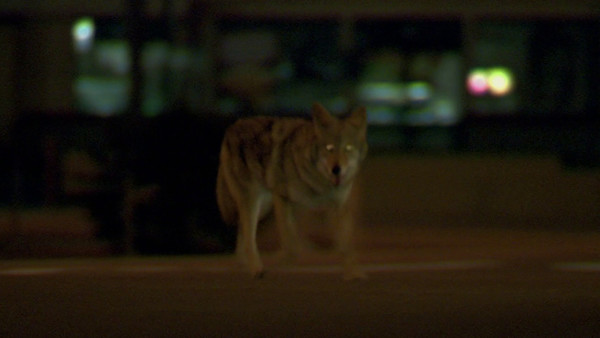
If the point isn't clear enough yet, an enterprising fan even remade the film's memorable coyote sequence in GTA V's powerful Rockstar Editor suite. Needless to say, it's a note-perfect translation from one medium to another:
1. The Subtly Surreal Tone
And finally, it's important to consider the movie's tone, for while Collateral certainly isn't the outwardly comical social satire that GTA absolutely is, there are some darkly comedic moments, such as Max helping Vincent talk back to his penny-pinching boss.
Moreover, though, there are moments of levity between all the murder, such as the sequence where Vincent forces Max to visit his mother in the hospital, which feels like one of the many non-shootout respite missions peppered throughout the GTA franchise.
Though Collateral is mostly quite grounded, there's a subtle cartoonishness to it, through surreal asides such as the iconic coyote sequence, where Max stops the car to watch a coyote cross the road, set to Audioslave's terrific "Shadow on the Sun".
This is exactly the sort of eccentric, seemingly random moment that the GTA series has become known for in recent entries, rewarding players who dare to explore the city with an obviously pre-programmed but seemingly "emergent" scene intended to appear off-the-cuff and generated exclusive for the player.
In broader narrative terms, some of Collateral's more implausible plotting does feel rather video game-y in its contrived nature, and so, it's easy to accept Vincent and Max's story fitting easily into a GTA plot.
If Max switched to the right radio channel, one could certainly imagine him listening to Lazlow Jones on Chatterbox FM.