Film Theory: David Fincher's Se7en Is Set In Gotham Before Batman
Before Batman Begins, there was Se7en.
David Fincher's Se7en is one of the most iconic thrillers of the 1990s, a tightly-wound exercise in gut-wrenching suspense anchored by excellent performances from Brad Pitt, Morgan Freeman and Kevin Spacey.
But above even its unsentimental approach to violence and grimly haunting ending, Se7en is one of the most atmospheric films of its genre ever made, and a big part of the reason for that is Fincher's incredible job of building a realistic yet deeply unsettling world for these characters to inhabit.
In recent years, there's been a fan theory that's grown considerably in popularity online, that the city depicted in Se7en is effectively a pre-Batman Gotham City.
Now, there aren't any direct indicators or Easter eggs in the film that suggest Fincher was consciously attempting to convey this, but in examining the film's tone and aesthetic, not to mention some neat coincidences between Se7en and Christopher Nolan's Dark Knight saga, it's a theory that slots together quite effortlessly.
Whether you accept Se7en as a tangential companion piece to Batman media or a more direct prequel-of-sorts to Nolan's films, it doesn't take much fudging at all to make the properties connect in a satisfying - and more importantly, fun - way.
And so, read on as we detail the shared DNA and shocking consistencies between Fincher's unforgettable thriller and the Caped Crusader's beleaguered hometown...
5. Se7en's Curiously Unnamed City

One of the most fascinating aspects of Fincher's film is that, despite the city basically being a character in its own right, it's never actually given a name.
David Fincher shot the movie in Los Angeles, though through clever editing, selective use of locations and smart colour grading in post-production, he was able to make the city more closely resemble a grey, imposing metropolis such as New York City.
In fact, so convincing is the trick that many critics cited the movie as taking place in New York, despite none of the movie's characters nor any single shot confirming that setting.
We don't even get a clear look at Detective Mills (Brad Pitt) or Somerset's (Morgan Freeman) badges to even hint at where the story might be taking place.
Clearly this was an intentional flourish on Fincher's part, amalgamating East and West Coast cities into a homogenous ideal of urban rot, and it quite perfectly allows the audience to accept that this fictional creation could indeed be Gotham City.
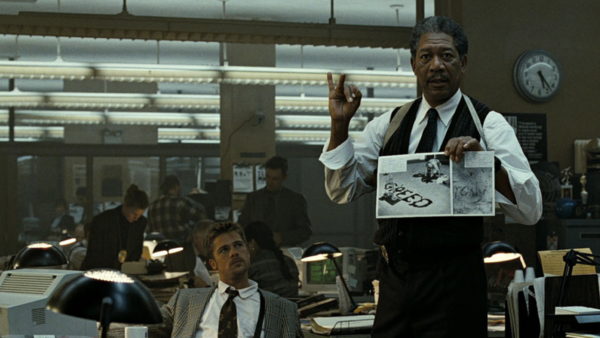
A street sign confirms that Se7en's unnamed locale was incorporated in 1926 and has a population of approximately 8.3 million, which isn't far off the typical estimates of 10 million for Gotham City.
While Fincher surely gave audiences a non-specific setting to enhance the heightened relatability of the story, he also removed a barrier to accepting the fan theory - there aren't any culturally specific trappings of either California or New York that would require some added suspension of disbelief.
But of course, it's easy enough to pawn this off as a happy coincidence. The fact that the film's antagonist, John Doe (Kevin Spacey), is basically a quintessential Batman villain? Not so much...
4. John Doe Is A Classic Batman Villain
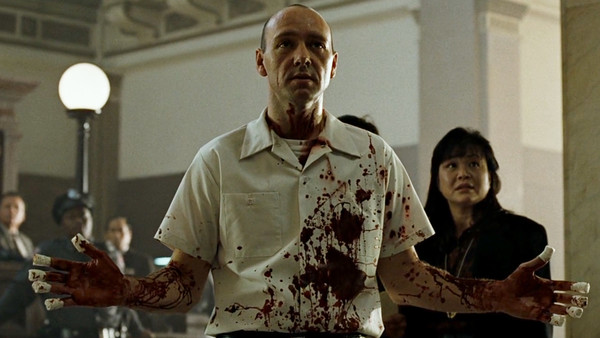
John Doe's plan throughout the film is, of course, to perpetrate seven grisly murders, with one corresponding to each of the seven deadly sins - gluttony, greed, sloth, lust, pride, envy and wrath.
And it follows that the theatrical, almost playfully effed-up nature of Doe's quest could've easily been torn from a classic Batman comic.
Despite Se7en's gritty look and tone, there's an undeniably contrived quality to Doe's scheme that requires an inexplicable number of things to go his way, not unlike the convoluted schemes you'd see cooked up by, say, The Joker or The Riddler.
There are numerous moments that especially point to Doe as a classic Batman villain in disguise: the Riddler-esque clues he leaves for Mills and Somerset after every crime, the Joker-like manner in which he defaces Mrs. Gould's (Julie Araskog) picture, and the literally hundreds of notebooks Doe has filled with his own psychopathic thoughts.
That's not to forget the fact he's described as independently wealthy and clinically insane - two hallmark tropes of iconic DC supervillains - and the film's iconic finale doesn't feel a million miles away from something you'd see The Joker pull off in Christopher Nolan's Dark Knight universe.
The final twist, that Doe commits envy himself by murdering Mills' wife Tracy (Gwyneth Paltrow) and goads Mills into murdering him and completing the cycle with wrath, is perhaps the most dementedly Joker-ish act of all. Zero fear of death, total desire to punish the "hero" as much as possible.
In much the same way that Gotham's villains lock the city in a vice grip of fear, so too does Doe terrorise the unnamed city's residents, while naturally whipping the media into a frenzy.
But Doe is ultimately just one piece of the puzzle, the horrifying villain presiding over a city rife with degenerates primed to fill out the Caped Crusader's rogues' gallery...
3. There's A Ready-Made Rogues' Gallery

Rewatching Se7en, it becomes clear just how expertly Fincher employs world-building to create a palpable atmosphere of toxic dread, by depicting a city that, like Gotham, is completely absorbed by corruption and moral bankruptcy at every level.
Se7en isn't just content to depict its decay through Doe's actions, though - the majority of his victims represent problematic aspects of society in one way or another.
For instance, it's easy to imagine how a character like Leland Orser's lust victim (pictured above) - who was forced at gunpoint to rape a prostitute with a bladed strap-on - could become a deranged villain in the future, riddled with PTSD after what Doe made him do.
Then there's sloth victim Victor (Michael Reid MacKay), who while technically more of a vegetable than a functioning human being and implied to have little time left to live, is nevertheless grotesque enough to fit the bill of a classically terrifying Batman antagonist should he find a way to escape the hospital.

Even outside of the main plot, Fincher does a fantastic job hinting at the overabundance of fear pervading throughout the city.
Crimes can frequently be heard going on outside both Mills and Somerset's apartments, Somerset drives past a dead body on the sidewalk at one point, and even tells a grim story where a man got robbed the night before, only to be additionally stabbed in both eyes by the attacker for no reason.
But perhaps the most Batman-inspired crime comes in the form of the rampant corruption implied in the city's police force.
Somerset tells Mills that the press frequently bribes the police to get crime scene tip-offs, and at the end of the film, it's suggested that John Doe used similar means to find out Mills' address and murder his wife.
And in a neat coincidence, character actor Mark Boone Junior appears in Se7en as a corrupt FBI agent who accepts a bribe from Somerset to access some FBI files, and Junior then shows up in Batman Begins as, you guessed it, a corrupt cop partial to being bribed. It sure seems like he got a demotion from the FBI, though.
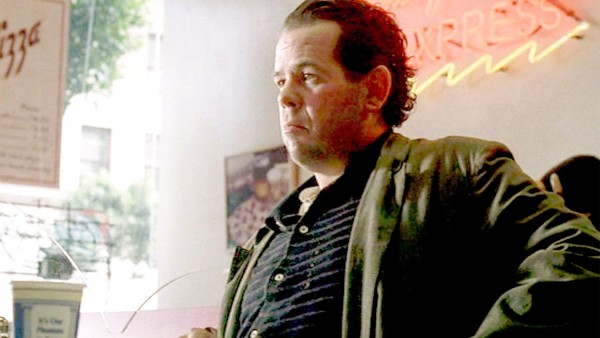
This all adds up to a cesspool of criminals, both violent reprobates and white-collar offenders, that bears an uncanny resemblance to the grim Gotham City envisioned before Batman showed up to save it.
But there is one human constant across these two stories, and of course, it's Morgan Freeman...
2. Morgan Freeman's Detective Somerset Is The Key

The primary link between Se7en and The Dark Knight saga in particular is Morgan Freeman, who appears as Detective Somerset and Bruce Wayne's (Christian Bale) gadget-smith Lucius Fox in the films respectively.
Quite aptly, Somerset is seen conducting the sort of deep dive detective work throughout Se7en that you'd expect Batman to be doing.
Oddly, though, none of the Batman movies have done a whole lot to present the Caped Crusader as a genius detective, bar that comically contrived bullet reconstruction sequence in The Dark Knight.
But Somerset is decidedly more interesting as a human being than he is a cop: he's been spending his entire adult life dealing with the crime in the city, and even still, he desperately wants to mine some humanity from the pit of despair.
This is confirmed by his terrific closing narration, that for all of the world's ugliness, it's still worth fighting for. In that respect, he's a little like Bruce Wayne, no?
Is it a bit of a leap to suggest that Somerset retired from the police force and became Lucius Fox years later? Sure, but one character absolutely informs the other, and their personalities aren't a million miles away from each other either.

Hell, Se7en even features a scene where Somerset receives FBI information about what books people have been checking out of the library, and as we all remember, Lucius Fox proves himself deeply concerned with notions of privacy when Bruce uses his phone-snooping technology to help battle The Joker.
Somerset can dovetail neatly enough into Fox because the former has no family, while virtually nothing is ever said about Fox's private life.
But even if you find that link a little too contrived, Somerset's world-weary perspective sheds further light on just how much of a moral toilet the city is, and how closely it resembles the notoriously crime-riddled Gotham.
In fact, you can easily argue that Se7en did Gotham City better than any of the actual Batman movies have...
1. It Feels More Like Gotham Than Nolan's Batman

The Gotham City of Nolan's films has been received with a fair level of indifference by Batman fans.
Though Batman Begins actually made a solid effort to create a unique locale complete with its own transportation system created by the Waynes, the sequels more-or-less threw this out and settled for a fairly generic American metropolis - in this case Chicago.
The opening lines of Sam Hamm's screenplay for Tim Burton's Batman describe Gotham as if "Hell erupted through the pavement and built a city", and that honestly sounds like the perfect written embodiment of the city.
It's also a fitting description of Se7en's unnamed city, teeming with all the aforementioned crime as it is.
The city's systemic issues and generally tawdry nature are also deeply felt away from the crime, though. Mills and Somerset both reside in unglamorous apartments, with Mills living next to a train line which constantly rocks his home.
It's not a million miles apart from the crummy apartment Jim Gordon resides in in Frank Miller's legendary comic Batman: Year One, either.
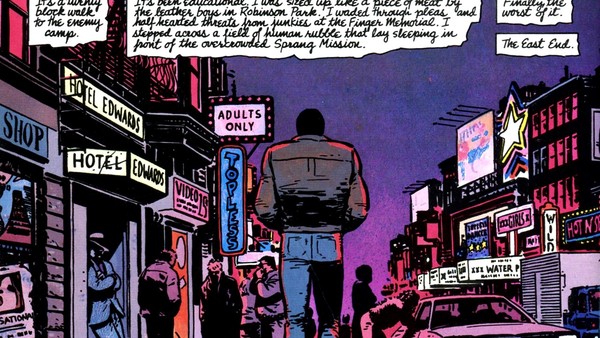
In purely aesthetic terms, Se7en's city is constantly raining - a Gotham hallmark if there ever was one - and the various crime scenes are shot in dingy low light, which again emphasises the ugliness and, honestly, makes the viewer just want to take a shower.
Especially telling is the memorable foot chase between Mills and John Doe, for when the chase reaches a winding alley-way, it's easy to imagine this being the very same alley where the Waynes were gunned down in cold blood.
The bleakness is so oppressive throughout and creates a rich, thick fog for Fincher to tell one of the most absorbingly grim films of the 1990s.

Nolan's Batman films are often compared to the crime thriller greats such as Heat and The Departed, but the director probably should've been looking to Fincher if he wanted to sell Gotham as a thoroughly dirtied, systemically broken city.