Film Theory: Was The Dark Knight's Joker Actually A SPY?!
Licence to kill... The Batman!
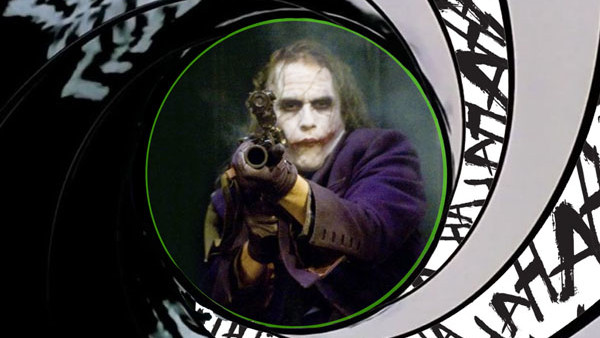
One of the great indications of the success of Christopher Nolan's version of the Joker in The Dark Knight is how much he's talked about a whole decade after he debuted on screen. Still classed as one of the greatest comic book movie performances ever, the Clown Prince Of Crime earned Heath Ledger an Oscar (an unprecedented achievement for the genre) and is still the benchmark for movie villains. It's also the weight that will hang around every actor who dares try and play the Joker's necks.
The performance is underpinned by mystery and an identity crisis that only appears to be resolved when he comes face to face with Batman and has his "you complete me" epiphany. And that mystery is precisely why there are so many theories seeking to define him, despite the obvious fact that he doesn't want to be defined.
But for that precise reason, there might be one theory that actually answers the identity question best. What if his desire to remain anonymous is, in fact, PART of his identity? What if it's part of his job? What if he was actually a spy?
The logical place to start is a theory that's been going around for a long time: that the Joker is a Gulf War veteran...
5. The War Veteran Theory

One of the most popular theories about Ledger's Joker suggests that he is a former soldier suffering with PTSD, which would explain both his tactical nouse and his aptitude for weaponry and combat (he's flawlessly able to perform the regimental gun routine during the police parade). He looks like he's experienced and his time at war could explain both his identity crisis and his desire to watch the world burn.
But it isn't enough to simply say that he's a war veteran - or even that he's an obvious PTSD sufferer. He might present the image of a man without a plan - a dog chasing cars - but the precision with which he crafts his plans are more than just tactical experience. Consider the way he uses Melvin White as bait to stop Batman interfering in the parade plot: the Joker, whoever he is, is a precision instrument whose plans took weeks - even months - to enact.
And anyone with even vague experience of PTSD - or anyone who has struggled with it - knows that condition and the Joker's meticulous plotting would not be easy bedfellows. He is a contradiction of what most people think he is: the idea of him being the product of something traumatic is no more than part of his great facade. Hell, he even tells us that by spinning the lies about his scars. There's something else going on here.
Plus, there are just too many specific details that point to something even more: that his service was clandestine and covert. That he was a spy, in other words...
4. Intelligence On Gotham's Hierarchy And Leadership
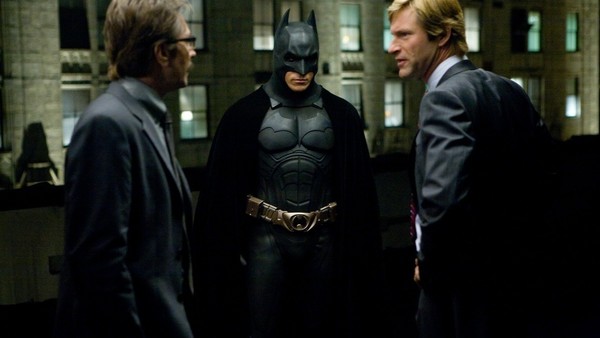
For someone without a plan, the Joker knows an awful lot about the "schemes" of the "schemers" that he blames Harvey Dent's downfall on. He knows all about the criminal networks of Gotham - in intimate detail - and he knows about the rampant corruption in the police force and government. That's not the kind of information that just falls into your lap.
It's far more likely that he spent the time before he popped up in Gotham - seemingly out of nowhere - discovering as much as he could. He accessed criminal databases (how else would he have found Melvin White?), he has to have monitored dirty cops and officials (going deeper than Batman and Harvey Dent seemed capable, given his ease) and he put all of his chess pieces in place. His appearance in Gotham was very much the final part of a long-gestating plan.
And without a network, the only explanation possible is that he was trained in surveillance and information extraction. In other words, he was a spy.
The key question is: does he know Bruce Wayne is Batman? There are certainly hints: as in him cheekily asking Batman if Harvey knows about him and "his little bunny", and while he protects Batman's secret identity, that's not really what the exchange is about.
Crucially, the Joker doesn't CARE about who Wayne is beneath the cowl, because it corrupts his idea of the Joker/Batman dynamic. But you should never doubt for a moment that he knows the truth by the time they come face-to-face. And that suggests that he's done what most of Batman's enemies (and lots who've been WAY more motivated to do so) have managed: he found out Wayne's identity.
That's no small achievement, especially for a "dog chasing cars."
3. Psychological Manipulation And Withstanding Torture

One of the most significant scenes in picking apart the Joker's real secret identity is his face-to-face encounter with Batman in the interrogation scene. On the surface, it seems that the Joker is taking a beating here as some form of perverse validation - as part of his revelation that he and Batman are grotesquely linked - and that he feeds off the pain, as if his whole intention was to get Batman to hurt him.
But that's not true: the pain does nothing to him. As he says, Batman holds no power over him, because the "interrogation" simply doesn't have an effect on him. And not only that, but he reveals that he has experience of interrogation techniques almost immediately:
"Never start with the head, the victim gets all fuzzy. He can't feel the next-"
His ability to withstand torture, as well as his expressed awareness of how that sort of interrogation works, is a further hint that he has worked in espionage on the front line. Up until Barack Obama's presidency, torture was an acceptable practice in official interrogation, as the CIA used techniques actually developed from their own Survival, Evasion, Resistance, and Escape (SERE) training given to military personnel to resist and survive torture in the event of capture.
Essentially, the only way the Joker could be both aware of the mechanics of torture and able to resist it would be if he'd been through that programme himself and had been employed at some point in "acquiring intelligence." Again, because he has to have been a spy.
And then of course there's the whole symbolism of him wearing masks...
2. The Symbolism Of Wearing A Mask

It's important to address the Joker's identity fluidity in The Dark Knight, too. His look is striking, but it's only part of the story - more important is the idea of him disguising his true identity wilfully.
A significant part of this iteration of the Joker's mystique is his unwillingness to reveal "how he got these scars" and while that evasiveness suits the projection of chaos that serves his agenda it isn't because there is no definitive answer. It's because his look is no more than a mask, just as the rubber clown mask he wears in the opening heist is.
The symbolism of that scene confirms that the clown mask he wears is an adopted persona designed to hide his true identity. Why else would he wear the mask? He has no need to hide his identity - he's trying to make a statement about his arrival. The mask element is for the audience - a trick to show that his whole character is a mask: just as Bourne, Hunt and Bond adopt disguises to complete missions.
And underneath that mask is the black ops veteran who set his crosshairs on Gotham, pulled on his disguise and went to work. But why would he? What's his ultimate goal?
1. The Joker Actually Wants To Save Gotham

As we've discussed in another theory already, the Joker actually works for Gotham positively. He cleans up the police force and local government of corruption, he brings down organised crime in a much more meaningful way than Harvey Dent (and is much more successful than Batman) and he teaches Gotham a lesson about morality.
He also gives Gotham's residents what they need more than anything: a martyr and a monster to loom over them as a deterrent. And it works for eight years (until Bane arrives to enact Talia Al-Ghul's revenge on Batman). It doesn't fail because of a problem with the Joker's plan, it fails because of Batman's previous sins.
The image of The Joker as a former Gotham resident who returns to use his certain set of skills to save his home before disappearing once more is certainly a compelling one. And it works a lot more than the pretence that he has no plan at all. He's no agent of chaos, but he could certainly be an agent of some description.