Hellboy: 20 Easter Eggs And References Explained
Lobster Johnson: hero to all, Easter Egg to many.

Despite some scathing reviews - from critics and fans alike - Hellboy does a lot right in terms of the original source material, featuring as much of it as the film possibly can in its runtime.
Admittedly, this may be one of the complications within the movie, as there's just so much comic content stuffed into the film that it can at points feel like a series of different comics jumbled together.
But in terms of easter eggs, nods to the series as a whole, and references to the source material, this issue in terms of pacing results in an ungodly amount of moments where even the most obscure panels get their moment in the sun.
It's also impressive to consider the sheer level of care taken to translate so much from the comic into a different medium - even if that medium did involve making several characters put on a questionable British accent.
The easter eggs and references found in Hellboy are pretty much the best thing about it - so it's a good thing it has a whole heap of them.
20. Darkness Calls

With much of Hellboy: Darkness Calls not being featured within the overall story of the film, it is interesting how specifically Chapter Four plays an important role within it.
As indeed, the reclaiming of Nimue's head - and the murder of the monks that reside in the church her head is hidden within - is played almost panel for panel the way it is in the comic, aside from the inclusion of a little extra gore here and there.
19. Hellboy's Mother

The tale surrounding Hellboy's mother, Sarah Hughes, is that she married the demon Azzael, essentially sold her soul to him, and then gave birth to the child that would go on to be known as Hellboy.
It's particularly interesting that this element of the plot remains the same in the movie as it does in the comics, as it suggests that Hellboy's demonic father and siblings also exist in this universe - opening the potential for the (admittedly unlikely) sequel to feature them in some capacity.
18. Rasputin
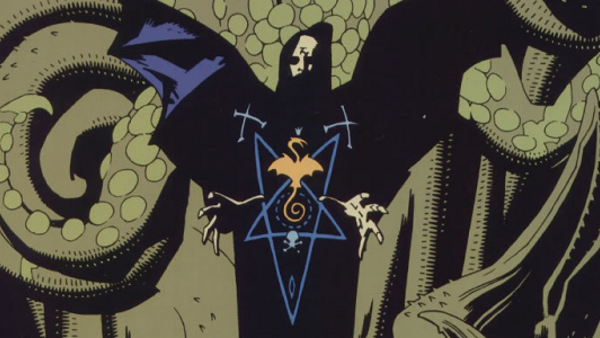
One of the most interesting things about the decisions the filmmakers made when adapting Hellboy - aside from the drama of the production itself - is the exclusion of Rasputin. Aside from the initial reference to him being responsible for the idea to summon Hellboy is the first place, he's never brought up.
As it is, there appears to be no intention to bring Rasputin into the film canon, which should make for an interesting absence - given he is one of the comic franchise's most major villains.
17. The Frog Monsters
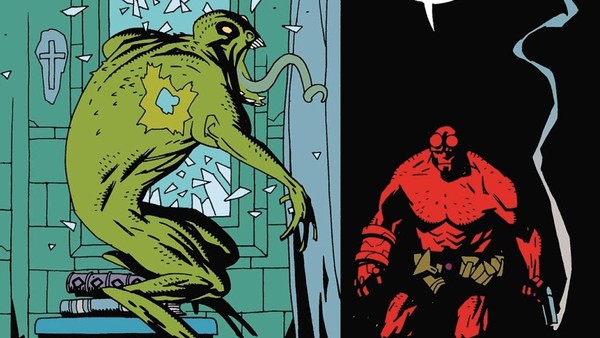
In the movie, Nimue's dramatic summoning of an army of evil creatures serves as an exciting way to feature all the best comic baddies the CGI department could put together.
The most interesting of these included creatures, however, is by far the frog monsters that come at the front of the crowd. The strange, slightly gross frog creatures are actually some of the first enemies Hellboy fights in the comic, and so it's a nice touch to see them make it into the film.
16. The Crooked Man
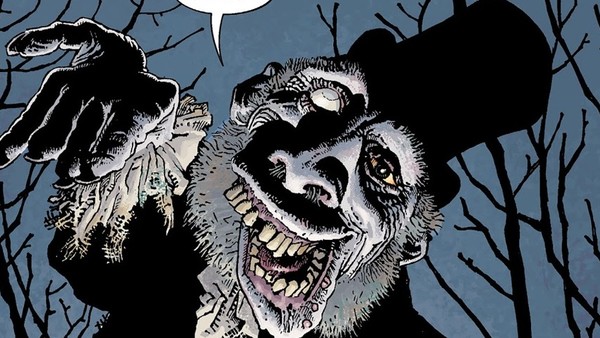
While the Crooked Man doesn't personally feature within the Hellboy film itself, his ability to be totally unnerving has been passed off to Baba Yaga, in a way that appears to specifically reference the corrupt creature.
Fans of the comics were potentially surprised at the version of Baba Yaga they were presented with in the movie, namely because her continual nightmarish contorting as she moves is something that is not a feature of her comic equivalent.
This nightmarish element appears to have been taken from the Crooked Man - a reliable source of body horror - and added as a trait of Baba Yaga's, likely to add an extra helping of disgust to the disturbing moments the series is so well known for providing.
With how horrific Baba Yaga managed to make 'crooked' movements appear, it's maybe a small blessing that the Crooked Man himself didn't feature physically within the film.
15. Ogdru Jahad
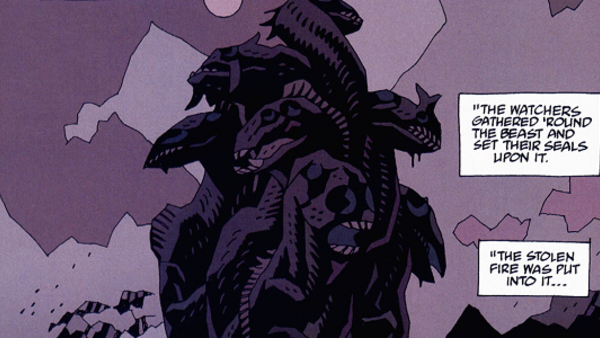
Given there is only one dragon in the Hellboy source material that actually looks like a dragon - the other being the nickname of a magician - it's safe to say that the wyvern Hellboy rides in Neil Marshall's film is a reference to the Ogdru Jahad, an evil entity that is sealed away by the magic contained in Hellboy's right hand.
Nimue briefly turns into a similar dragon when possessed by the Jahad, so there's also a very real chance the dragon could be in reference to this. Either way, the creature features majorly in a potential negative future, should Hellboy turn to the dark side.
14. The Heliopic Brotherhood Of Ra

At one point early in the movie, in a throwaway line no less, Hellboy mentions having met Ra in the underworld before - with the kind of casual air that suggests he could totally be making a huge joke out of the whole thing.
However, with Hellboy having interacted with a cult belonging to Ra in the comics, it seems more likely that this line is in reference to some shenanigans surrounding that encounter on the page.
With the Osiris Club being an offshoot of the Brotherhood, it only makes sense that Hellboy has dealt with both, and so his chances of meeting Ra through the god's fanclub seems more than likely.
13. Project Ragna Rok

Project Ragna Rok is the codename for the Nazi experiment to create a Doomsday weapon, which in the comics resulted in Rasputin summoning Hellboy from the underworld to Earth.
Although the Nazis responsible are not shown in the film after the downfall of the project - as the figures of Leopold Kurtz, Ilsa Haupstein, and Karl Kroenen don't feature in the film - the concept itself remains loyal to its original comic interpretation.
12. The Chicken House

Despite being an unusual setting, the appearance of Baba Yaga's moving house - and its chicken-footed transportation method - was a pleasant moment in the otherwise nightmarish realm of the child-eating monster.
As a completely surreal, almost funny detail, it's close to heartwarming to see the Chicken House feature within the film universe - even if it houses its single creepiest character.
11. Merlin

Swapping a forest grave for one miles underground, Merlin - cursed to permanently exist on Earth until its end - managed a significantly more important role in the film than he did within all the comics combined.
This is because Merlin's role is blended with Morgan Le Fay's from the comics - as in the comics it's Morganna who tells Hellboy of his blood relation to King Arthur, and his destiny to wield Excalibur. Strangely, the other difference between the two is that his curse is broken in the film - as his summoning of the mythical sword takes up the last of his magic, turning him to dust.
While it's a shame we miss out on all the spooky glory Morgan Le Fay provides in the comic, it's perhaps best that Merlin takes this role instead, as one of the key criticisms surrounding Hellboy is how cluttered its storyline was already.
10. Camazotz

For those not well-versed with the Hellboy comics, the character's first scenes within the film - that involve him wrestling with a vampire luchador and then killing said luchador - are the film equivalent of throwing a child who doesn't know how to swim into the deep end.
This is because the vampire wrestler - known as Camaztoz, a Mayan name given to demonic bat-like creatures - is actually part of a Hellboy storyline known as 'Hellboy goes to Mexico', wherein the red devil teams up with three wrestlers who also fight evil. After building a genuinely heartwarming relationship up between the hero and one of the brothers, the man is then kidnapped by the vampires the team are hunting, turned into a vampire himself, and then forced to fight Hellboy in the weirdest match this side of Wrestlemania.
One detail the film misses out is that, in the comics, the luchador's last words are not a prophecy surrounding the end of the world - they are, instead, him weakly thanking Hellboy for putting him out of his misery. Who knew a vampire luchador could have such a big heart?
9. Benjamin Daimo

Of all the characters expected to make a major appearance in Hellboy, Benjamin Daimio - former U.S marine turned BPRD member - was likely on the bottom of many people's prospective lists. Yet Daimio features as essentially one of the three main protagonists of the story, albeit with a distinctly more British persona than in the comics - and distinctly more in control of his secret were-Jaguar powers.
This variation from Daimio's comic storyline indirectly avoids his tragic downfall towards the end of his arc, as Benjamin is forced to exile himself from society upon releasing the powers of the Jaguar, which takes over his body from this point onwards.
A lot of Neil Marshall's Hellboy is determined to make the series more gory and darker than its comic equivalent - so it's nice to have one element that's actually much brighter in tone.
8. The King Arthur Legend

While it doesn't feature as prominently as one would have perhaps expected from a film that includes the Hellboy: Wild Hunt storyline, the legend of King Arthur still finds its way into the Hellboy film, Excalibur and all.
However, the purpose of the legend does differ between its comic and film versions. Within the film, taking Excalibur is merely the catalyst for Hellboy starting the apocalypse - which, although interesting, is pretty simple.
In the comics, however, it's a little bit more complicated than that. Hellboy can bring about the destruction of the Earth with the sword, sure, but in a different sense - as the prophecy surrounding the Arthurian legend states that should Hellboy use the weapon to try and slay Nimue, it will bring the end of days - so Hellboy decides to fight her without it.
The inclusion of the King Arthur Legend within the film is slightly unusual, but it does get to the heart of the eclectic mix of folktales and mythology that makes the series so good.
7. The Bruttenholm Speech

Although Bruttenholm is a decidedly stoic character, there is one distinctive break of this characterisation - one that finds its way into both the film and comic alike.
In the climax of both, Hellboy and his adoptive father have an emotional heart to heart on why the professor decided to let the demon live, despite the prophecies surrounding him.
The film adaption characterises Bruttenholm as decidedly less sensitive in this moment, but both incarnations make the same facts clear; that they consider Hellboy their son, that they know he has goodness in him, and that Hellboy has in turn made them a better person. It's not the first movie you'd think of when it comes to having a touching father/son moment, but it's certainly a focal point of the entire storyline.
6. Lobster Johnson

If there's one small redeeming feature in the entirety of the new Hellboy film, it's that we get not just one, but two appearances of the beloved crustacean-themed hero known best as Lobster Johnson.
Lobster Johnson is, in the Hellboy world, thought by the majority of society to be an imaginary figure only theorised about by conspiracy nuts. But Johnson is very real, and is dedicated to bringing down the evil plot surrounding Hellboy's birth, armed with only his wits and his Claw of Justice.
While the Lobster's second appearance does tragically reveal the man has died in the proceedings of the film, the fact that this also reflects comic canon provides some hope for the continuation of the blue-blooded hero, as canonically after Johnson's death the man's spirit continues to assist the BPRD with their efforts to prevent the end of the world - proving that even after death, we still owe everything to Lobster Johnson.
5. Gruagach

Voiced by Stephen Graham and played by Douglas Tait, Gruagach - who plays a surprisingly large role in the overall proceedings of the comic, and is one of the most long-term enemies of Hellboy - features majorly in the film adaptation.
The Gruagach's true comics nature, however, is not alluded to, likely because of time constraints. In the source material, the beast begins its life as a shapeshifter, who falls in love with a woman, and loses his powers when transforming into a bird - to show her his abilities - and is then promptly eaten by a cat. The Gruagach does not die, but is instead trapped into the form of a changeling, which then leads to his first encounter with Hellboy.
Even with a shortened backstory, the Gruagach manages to play an interesting role within the film itself - even if hearing it speak in a Scouse accent is initially a little jarring.
4. Crown Of Bethmora

Hellboy's climactic transformation at the end of the film - while not perfectly justified - manages to both look cool, and also references a pretty major part of the comics.
The 'true' demon form of Hellboy is referenced repeatedly throughout the source material most crucially due to it revealing one of his potential destinies - through the crown of the apocalypse that appears on his head when he uses his more demonic powers.
Although it isn't directly explained within the film, the crown - and Hellboy's rejection of it - is absolutely crucial to the storyline, as otherwise Hellboy's fate is solemnly sealed as the bringer of the end of days.
3. Baba Yaga's Eye

While almost the entirety of Baba Yaga's appearances within the film reference the Hellboy comics revolving around her, the reference to Baba Yaga's missing eye is by far the most important.
This is because Yaga's lost eye links directly back to the Hellboy mythos, in that Hellboy took her eye out in their first encounter, after he fights the witch upon discovering she is responsible for a series of child abductions and murders that he has been investigating.
Not only is referencing this storyline important in establishing why Baba Yaga is so absolutely committed to destroying Hellboy, it also works as a nice little wink to some of the comic events that take place outside of those we see adapted into the film universe, which serves to make the plot feel a little more grounded.
2. Abe Sapien

In an unusual move, one of the most iconic characters from the Hellboy franchise - that is, the aquatic Abe Sapien - is introduced in the very final scene of the film.
When Hellboy, Alice and Daimo go to investigate the Poseidon Cult, their journey leads them to a large, water-filled tank, complete with a gold-plate that contains the phrase 'Icthyo Sapien' - a direct mirror of Abe Sapien's introduction in the comic universe. This is completed by Abe's webbed hand pressing against the inside of the glass, in a clear direct reference to the amphibian's beginnings.
While Sapien's intro is much different time-wise than his comic counterpart, it's a welcome surprise to see the much-beloved character feature in the film, even in a profoundly minor role.
1. Koshchei The Deathless

One of the most exciting reveals in the entire Hellboy film comes in the second post-credits scenes, wherein Baba Yaga sets her pet undead warrior, Koshchei the Deathless, after Hellboy in revenge for him breaking her pact.
This almost perfectly mirrors the plot of Hellboy: Darkness Calls, where Baba Yaga similarly uses her possession of Koshchei's soul to send the man after Hellboy. Unable to die, and capable of recovering quickly from staggering wounds, there's a very real chance that Koshchei could make for one of the most brutal and impressive fights the superhero franchise has ever seen.
While Hellboy's reviews make it fairly likely that a sequel to the film will not be considered, the concept of Koshchei featuring in it almost makes it worth producing for that alone.