Interstellar: 10 Reasons It’s Nolan’s Worst Film

An inter-galactic swing and a miss...

Interstellar, Christopher Nolan's dystopian space odyssey starring Matthew McConaughey, Anne Hathaway and Jessica Chastain, is in many ways the Nolan movie we've had coming since the director first stepped into the realm of blockbuster filmmaking. It's ambitious, loud, unapologetically intellectual, occasionally awe-inspiring and narratively twisty, and confidently, proudly so on all counts. It's also po-faced, ham-fisted, over-long and pretty much hollow. These are aspects that represent the worst of Nolan, and they've never been as prominent as they are in Interstellar. The film has some great features: there's a wonderful score from Hans Zimmer and his church organ, an achingly emotive performance from McConaughey in the lead role, and a collection of space sequences to rival those of last year's Gravity. It's also probably Nolan's most personal film. The positives in the film are challenged, however, by Nolan's biggest blatant weaknesses having grown to such humongous proportions. Whereas the flawed The Dark Knight Rises papered over some of the cracks with technical artistry and strong performances, the gaping holes in Nolan's craftsmanship have become impossible to ignore in Interstellar. They're there because Christopher Nolan is Christopher Nolan: geek lord and saviour and untouchable blockbuster panjandrum. The studios know that Nolan is practically God at the box office, which gives him total creative freedom to indulge himself - the result is Interstellar. Interstellar is, for better and for worse, the most Nolany film that Christopher Nolan has ever made, and there are ten major failings behind it...

10. The Sound Mix

Let's get this out of the way early: though Interstellar mostly works in terms of sound, despite Nolan's protestations otherwise, there are undeniable problems with the sound mix. Hans Zimmer's organ-led score is one of the best, most uncomplicated things about the film, but there are scenes where it goes past doing the emotional heavy lifting and just straight-up drowns out what we can only assume is important dialogue. Zimmer's music rises to crescendos, dips and soars to match the drama, and reinforces the sombre tone of the film, but there are times where it invades rather than accompanies the action. Nolan has claimed that the sound issues are intentional, saying, "I don't agree with the idea that you can only achieve clarity through dialogue. The theatres I have been at have been doing a terrific job in terms of presenting the film in the way I intended. Broadly speaking, there is no question when you mix a film in an unconventional way as this, you're bound to catch some people off guard." So there you have it - it's your fault that you can't hear portions of Interstellar's dialogue when the soundtrack is blasting all over it.

9. Lecturing The Audience

Consider Nolan's previous statement: "I don't agree with the idea that you can only achieve clarity through dialogue." Which would be more believable if Chris and his screenwriting partner (and brother) Jonathan hadn't made Interstellar so heavily wordy. Instead of telling the story visually a la Stanley Kubrick's 2001, Nolan relies on expository dialogue to spell out EVERYTHING in Interstellar - including the complexities of space-time and interstellar travel - rather than simply trusting the audience will go along for the ride minus any lecturing. It means the film can be a crushing bore, especially in the moments that the characters talk hard science with all the throwaway attitude of discussing what's for dinner later. The problem is that space travel and quantum physics are not subjects so easily spelled out in layman's terms. Nolan has rightly been praised for treating his blockbuster audience like grown-ups (Inception is virtually unparalleled in how it engages as popcorn entertainment as well as intellectually stimulating cinema), but in Interstellar there's the feeling he's having to talk down to us to get his and theoretical physicist/executive producer Kip Thorne's message across. There's no "clarity", just unintended obfuscation.

8. The Dialogue

With so much dialogue bloating the Nolan brothers' script, you'd hope it was full of gems of wordplay. Instead, a regrettable amount of the dialogue is cliched, on-the-nose or outright inhuman; the characters of Interstellar, you see, don't talk like real people - they talk like they live in a movie. Consider one of Cooper's monologues to his father-in-law: "Perhaps we've just forgotten that we are still pioneers. And we've barely begun. And that our greatest accomplishments cannot be behind us, because our destiny lies above us." If that's not hokey enough for you, there's always Amelia's, "Love is the one thing that transcends time and space" line, or Dr Brand's, "You're the best pilot we ever had. Get out there and save the world." Clunkers like these are matched by some nonsensical back-and-forths, like this one taking place between CASE and Cooper, as they attempt to reconnect with the Endurance: CASE: "This is not possible." Cooper: "No - it's necessary!". Considering there's also endless talk of wormholes and fifth dimensions, you'd have thought the Nolans would at least recognise that impossibility and necessity aren't two sides of the same coin.

7. The Sense Of Humour Malfunction

A major influence on Nolan's filmmaking life has been Batman Begins. Not just because it was his first foray into big Hollywood cinema, but because the film's success was the first indication he had that popcorn entertainment could also be swallowed as 'serious' cinema if done right. Since then, Nolan's films have slowly been jettisoning the humour and upping the solemnity, and now what we're left with is Interstellar. It's a sci-fi action spectacle that wants to be a harrowing family drama. It wants to entertain you, but it also wants to be taken Seriously. In fairness, Interstellar does (infrequently) go for humour, but the sole recurring gag involving the honesty and humour settings of TARS that's repeated over and over manages to be about as funny the last time as it is the first. A moment of honesty: has anyone really laughed out loud at a Christopher Nolan film since The Dark Knight? It's one thing to keep the tone this dour in a true-to-life weepie, but it's another thing totally to ask audiences to grant complete reverence to something that's basically pulp fiction.

6. Wasted Actors

To use a sport analogy, Interstellar is Manchester City: it's hired all the best people without first considering where they'll all fit in. Take, for example, the likes of Casey Affleck, David Oyelowo and Topher Grace, who are essentially Interstellar's super subs given a few minutes of work when they're capable of so much more. Affleck, an Oscar nominee and one of the best American actors currently working, plays Murphy's also-ran brother Tom. And Oyelowo, likely to soon be an Oscar nominee for his portrayal of Martin Luther King in this year's Selma, puts in an appearance as a school principal so peripheral that unknown Collette Wolfe - playing a schoolteacher - does much of the talking in his scene. Of course, that Dr Mann is actually played by Matt Damon is one of the film's biggest reveals, and the emotionally wrecked, duplicitous Mann should provide Damon with one of the film's most complex characters. Alas, Damon finds himself with very little screen time, and his appearance, like Affleck's, Oyelowo's and Grace's, is distracting more than anything. Without question, these actors will have jumped at the chance to work with someone as prominent as Christopher Nolan; you'd have expected more to have been made of them.

5. Poorly-Written Characters

Nolan has utilised big actors in smaller roles before, encouraging them to invest something extra in order to make the character memorable (see: Tom Hardy in Inception, Rebecca Hall in The Prestige), but the script for Interstellar puts so much focus on Cooper and Murphy that most of the actors in the smaller parts are completely wasted. Looking at Damon again, Mann is so blandly drawn that the actor has barely anything to do - the character is defined by his loneliness and dedication to the mission, while no real attempt is made at giving him an actual personality. It's a common problem with the film. Interstellar's characters function according to what the plot requires of them, and it extends to the leads. As good as McConaughey is, and as powerful as he is in the role, we don't know all that much about Cooper. Everything Cooper does is based on the love he has for his kids and his desire to save the world. As Nolan complicates his stories, his characters simplify further, and here he seems largely interested in the cold, hard facts (until he makes a jaw-dropping dive into pure fantasy - more on that later). A challenge is to list personality traits for each principal player - congratulations if you manage more than one per character.

4. Dull Photography (For The Most Part)
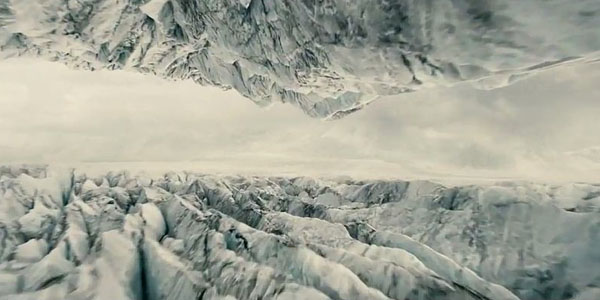
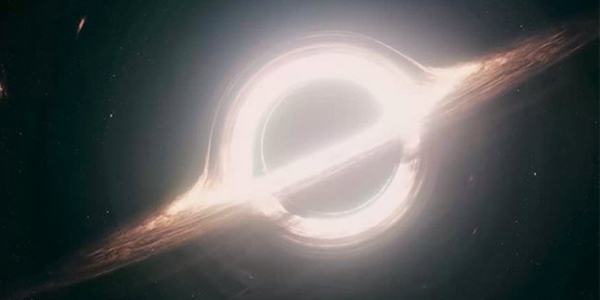
The Earth is a dustbowl; Miller's planet is covered in water, Mann's planet is covered in ice. And space is, well, space - empty and black. Then, just when you think there's going to be something visually astounding found in the black hole (something akin to 2001's stargate sequence, perhaps), even that gives way to discovery that the fifth dimension is - for Cooper - just endless corridors of book cases. It's almost like Nolan intentionally shot himself in the foot from the start to prove he could make something visually dynamic out of such drab settings. Some of the set-pieces set in space are, by contrast, breathtaking. The journey through the wormhole is spectacular, as is the slingshot move across the imposing, glowing Gargantua. But these aren't enough to compensate for a film that, for the most part, works in monotonous shades of beige and grey. With Nolan's usual DoP Wally Pfister gone off to direct movies of his own, acclaimed cinematographer Hoyte van Hoytema was drafted in to lense Interstellar. Responsible for the gorgeous Her and Let the Right One In, Hoytema's photography here is plain and unmemorable. Maybe he and Nolan didn't click, or maybe there was never much room to find optical inspiration on Interstellar in the first place.

3. The Length

For a while now, Nolan's films have been building in size and growing in running time. For Nolan, bigger and longer indicates the import of your film - it shows it's an epic. But whereas The Dark Knight Rises - with its panoply of characters old and new, as well as its various twists and turns - was overstuffed, Interstellar finds itself stretching out a thin plot over almost three hours. The film IS ambitious, so it can occasionally feel like it justifies the length, but it's mostly hollow, and at least half an hour too long. The biggest surprise, considering it's a Nolan film, is that some stretches are quite simply boring. Do we, for example, need to spend so much time on Dr Mann's planet when his basic motivation is only ever to steal the Endeavour? Beginning on his planet, we go from set-piece to set-piece, but they drag not just because the entire Mann sequence feels like a detour into a much duller film starring Matt Damon as the villain, but because - with the apparent lack of care for the characters - it feels like there's so little at stake. Also look to the moment in which the older Murph burns her brother's crops so he's drawn away and she can 'infiltrate' his open house that she has every right to just walk into. Nolan thinks he's adding tension, but really he's just unnecessarily extending another sequence.

2. The Logic

What logic? Within half and hour of discovering the super-secret last-ditch space project that will either save all of mankind or ensure it dies on a planet where all that's on the menu is corn, Cooper's hired as the lead pilot. There's no schooling on the mission, no training to acquaint him with the new equipment, and certainly no testing to check if his fairly crucial piloting skills are still up to speed after years spent kicking back on a farm. Thankfully, the rest of the crew at least decide to tell the man piloting their ship all the details of his mission once they're in space. There are other inexplicable elements just dropped into the story that also happen to have no bearing on the plot. What purpose does Cooper capturing the rogue drone serve within the story? What is the point in changing history regarding the lunar landings? Why even introduce Topher Grace's doctor as a character, when his only purpose is to confirm what we already know about the health of Tom's family and give Murphy a romantic interest? Still, all of these pale in comparison to the big one.

1. That Ending

Here's where the logic of the film goes haywire. It's ironic that one of the least Nolanesqe facets of the film is also the biggest problem of all - after two hours of explaining away what might come across as fantastical with real science, Cooper's descent into the black hole leads to a total reversal, in which Nolan for the first time allows his heart to rule his head. As Cooper enters the fifth dimension, he's informed by beings from the future that he was Murph's 'ghost' all along, leaving messages in Murphy's belongings in her room by using gravity. There is no universe in which gravity can transcend time and space. But even if it could, why would Coop rely on such a long shot in transmitting his message? Why leave the message for his daughter as a child rather than as an adult? Why not go back further and try to communicate with people before the world started to die? There's also the notion that Cooper would have had to communicate with himself from the future in order to set off the chain of events depicted in the film - but how did future Cooper get there in the first place to tell Cooper from the past to get there? Nolan seems to think he's raised a clever chicken and egg scenario, when really it's quite obvious in this case that one definitely did have to come first. Of course, much of the film is based on theory, but the entire ending just comes across as a ridiculous fantasy to neatly tie up the film. It's where Nolan's previously unseen sentimentalism, and where love transcending time and space, smashes the logic. Nolanites will defend the film to the end, claiming that what Nolan is TRYING to do is the same as him managing to do it. They'll cite the ambition, the intelligence, they might even claim the forgettable action sequences are something to write home about. But they'll have a hard time convincing themselves that an ending this shoddy is the best way to end Nolan's ninth - and worst - movie.

Contributor
Contributor

Lover of film, writer of words, pretentious beyond belief. Thinks Scorsese and Kubrick are the kings of cinema, but PT Anderson and David Fincher are the dashing young princes. Follow Brogan on twitter if you can take shameless self-promotion: @BroganMorris1