Oscars 2006: If We Picked The Winners (Best Actor)
 The good, the bad, and the mediocre: that's what you get with the Oscars, and in this article, I'll be highlighting the latter of the three. Whether in writing or in thought, it is actually an extremely useful exercise to analyze the middle of the road fare, for when we understand what separates the average from the excellent, we have a better understanding of the things that truly move us as human beings. If "it's all relative," then we sure as hell better know relative to what, and here we will now begin discussing the what. As a critic of the Academy (and who isn't), the question arises, was 2006 just a middling year for lead actors, or did the Academy, yet again, skip over superior work for more comfortable choices conforming to their typical patterns of familiarity? While maybe not the most stirring year for male lead performances, like almost any year, 2006 did have some above-par turns, but a typical Oscar nemesis reared its ugly head, preventing meritocracy from ruling the day. And what is this nemesis, you ask? It is the ensemble film. I don't know what it is about films with great ensemble casts that prevent the Academy from rewarding their individual actors (category confusion, cast cancellation?), but with a few exceptions (such as the first two Godfather films), multiple cast members from the same film are rarely nominated, no matter how deserving they all are. For 2006, the biggest example of a wronged actor is actually one of the nominees (which was undoubtedly part of the problem), Leonardo DiCaprio. As you will see momentarily, DiCaprio was nominated for Best Actor in 2006, but not for his career's best work as an undercover Boston policeman in Martin Scorsese's The Departed, but rather for his underwhelming role as a mercenary involved with the African conflict diamonds trade in Blood Diamond. How DiCaprio did not win, much less get nominated for The Departed is a mystery that only people in Hollywood know the answer to. It may have something to do with the fact that DiCaprio's costar in The Departed, Matt Damon, was also likely eligible for the lead category, and, likewise, gave one of his all-time best performances. As some sort of stupid compromise, instead of doing the right thing and nominating them both, some in the Academy may have decided to throw their weight behind DiCaprio's sub-par Blood Diamond performance. It doesn't make sense to me, but it's the type of reasoning the Academy seems to employ all too often. Another wonderful performance from a great ensemble film that was deserving of a nomination was Greg Kinnear as an aspiring motivational speaker in 2006's Little Miss Sunshine. Again, I'm not sure of which category most people placed him in, but as the dad of Little Miss Sunshine herself, if he is not considered lead, then I guess everyone in the film is "supporting". Another worthy, but categorically questionable, performance is that of Michael Sheen as former British Prime Minister Tony Blair in The Queen. It's one of the best portrayals of a modern political figure that I can remember (and one Sheen has done three times), but whether it should qualify as a lead performance is tough to say. For now though, let us take a look at the group of so-so nominees.
5. Peter O'Toole - Venus
 The Academy loves its veterans more than a small Midwestern town during a Memorial Day parade, and they show them their love by consistently showering unworthy old-timers with awards and nominations that would not be considered were it not for their reputation. This is especially the case for Hollywood veterans who have for some reason or another, failed to win an Oscar, such as Peter O'Toole. In fact, many times they make up for past transgressions by giving the "once-great" actor an Oscar for second-rate work (see Paul Newman's win for The Color of Money), thereby ripping off some more deserving young actor who they will inevitably have to reward for some inferior performance later on, starting an endless cycle of unjustly rewarding seniority over merit. The fact then the Academy didn't feel it was necessary to reward the legendary eight-time Oscar losing actor (which is more nominations without a win than any other actor in Oscar history), tells you something about the performance. Now don't get me wrong, I love Peter O'Toole. I consider his performance in Lawrence of Arabia as one of the all-time greatest performances in cinema history. It was a role he should have easily won for (although, the actual winner, Gregory Peck in To Kill a Mockingbird, is inarguably terrific as well). His performance in Venus though, while not terrible, is an all too common retread of the "dirty old man" role that was tired and trite when whoever originated it first made goo-goo eyes at some young pretty thing who could have any man her own age (or even middle-aged) whenever she desired. A beautiful young woman, hanging out with a dying old man, just so he can have some jollies vicariously recalling the days of his sexual conquest is the type of nonsensical sentimentality that I can't stand, and O'Toole does nothing new with the role to make it interesting. A suave, delusional, womanizer, O'Toole's Maurice acts exactly as you would expect him to, which is the problem. Peter O'Toole is a great actor, who should have won an Oscar at some point in his career, but I, for one, will not let sentimentality ease my analysis. This is a performance that was not worthy of winning, or even being nominated.
4.Leonardo DiCaprio - Blood Diamond
 Why Academy, why did you not nominate DiCaprio for The Departed? I know I already discussed this above, but I can not think of this nomination without anger boiling up over this ridiculous mix up. I want someone who voted to nominate DiCaprio for Blood Diamond over The Departed to explain to me their reasoning. What was it that you liked about his performance in Blood Diamond so much that it was somehow superior to his role in The Departed? Was it the crappy European accent? Or maybe it was the prototypical character arc, starting out as a brash, hubristic man who is "only in it for himself", moving on to a brooding fragile man with flaws and a "troubled past", and finishing up as the reformed self-righteous prodigal son who proves he "really was a good guy all along" by making an enormous sacrifice? Is that what suffices as good acting to you, hitting the preordained paces? As an accounted DiCaprio fan myself, it pains me to have to criticize the man this way, but in this rare occasion, I honestly don't blame DiCaprio that much for the misstep. For even though I do believe an actor is ultimately responsible for his or her performance, there is one man who I think should take the lion's share of blame for DiCaprio's formulaic performance, and that man is Ed Zwick. Zwick has never been a favorite of mine, to put it politely. In fact in my book, he has a sort of anti-Midas touch, turning everything he works on into pewter. Zwicks modus operandi, in films such as Glory, The Last Samurai, Defiance, and Blood Diamond, is to take subject matter of great historical or political importance, and turn it into an entertaining action flick. The result is almost always a coarsening and oversimplification of key issues and events that make his films hard to stomach, even when you agree wholeheartedly with the central moral of the story. The Academy clearly disagrees though, as Zwick has managed to be successful, particularly when it comes to his actors, in securing nominations. Still, if I was an actor, I would stay far away from a Zwick project. Many a fine thespian has turned in some of their worst performances under his stewardship, and unfortunately, DiCaprio's no exception. As much as I would have been tempted to vote for DiCaprio and just pretend I was voting for his performance in The Departed, the rules are the rules, and DiCaprio's paint-by-numbers turn in Blood Diamond is far from "Oscar worthy".
3. Ryan Gosling in Half-Nelson
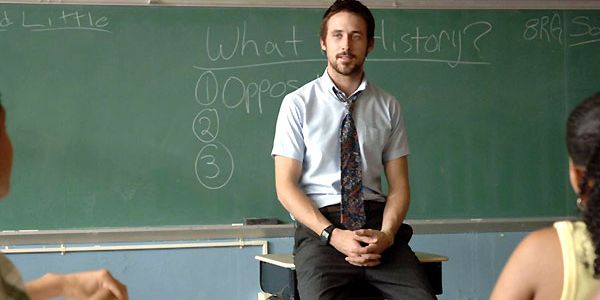 Ryan Gosling has emerged as one the preeminent contemporary movie stars over the last few years. After receiving rave reviews in the surprise hit of the 2011 Cannes film festival, Drive, Gosling followed that up by starring alongside Steve Carell in the big summer romantic comedy release, Crazy, Stupid, Love, and towards the end of the year, Gosling starred in, The Ides of March, the George Clooney-directed political thriller that received a Best Adapted Screenplay nomination. This year, he gave a stunning performance (my favorite of the year thus far) as a low-life bank robber trying to provide a future for his new born son in the underrated The Place Beyond the Pines and will be seen (but apparently not heard too much) in about a months time in his second collaboration with Drive director Nicholas Winding Refn in Refns latest directorial effort, Only God Forgives, which premiered a Cannes a few weeks ago to decisively mixed reviews. Interestingly, Gosling has built his movie stardom through the unusual route of becoming an art-house hero, because with the exception of The Notebook, Gosling has built his cult mostly through solid performances in independent films. One of the first of these was in Ryan Flecks Half-Nelson. While I have come to join the Gosling fan club due to his recent performances, I have to admit to disliking Half-Nelson with a passion and not being all that enamored with his performance in the film. Half-Nelson tells the story of an insufferably sanctimonious drug-taking junior high-school teacher who works in a poor urban neighborhood and quickly becomes a close friend and mentor to one of his students. The movie is everything I hate about "realist" cinema. Insincere, pious, and pretentious, the movie, however much it pretends to deny this, thinks it knows the world better than the world knows itself. The film uses Gosling's "too cool for school" schoolteacher (I know, how ironic, right?) as its chief proselytizer of this message, and in the process creates a character so ostentatiously didactic, that he makes your average college professor seem devil-may-care. As many issues as I have with Gosling's character though, the film's problems derive more from the direction than the acting. It is the film that canonizes this hip schoolteacher, not Gosling, and the fact of the matter is there are people in the world like the films protagonist and Gosling does an apt job of recreating the character. I may dislike the movie and its main character, but judging the performance objectively, Gosling does a sufficient job, showcasing the potential he delivered on in subsequent years and performances.
2. Will Smith - The Pursuit of Happyness
 Starting with his Fresh Prince of Bel-Air days, then moving on to become a major Hollywood action star in films such as Independence Day and Men in Black, seeing Will Smith competently take on the lead role in a dramatic awards season film was a bit of a shock to many. This led to what I believe to be grading on the curve for his performance in The Pursuit of Happyness. Rave review after rave review poured in all singing the praises of the rapper-turned-actors compelling portrayal of the true-life story of Chris Gardner, a man who went from a struggling salesman, to a homeless man on the streets with his son (played by Will Smith's real life son, Jaden), to finally, a wealthy stockbroker. It's an amazing story that is perfectly set up for the Hollywood schmultz treatment, which the movie does dabble in, although not to the extent of some of its contemporaries (The Blind Side anyone?). This tendency to trifle in the trite is unfortunately not only true of the movie however, but at times, also of Mr. Smith's performance. Instead of being a man doing his best to deal with the circumstances life has given him, in certain parts of the film he feels more like a man who knows, we know, that he knows, he is in tough a bind. It's a typical problem in melodrama, and as much as I would like to say that Mr. Smith avoids this pitfall, he does not completely. It is by no means a weak performance though, and when it works, it works well, which makes the adoring reviews understandable. Will Smith has always seemed to be a go-getter (which you would have to be to go from rap star all the way up to genuine Hollywood stardom), and this natural independent attitude is exactly what is called for the portrayal of Chris Gardner, a man who is obviously infused with the intangible entrepreneurial spirit. The relationship between Smith and his son is also very convincing and natural, which is no doubt helped by the real life rapport between Will and his son Jaden. It doesn't reach the heights of say Ryan and Tatum O'Neal in Paper Moon, but it certainly feels more natural and authentic than the father-sons most recent pairing, After Earth, which just monumentally tanked at the U.S. box office. Smith has always seemed one more concerned with his persona as a movie star than his reputation as an actor (which, because he wouldn't get to kill a bad guy, is why he turned down the lead in Tarantinos smash Slavery-Western, Django Unchained). Due to this, I, along with many others no doubt, will always be dubious of his attempts to really act in any serious manner, but overall, his performance as Chris Gardner is a fine one, and a performance Smith should be pleased with.
1. Forest Whitaker - The Last King of Scotland
 Now we come to the winner, Forest Whitaker in The Last King of Scotland. Out of the five nominees I do agree with the members of the Academy that he was the best, although to be honest, I'm not as crazy about the turn as many seemed to be. As soon as the movie hit the scene, and it was clear that it would be eligible for the 2006 Oscars, Forest Whitaker was anointed king of Hollywood (not Scotland) for his performance as Idi Amin, the despot dictator of Uganda during the 1970's who ruled over the African country with a tyrannical fist. As with Half-Nelson, the key here as an objective juror is to judge Whitaker's performance on its own, disregarding the subpar quality of the film itself. Exploitive, hokey, and unilluminating, the film surprisingly takes on the tone of a cheap "B" horror movie at times, but putting these facts aside for a moment, what are the merits of Whitaker's performance? It's definitely a good performance, unquestionably worthy of the nomination, but something keeps me back from embracing it as fully as I might of with say the performance of Javier Bardem in No Country for Old Man, or Heath Ledger in The Dark Knight. When I break it down, it's clear that this hesitation is due to the nagging notion that when watching Whitaker as Idi Amin, I am watching mimicry more than true thespian art. It is nonetheless a superb imitation, but much like Jamie Foxx in Ray, there is something lacking to the character as a person. Whitaker does infuse Amin with a jovial side, along with a merciless thirst for the blood of anyone who gets in his way, and for the most part, he doesn't overplay his hand on either side of the coin. The problem though is he doesn't really enlighten us to the man's philosophical core, instead turning the man into some treacherous super villain you might see in a comic book film. Now it's hard to put the blame for this directly on Whitaker, given as most of this responsibility falls on the films writers and director, but the great actors always manage to find a way, even in the minutest of details, to add something in order to flesh out a character. Whitaker does not do this with his version of Amin, settling for the straight up evil that inevitably leaves you cold. It is a great performance (don't believe I think otherwise), and there have been far worse performance that have passed the Academy's test of valor, but there's just that something special missing from the performance to categorize it as a true "tour de force". That concludes my take on 2006s Best Actor race, but let me know what ranking you would put the nominees in if you had your druthers in the comments section below, or sound off on what great performances from the year you think the Academy missed out on all together.