Star Trek: How Chris Pine Made Us Believe He's Kirk
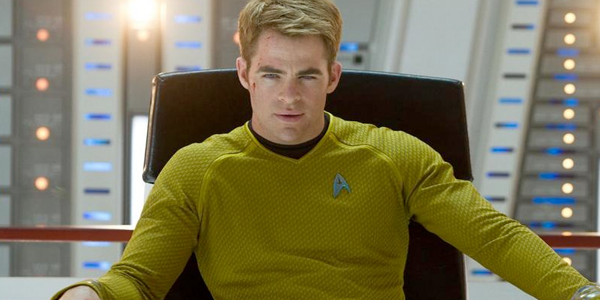 When actor Chris Pine was hired to play James T. Kirk in the J.J. Abrams Star Trek films, he knew he couldn't simply do an impersonation of William Shatner; it would have come across as parody. He had to find a way to capture the essence of Kirk without directly imitating the original actor. This was fairly easy in 2009's "Star Trek" because he was playing a very young Kirk something Shatner had never done. But with "Star Trek Into Darkness," Pine was required to take on the more familiar captain's role, and he manages to make it his own. Here's a look at five moments when Pine's performance made us say, "Oh yeah, that's Kirk!"
5. He Is Obsessed With The Enterprise
 Walking with Spock across the campus of Starfleet Academy, en route to a meeting with Admiral Pike, Kirk can barely contain his excitement. He is absolutely sure that the Enterprise has been chosen for Starfleet's first deep-space, five-year mission. It never occurs to Kirk that he is being summoned for disciplinary action. So when Pike tells him, "They've taken the Enterprise away from you," it takes several seconds for the realization to sink in. Then we see the light fade from Kirk's eyes. His identity and self-worth are tied to that ship, and when he loses command, he has nothing. Chris Pine conveys all this with subtle facial expressions, and his reaction is consistent with Kirk's single most defining characteristic. Many times during the original Star Trek series, we heard Kirk refer to the Enterprise as "MY ship." The depth of his obsession became apparent in the episode "The Naked Time," when a virus caused crewmembers to reveal their true emotions. On the one hand, Kirk seemed to complain that he wasn't allowed to have a personal life. ("This vessel I give, she takes.") But at the same time, he wouldn't trade "his" ship for anything in the world. Alone in an empty room, he whispered to the ship's walls, "Never lose you. Never." Yet the alternate-reality Kirk does lose the Enterprise much to his chagrin and the captaincy reverts to Pike. But later, there's an unexpected reprieve: Despite protests from Starfleet Command, Pike asks Kirk to be his first officer. When Kirk hears this news, he's overwhelmed with gratitude. ("I don't know what to say.") He understands that being second-in-command offers the only pathway back to the captain's chair, and he'd rather play second fiddle on the Enterprise than end up in charge of some obscure freighter.
4. He's A Tough Yet Inspirational Leader
 Kirk is younger than many of the people under his command, yet he has managed to earn the trust and loyalty of most of the crew. When he goes on an away mission and designates Sulu as acting captain, Sulu pauses for a second. Kirk asks him what's wrong. "I've just never sat in the chair before," Sulu admits. Kirk gives him an encouraging smile. "You're gonna do great," he says (and is later proven right). But he knows his main job as captain isn't to boost the crew's self-esteem; it's to give orders. And if those orders aren't obeyed, the ship's entire command structure could crumble. So Kirk is taken aback when one of his senior officers defies him. Scotty threatens to resign if Kirk brings long-range photon torpedoes aboard the ship. Kirk doesn't have a choice; he's following orders from Admiral Marcus. He argues with Scotty, who gives an ultimatum: Does Kirk accept his resignation or not? "I do!" Kirk shouts, and immediately looks stunned at his own words. Scotty, too, is shocked. He didn't expect Kirk to call his bluff. The two men stare at each other. Kirk looks simultaneously resolute and regretful. He likes Scotty as a friend and desperately needs him as chief engineer. But to maintain the discipline of command, he has to demonstrate that he means what he says. Being the captain also means accepting responsibility for everything that happens to the ship, whether or not it was his fault. When Admiral Marcus, speaking from the bridge of the Vengeance, vows to destroy the Enterprise, Kirk makes an impassioned plea for his crew. They were just following orders, Kirk says, and the decisions were his alone. "All I ask is that you spare them," he says. "I'll do anything you want. Just let them live." When Marcus refuses, Kirk turns to his crew and says, with sincere contrition, "I'm sorry." The scene echoes a similar situation in "Star Trek II: The Wrath of Khan," where Kirk addressed another vengeful madman: "Khan, if it's me you want, I'll have myself beamed aboard. Spare my crew."
3. He Values Friendship Above All Else
 Believe it or not, there is something more important to Kirk than the Enterprise: his relationships with his closest friends. This was beautifully illustrated in the episode "Amok Time," where Kirk was willing to sacrifice both his career and his life in order to save Spock. The Kirk-Spock friendship is also the central theme of "Star Trek Into Darkness," and there's a pivotal scene that sets the stage for what happens toward the end of the movie. Kirk and Spock have been barely on speaking terms since Spock wrote an incriminating report that got Kirk into trouble, causing him to lose the Enterprise. They've now been reassigned to different ships. But as they part ways, Kirk wants Spock to know that he doesn't hold a grudge. "The truth is, I'm gonna miss you," he says. The appropriate response would have been something along the lines of, "I shall miss you as well." Spock opens his mouth to reply, then hesitates. Kirk waits, hopeful and expectant. His expression is completely open and emotionally vulnerable. And then, the moment is gone. Suddenly impatient, Kirk walks away. He doesn't speak, but the look on his face clearly says, "Ah, the hell with it." Yet despite Spock's apparent inability to reciprocate and his tendency, at times, to be downright annoying Kirk refuses to give up on their friendship. One reason: He enjoys the unique give-and-take between them. Spock continues to insist despite ample evidence to the contrary that he is governed only by logic. Kirk knows this isn't true, and Spock knows that he knows, yet both men play along with this charade and secretly delight in it. For example, as Kirk is preparing for a mission to the Klingon homeworld, Spock says, "I would be happy to accompany you on the away team." Kirk looks at him with a teasing smile and says, "You? Happy?" It is in this scene that Chris Pine most resembles Kirk. It's shot from an angle familiar to us from the TV series, with Kirk in the captain's chair, looking slightly upward and over his right shoulder at Spock. The Vulcan later proves that he, too, is capable of teasing. When he reveals that Carol "Wallace" is in fact Admiral Marcus' daughter, Kirk is flabbergasted. "When were you going to tell me that?" he asks. "When it became relevant," Spock replies. "As it just did." The befuddled look on Kirk's face is almost identical to Shatner's reaction in "This Side of Paradise," when he came across his science officer hanging upside-down from a tree, laughing. (Spock had lost his emotional inhibition after being infected by alien spores.)
2. He Doesn't Want To Grieve In Public
 The original Star Trek series was filmed in the 1960s, when the societal norm was that men don't cry. That's why we almost never saw Kirk shed tears. Even in "The City on the Edge of Forever," when he had to allow Edith Keeler to die in a car accident so that history would not be changed, Kirk restrains himself. He's out there on the street, with a crowd standing around, and he doesn't want to make a scene by crying. But his clenched fist is shaking a telltale sign that it takes enormous effort to keep his grief in check. In "Star Trek Into Darkness," however, there is no holding back for Kirk when he sees the dead body of Christopher Pike. Kirk doesn't want to cry in front of Spock, but he can't help himself. So he does it almost silently, with his mouth closed, his fist gripping Pike's uniform. It's a smart performance from Chris Pine, who manages to show Kirk simultaneously restricting his grief and giving in to it. Then, in less than a minute, Kirk regains control. He takes a deep, trembling breath and pushes himself away from Pike's body. Other than lightly touching Spock's shoulder to steady himself, he does not interact with the Vulcan. He slowly walks away, feeling too drained to speak. Some fans may contend that Kirk should have remained stoic. But what happens to him in this movie is much more traumatic than the events of "City." Let's be honest: Kirk only knew Edith Keeler for about a week. How deep could his attachment really be? By contrast, Christopher Pike was arguably the most important person in Kirk's life. By luring the wayward young man into Starfleet, Pike rescued him from a meaningless existence and gave him a sense of purpose. But Pike was far more than a mentor; he was the father figure Kirk never had, even referring to him as "son." Seen in that context, Kirk has essentially experienced the death of a parent. No wonder McCoy is so concerned about his state of mind.
1. He Despises Khan
 After initially questioning Khan in the brig, Kirk is preparing to leave when Khan taunts him, stopping him in his tracks. Spock warns him not to respond to the prisoner, but Kirk says, "Give me a minute." At this moment, Chris Pine truly seems to be channeling Kirk. With his back ramrod straight and his arms held stiffly at his sides as if at attention (a posture Shatner often used when he wanted to project an air of authority), Kirk pivots and marches back toward Khan. In a low, menacing voice, he says, "I was authorized to end you. And the only reason why you are still alive is because I am allowing it." His quiet fury here is reminiscent of a previous encounter between the original versions of Kirk and Khan: "Kirk ... You're still alive, my old friend." "Still ... old ... 'friend.' You've managed to kill everyone else, but like a poor marksman, you keep missing the target!"