Star Wars: 12 Homages To Classic Cinema In The Last Jedi
Made by cinephiles for cinephiles.

Dating all the way back to May of 1977, Star Wars has been a franchise founded on an undying love of cinema. George Lucas' original, Kurosawa-indebted film was the culmination of all of his greatest loves, intertwining to create something entirely new. The film wore its love on its sleeve and acted as though its homages were badges of honor.
Forty years later, Rian Johnson has delivered an installment that accomplishes a similar feat. While Johnson makes a huge point of referencing and subverting expectations brought on by prior Star Wars films, he also packs the film to the brim with homages to cinematic classics.
This should come as no surprise to anyone familiar with Johnson's work. His debut film, Brick, was a giddy film-noir homage with a high school setting. Johnson demonstrated an incredibly adept ability to weave genres early on, and this ability only grew in power. By the time he was making Looper, he was able to seamlessly weave together the tales of open-world sci-fi and intimate western into one incredibly affecting, cohesive product.
This strength and his love of cinema carries over into his take on Star Wars. The result is the most brazenly original installment in the franchise, that is absolutely not afraid to wear its homages proudly.
Let's take a look at some of the films that most inspired Johnson, and exactly how he repaid them.
12. Twelve O'Clock High

This classic WWII film tells the story of a select group of fighter pilots. Its style and cinematography played a huge role in inspiring the opening space battle above D'Qar. The film centers heavily around bombers and their use in the war.
Johnson has spoken publicly about this film and the impact it had on him when crafting the film but prior to release, few would have expected just how prevalent said impact is.
The Battle of D'qar features the use of the newly-incorporated Resistance Bombers and tells the tale of Poe Dameron's ragtag team of Resistance fighters taking on a gargantuan foe. The Resistance Bombers are slow-moving and unable to truly defend themselves, instead relying on the use of smaller crafts to help lead them to their goal, which is exactly how the pilots operated in Twelve O'clock High.
Even once the film focuses in on the individual struggle of Paige Tico as she attempts to drop the payload, the entire affair could not feel more like a WWII film. It chronicles the struggle of the pilots as a team in trying to deliver the payload, as well as playing up the impact of the choices and fears experienced by each individual.
It is a powerful opening sequence, made all the more affecting for just how harrowing and real it feels as a result.
11. Rashomon

Kurosawa's classic film was an existential meditation on the nature of truth in cinema and one of the very first films to utilize an unreliable narrator. The entirety of the plot is composed of multiple iterations of the same incident but from a different perspective each time. As a result, the story is drastically altered each time, depending on who is telling it.
Johnson utilizes this same technique to great effect when it comes to the relationship between Luke and Kylo Ren. On three different occasions throughout the film, we are told the story of what happened the night Kylo turned on Luke.
The first version told by Luke paints him to be the victim of the memory. He was but a well-meaning teacher, whose pupil turned against him and destroyed everything he loved. The second telling is when Kylo recounts waking from his sleep to find a menacing master standing over him with a drawn lightsaber. Thus, Kylo's version paints him as the victim of the story, simply fighting back against his murderous master.
The final time we see the memory unfold is from Luke once again, but this time is a more open and honest version. Here, Luke opens up about his guilt and doubt, and how that leads to Kylo's reaction. In using Rashomon's structure for these stories, the film offers deeper insight into both Luke and Kylo's characters and allows us to see their world through their own eyes.
10. Back To The Future

One of the major new inventions that loom heavily over Last Jedi's story is the First Order's use of a tracker that can successfully track a ship through lightspeed. This tracker is what nearly dooms the Resistance and dwindles their forces, as they are rendered incapable of escaping.
Finn and Rose wind up embarking on a journey of their own to find a way to disable this tracker so that the fleet can escape, undetected. When this device is shown though, it is a bit of a revelation for more reasons than one.
The device's appearance is uncannily similar to that of the flux capacitor from the Back to the Future franchise. In those films, the flux capacitor is what allows them to successfully travel through space and time. The First Order's tracker in Last Jedi accomplishes a similar feat, allowing them to track ships through both space and time.
This is a fun nod to a fellow sci-fi franchise, that Doc Brown would be proud of.
9. Citizen Kane
Orson Welles' seminal classic may seem like a hefty load for a Star Wars film, but when Johnson goes for it, he really goes for it.
Rey's cave sequence on Ahch-To has a direct visual homage to a legendary shot from Welles' masterpiece. When Rey reaches out to touch the reflective surface inside of the cave, she becomes entrapped within it. Here, she sees a never-ending line of multiple versions of herself, all of which mimic the reactions of her own, delayed by mere seconds.
In Citizen Kane, a rather crucial shot sees Kane himself passing between a hallway with two mirrors. As he does so, the mirror we see creates a visual illusion, displaying an infinite line of Kanes, all of which are slightly delayed repetitions of one another.
This homage is a subtle but brilliant one, as Kane and Rey find themselves in similar places thematically. Whereas Kane wishes to return to the joyful bliss of his childhood, Rey wishes to return to the sense of belonging she feels she will find in her parents, who abandoned her as a child. They are both caught up in their childhood issues, and this visual representation of the ramifications and uncertainty of their actions is incredibly astute.
8. Wings
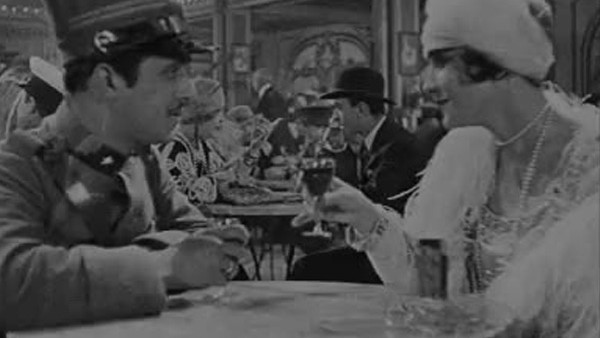
This 1927 film was the first-ever Best Picture winner, and deservedly so. It pioneered camera techniques, with results that still wow to this very day. One such shot was a dolly shot that careens across a busy restaurant floor. It looks as effortless as if the camera were floating, but took hours upon hours to perfect.
Rian Johnson takes this shot and recreates it, with a bit of Star Wars flair. When Finn and Rose arrive on Canto Bight, a recreation of this exact shot is used to give us an extended look at the hectic floors of the casino. The shot serves to further amplify the wonder that Finn is experiencing in finally seeing some of the stranger corners of the galaxy come to life before his very eyes.
If you needed any further proof that the shot was a deliberate homage to this fairly obscure beauty, Johnson confirmed it himself on Twitter after an eagle-eyed viewer noted the similarities.
7. Bond/Jones
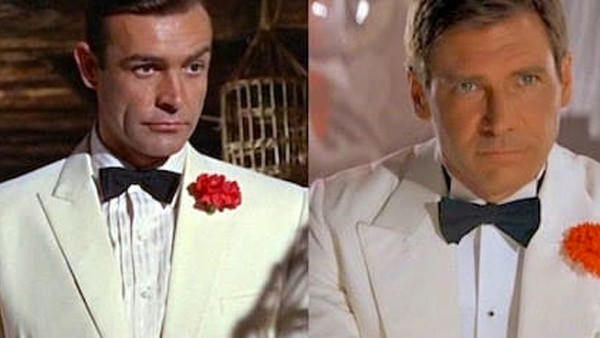
This particular homage is harder to nail down to a single film, as it is actually an extension of an homage that Spielberg and Lucas himself pulled back in the '80s.
When Finn and Rose are on Canto Bight, they are looking for a master code breaker with little to no success. All they know about him is that he'll be wearing a red plum bloom on his jacket. They eventually do find him, though he's of little help, and his attire fits the description and then some.
Dressed in a white tux jacket, with a black bow tie, and a red plum boom on his lapel, Justin Theroux's cheeky cameo is a direct callback to two of the suavest men to ever grace the silver screen; James Bond and Indiana Jones.
The get-up was originally worn by Sean Connery's 007 in Goldfinger. When Spielberg and Lucas were crafting their follow-up to Raiders, they decided to throw in an homage to Goldfinger, by having Harrison Ford's professor also sporting the same look. In continuing and expanding the long-standing homage, Johnson keeps it all in the Lucasfilm family.
6. Casablanca

This classic romantic drama is remembered for its performances and one-liners, but what is perhaps forgotten is just how chock-full of paranoia and dread the film can be. Set against the backdrop of WWII, the film chronicles the misadventures of the unlucky people living in the lawless land of Casablanca circa 1941.
In one particular sequence, in order to prove his allegiance to the cause, Berger displays a hidden compartment in his ring. The compartment displays the Cross of Lorraine, which served as a sign of loyalty at the time. One of Last Jedi's additions to canon was a ring very similar in nature.
In the film, Rose sports a ring that has a hidden compartment that displays the Rebel insignia. Rose reveals it to show the fabled 'broom boy' that she and Finn are with the Resistance. The ring again makes an appearance later on in the film, on the hand of said boy as he stares up at the night sky, hopeful for the future.
It is a beautiful moment, made all the more touching by this well-placed homage. The symbol of the Rebellion inspires hope in the downtrodden of the galaxy, just as the Cross of Lorraine did so many years ago.
5. Amblin

During their escape from Canto Bight, Finn and Rose ride atop the back of the fathiers. During this sequence, they destroy the casino itself and ultimately are able to ride to safety and set the fathiers free.
Everything about this sequence screams vintage Spielberg. For starters, there is a shot inside of the casino that shows a full glass rippling with vibrations from their footsteps before overflowing and crashing to the ground. This is a near-exact reference to the infamous scene of the T-rex's arrival in the original Jurassic Park.
Once the fathiers break free from the casino, they jump down to the beach. As they do so, we are given a gorgeous shot of them running along the sand, against the backdrop of a couple of glowing moons. This shot is highly reminiscent of Spielberg's most famous work, the shot of Elliot and E.T. flying against the moon.
Not to mention that John Williams' composition playing over it all is incredibly similar to the work he has done for decades as Speilberg's go-to composer. All of this works incredibly well for the film, as this sequence and Spielberg's filmography sport incredibly similar themes.
We all know Spielberg loves returning to themes of parenthood, and the creatures are called fathiers. This is no coincidence.
4. Vertigo

At the tail-end of the fathiers sequence, Rose and Finn are abruptly thrown from the backs of their new companions and they very nearly fall off the edge of a cliff. As Finn and Rose look down at the drop beneath them, we are treated to the age-old Vertigo shot.
The Vertigo shot is a dolly zoom shot that creates an uncanny, in-camera effect that makes the subject seem elongated or stretched in a strange way. The reason this is more commonly known as a Vertigo shot is because of Alfred Hitchcock. The legendary director pioneered the shot in his immortal classic, Vertigo.
In that film, as James Stewart scales to dizzying heights, the shot is used to re-emphasize the height and danger inherent in the scene. The shot has become a cinematic go-to in the decades since Vertigo, with several films using it in different and unique ways.
However, Last Jedi goes a few steps beyond the typical reference, in that it is a near-exact recreation of the shot. Finn and Rose may be looking over the edge of a cliff, but the shot's purpose and placement are exactly the same as they were for James Stewart all those years earlier.
3. Tokyo Drifter
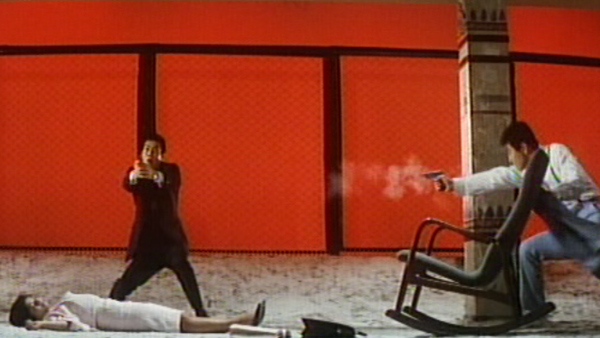
Similarly to Lucas before him, Johnson is clearly infatuated with Japanese cinema, and this bleeds into his work on Star Wars. Specifically, the lighting and cinematography work of Seijun Suzuki plays a large role in the film. This is especially true of the scenes in Snoke's throne room.
The sheer red-drenched opulence of the set itself is an immediate harkening back to one Suzuki's most famous scenes from Tokyo Drifter. The key sequence in Snoke's throne room goes on to be one of unexpected, brazen death and break-neck action sequences. Said famous scene from Tokyo Drifter shares many of these same attributes, acting as an unknown force in the equation of the film.
Throughout Tokyo Drifter, vibrant colors are interwoven into the story and used in innovative ways to relate to theme and character. Last Jedi pulls off a similar usage with the color red. Red is a recurring motif throughout Last Jedi, as recently commented on by the film's cinematographer, Steve Yedlin. The color red as a long-standing association with evil in Star Wars, yet Last Jedi is able to take that and twist it for all it is worth, using it as a color-coding device for thematic material. From Kylo's unstable lightsaber to Snoke's throne room to the smoke on Crait, red is a tell-tale sign.
This use of color in cinema comes straight from Suzuki's films, and it is incorporated in an incredibly effective fashion throughout Last Jedi.
2. Masada
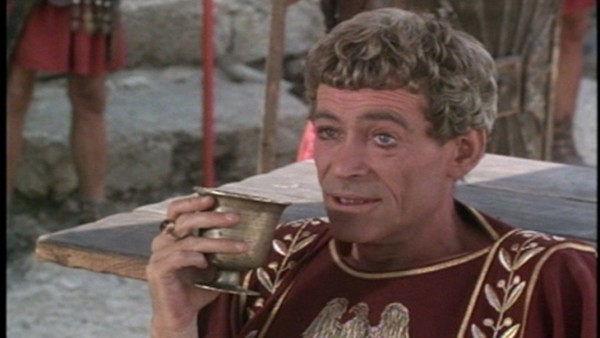
As recently revealed by Johnson, this event mini-series of the '80s played an integral role in shaping the finale of the film.
By the time the Resistance make it to the surface of Crait, they are in critical condition. They are grossly outnumbered by sieging First Order and forced to barricade themselves into the deserted Rebel base. This results in a finale that is essentially a high-concept, sci-fi recreation of the finale of Masada, a fact which Johnson pointed out;
"This big walled city and the battering ram that the Romans were building, to build up, I just remember how terrifying that battering ram was. So that's actually the pull for me."
The First Order's use of the superlaser siege cannon is the Star Wars equivalent of exactly that, as they attempt to burst through the wall protecting the Resistance. This homage serves a similar purpose to that of the opening battle's reverence for Twelve O'Clock High; it provides an added layer of realism and stakes to the world of Star Wars.
By rooting the idea of it in historical fiction, it creates a meta-narrative about the nature of war itself, making it all the more impactful.
1. Siegfried

Though not precisely a film, the impact of Wagner's operas are immeasurable on this newest installment in the Star Wars franchise. And that is not a sentence I ever expected to write.
This classic opera tells the tale of Siegfried, a human boy who has been a foster child for years. He is forced into a battle and story that is not his own, in which a broken sword plays a heavy (literally and thematically) part. Any of that sound familiar?
Rian Johnson confirmed as much on Twitter when asked about the connection.
Several aspects of Rey's characterization in Last Jedi seem to be directly influenced by Wagner's iconic opera, including the larger decisions Johnson made about Rey's parentage. While the easy and obvious choice may very well have been to simply label her a Skywalker, a Solo, a Kenobi, or what-have-you, he instead opted to make her an outsider.
Siegfried is ultimately left to re-forge the broken sword Nothung, which is left to him. Similarly, Rey ends Last Jedi holding the broken fragments of Luke's lightsaber - a sword left to her.