Star Wars: Rogue One Review - 8 Ups & 2 Downs
This is how you do a Star Wars prequel.
Rating: ★★★★☆
The Force Awakens brought Star Wars roaring back to life.
Fast forward almost a year to the day of that movie's release, and it's time for another instalment in the Star Wars franchise, albeit a markedly different one.
On the face of it, Rogue One doesn't have the pressures that accompanied J.J. Abrams' Episode VII; there's less hype and expectancy, no atoning for the prequels. Star Wars is already back, so Rogue One has more freedom.
And yet, while that helps, it still has its own unique task to accomplish. Standing outside the Skywalker saga, and the first of a number of planned anthologies, it must prove that Star Wars can stand alone. That when you strip away the Jedi and Sith (for the most part), the lightsabers and Luke, the Force and the Falcon, it's still worthy of being a Star Wars movie.
That Rogue One does that is a hell of an achievement. It's not a perfect movie, but it's one that shows Disney and Lucasfilm know exactly what they're doing here. It may be Opening Crawl: The Movie, but it's so much more besides. Here's a spoiler-free look at what Rogue One got right, and what didn't quite land.
8. It Looks Stunning

Given the many looks at the film we've had through the trailers and TV spots, this one should come as no surprise. Doubly so given Rogue One is the work of Gareth Edwards - his Godzilla had some faults, but visuals sure weren't one of them.
Like all good Star Wars films, there are plenty of practical effects here, and Edwards and his team blend them seamlessly with the CGI efforts. The various worlds that we visit, in particular Jedha, are painstakingly created to have that Star Wars feel. There's a real sense that this is a lived-in universe, one with plenty of dirt and grime, and at times the aesthetics hue so closely to the Original Trilogy it's sometimes hard to believe the films have been made 40 years apart.
Whether it's in the swooping space battles or the grounded action, the big set pieces or the smaller scale production design, it's a feast for the eyes. Edwards and cinematographer Greig Fraser combine to deliver something familiar, but with plenty of new spins too, with different colour palettes, and putting us more in the action than ever before.
7. The Connections To A New Hope

While Rogue One is presented as a standalone movie, that's quite obviously not true. Sure, we're not going to see Rogue Two (unless we're gonna get that movie about the Bothans and the second Death Star - and hey, if it's as good as this then bring it on), but the sequel does exist in the form of Star Wars (or 'A New Hope', if you prefer).
While I won't say exactly how close the movie gets to the start of that film, it does do a superb job of bridging the gap between the two. Upon watching the movie and seeing the events unfold, you know where you are in the story, and are left with a desire to go home and immediately re-watch Episode IV.
That may be where the connections end, but it's not where they start. It may be an anthology, it may have a rather different tone, but Rogue One still ensures to connect back to the bigger picture. There are a number of cameos and returning characters, from Genevieve O'Reilly's Mon Mothma to Jimmy Smits' Bail Organa, and from some impressive CGI recreations to a little fella called Darth Vader. At times it may come close to overdoing it - some characters or lines of dialogue crop up as if to just say 'look, it's Star Wars'.
But overall, from the aesthetics to the Rebel Alliance to the Death Star itself, it ties itself to A New Hope without being fan service or feeling pointless. Prequel has long been a dirty word among Star Wars fans. Rogue One means that should no longer be the case.
6. All The Rebels Are Great

To a degree, the ensemble of Rogue One means that the main players in the rebellion suffer a little from a lack of characterisation. We move quickly through their backstories, and there's little time to flesh them out (it also doesn't help that there's only one movie to do this in, whereas most iconic Star Wars characters have a full trilogy to evolve).
That said, the characters are so fun and interesting to be with in the moment that it's easy to overlook the flaws of them. Of the humans, Donnie Yen's Chirrut Îmwe is the clear scene-stealer. The blind warrior monk is, on a conceptual level, one of the most interesting characters in the film; someone who isn't a Jedi or Sith, but is a huge follower of the Force, and attuned to it in some sense. The film plays around with that, from his repeated prayers to his stylised takedowns of multiple Stormtroopers at once.
Chirrut forms a nice double-act with Jiang Weng's Baze Malbus, a gruff assassin who serves as his de-factor bodyguard, with a relationship reminiscent of R2-D2 and C-3PO. Diego Luna's Cassian Andor is the dependable Rebel veteran, one not afraid to get his hands dirty, and Riz Ahmed's Bodhi Rook - an Imperial pilot who defects - gets a few nice beats to play as well, both comedic and in becoming a hero. They all get their moments, and each comes away with at least one highlight.
Leading them all, of course, is Felicity Jones' Jyn Erso. While presented as your typical Star Wars lead - a young farmgirl whose parents are killed - there's less of a parallel with Luke and Rey. If anything, she's more closely aligned with Han and Leia; his rebellious nature and occasional cockiness, her ability to step-up and be the leader the Rebels need. Jones handles it deftly, providing the film with a clear anchor.
5. Another Droid We Were Looking For

There's one member of the Rebel team - Rogue One, as they call themselves - not mentioned previously, and with good reason. K-2SO is, of any of them, the one worthiest of his own mention.
You've probably heard by now that Alan Tudyk's motion-captured, reprogrammed Imperial droid steals the show and, in the wise words of Han Solo, it's true. All of it.
Kaytoo is simply an absolute delight to watch. In essence, he's a take on C-3PO in much the same way BB-8 was a riff on R2-D2. But whereas there's some debate about which little astromech you prefer, there isn't likely to be any with these walking globs of grease. Kaytoo has the some struggles to understand the humans around him, but whereas Threepio could come off as annoying, the new droid on the block is hilarious.
Tudyk's delivery nails the sarcasm, with pitch-perfect timing and the sort of wit we've come to expect from the actor. He gets the best lines and provides the most comic relief, but he's also an essential part of the rebellion, and shows his usefulness, resourcefulness, and kicks a lot of ass.
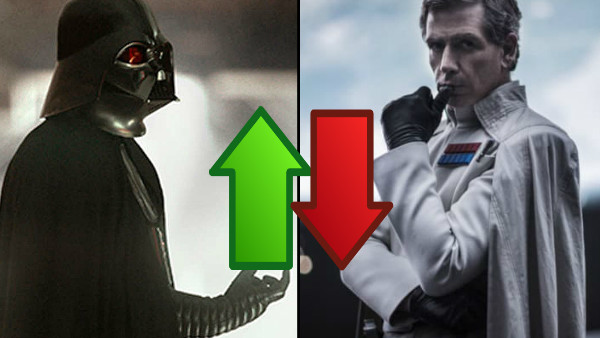
4. Darth F**king Vader

Darth Vader isn't in this movie *a lot*. Don't go expecting this to be the Darth Vader show. But do expect him to steal it.
Bringing back the Sith Lord was an interesting move, in that he's a Force-user in a movie ostensibly without it. Too much of him, and he could overshadow everything. Too little, and you'd either be left wanting more, or wondering what the point was.
Suffice to say, the got it pretty much spot-on. He's used sparingly, but it always feels essential when he's on-screen, and never does it seem like he's just there to show it's Star Wars or that he's being wasted here.
Best of all, though, is the sheer menace he conveys. This is the Darth Vader that Star Wars fans have been dreaming of seeing on screen after what the prequels did with Anakin. He is, at times, absolutely terrifying here, and has moments that rank among his very best in the entire saga.
3. Putting The War In Star Wars

War has always been a part of Star Wars. I mean, obviously - it's in the bloody name. The other movies have shown us conflicts, dived into battle, dealt with loss and despair. It's nothing compared to what Rogue One does with the idea.
This is as much a war movie as it as a Star Wars movie, taking from classics of that genre as much as it does A New Hope. As mentioned earlier when discussing the aesthetics, this is a film that's not afraid to show just how dirty it all is. The film is grimy, gritty, and realises the galactic conflict on a completely different scale.
You'll probably hear a lot of remarks like 'this is Star Wars for grown-ups', and while that's a little reductive, there is a degree of truth in it. This movie gets pretty dark at times, and presents the Rebels as much as the Imperial forces as people who'll do whatever it takes to win. They aren't just a happy-go-lucky bunch of good guys, but assassins, spies, and saboteurs.
Edwards does a superb job of showing all of this. We know people die in Star Wars, we know the conflict causes unspeakable damage. But Edwards here shows it, and shows it, and shows it. Heroes, villains, random extra you hadn't seen before, they die. And Edwards really excels in getting right into the battles, showing it on scales both grand and intimate (thanks to some excellent hand-held camera work), and the dread that follows these characters around.
2. The Entire Final Third

Star Wars: Rogue One is a very good movie. It's 2 hour runtime zips by, it fleshes out the galaxy and the Galactic Civil War, shows us a different side to the Rebels, gives us some wonderful new characters to root for, and is just a thoroughly entertaining ride. For the first two thirds, though, it doesn't really move above being very good. That's not a bad thing, of course - if all movies of that quality, cinema would be a much better place.
The final third, however, is on a completely other level. Heading on to the paradise-like location of Scarif, it's vintage Star Wars, in the way it's climax intercuts various different storylines and levels of battles, from the ground all the way up the sky.
But it also manages to be something else entirely. The final third of the movie is completely breathless; it'll leave your heart racing, your eyes bulging, your jaw dropping. If the movie as a whole is an 8/10, the final third is probably a perfect 10.
1. A Star Wars Story Worth Telling

At the crux of the potential success of Rogue One, and the whole notion of these anthology movies, is whether there's any point. Is there a genuine storytelling need for this movie, or are they doing it to milk the cash cow that is Star Wars?
While the money undoubtedly helps, the answer is a resounding yes, there was a clear purpose to this story. The biggest credit that you can give to the writers is they make this story, which occupies only a small part of that original opening crawl, something truly essential.
The way they use the information they have and build out from there, through Galen to Jyn and Jedha to Scarif, makes for a surprisingly compelling narrative, and a truly worthy Star Wars Story. Rogue One is with the Force, and the Force is with Rogue One.
Downs...
2. Giacchino's Score Doesn't Distinguish Itself

In fairness to Michael Giacchino, he didn't have a lot of time to work on Rogue One. Alexandre Desplat was originally set to score the movie, but when it came to those much-publicised reshoots, he had to drop out due to scheduling conflicts. Giacchino, who is a regular collaborator with The Force Awakens' director J.J. Abrams (and made a cameo in that movie) stepped up to the plate.
Unfortunately, that lack of time shows. Giacchino is no slouch when it comes to scoring big movies, most notably his utterly stunning work on Up. Here, however, he never really gets to put his own stamp on the movie.
The score's strengths come when Giacchino reworks some of John Williams' iconic Star Wars music, such as the Imperial March. There, the composer does a sterling job. But it's in creating something that stands as his own he falls short. There's no original theme here that stands out, with the ones not riffing on Williams feeling more like general blockbuster. Not bad, but not Star Wars.
1. Krennic Is Underwhelming And Overshadowed

Ben Mendelsohn does a pretty good job with Director Orson Krennic, a snivelling, smarmy member of the Imperial forces who is determined to climb his way up the ranks, hoping to get full credit for his superweapon and impress Lord Vader and the Emperor.
He's fine as just a mid-level member of the Empire, but falls short here when he's supposed to be the primary antagonist for our Rebel heroes. It's hard to buy him as anything more than that careerist, and he's castrated by spending so much time arguing with his fellow officers and being beaten to the punch by the Rebels. And with the presence of Vader and another villain looming large, he doesn't get the chance to make the necessary impact that sells him as the main bad guy of the film. (Of course, it's a bit less of an issue when your other bad guy is Vader.)
All that said, I feel the need to end on a more optimistic note. Rogue One is another stunning entry into the Star Wars saga and, for the future of the franchise outside of the Skywalkers, it gives a lot of... hope.
What did you think of Rogue One? Let us know down in the comments.