Terminator Genisys Ending: What Does It Really Mean?

An in-depth analysis of "WTF just happened?!"

Terminator Genisys is, without a doubt, the most complicated film in the franchise yet. Of course, Terminator was always a bit convoluted, throwing out paradoxes as if they're going out of style, but while in previous films the time travel was more of a narrative device to get the chase movie going, in Genisys the timey-wimey goodness is integral to every beat of the plot. This can mean any post-movie discussion is less about what worked and what didn't, and more just trying to iron out who sent what robot to what year from what timeline. You certainly don't need to have your brain engaged in full gear to follow the movie, but to understand its wider mythology takes a bit of hard thinking. So let's break it down, figuring out what exactly happened, what it all means and what it says about the franchise's future. Needless to say, MAJOR SPOILERS are present throughout.

What Actually Happens?

Before focusing in on the minutia, let's get the broad strokes of the story as simply stated as possible. Terminator Genisys starts off going over the ground of the original movie. In a post-apocalyptic war between machines and humans, Skynet sends a Terminator back in time to kill Sarah Connor, mother of Human Resistance leader John Connor. Kyle Reese is sent back to stop it, which in the original timeline led to him becoming John's father. But this time things are different. The T-800 and Kyle arrive as they did in the original, but then things take a bit of turn. Because of some meddling in the future, Sarah Connor is now a badass accompanied by an aged T-800 Guardian (affectionately known as Pops). Together the trio manage to stop both a rampaging T-1000 and the original Terminator, before turning to the bigger picture. They travel to 2017 in an attempt to avert a new Judgement Day, where Skynet is posing as cloud software Genisys. The engineer of the whole thing is John Connor, who has been turned into a part-man, part-machine by Skynet and sent back to ensure the nuclear war happens in the new timeline. In the end, Pops disintegrates John in his rudimentary time travel machine, which also destroys the Cyberdyne building and Skynet with it. The Guardian fuses with liquid metal to become a mash-up T-800/T-1000 and he, Sarah and Kyle (after doing some timeline sorting) head off to a new, safe future. So now that's clear, let's take a deeper look at what this all means (click next)...

So, What's The Terminator Timeline Now?

The best way to look at the timeline of the original Terminator is as a loop - Skynet sends a Terminator back in time to stop the birth of John Connor, but in doing so leads to Kyle Reese actually fathering the leader. The later movies add more ambiguity to the mechanics, but that Grandfather paradox is the general idea. Genisys jumps off from that flat circle, with some unclear force (we'll get into what it could be later) altering the timeline by sending Terminators back to an earlier point, 1973, which sends everything in a different direction. In 1973, a Terminator tries to kill Sarah as a child and she meets Pops. This creates a new timeline. In 1984, Kyle Reese travels back in time, meets Sarah, and they plan to go to 2017. In 1997, the original date of Judgement Day, nothing happens. Then, in 2017, they avert the new Judgement Day. The important thing to take from this, however, is that each timeline functions independently of the others, almost like a different dimension - travelling back doesn't erase the future, but make a new, different one. The other futures still exist in an alternate universe, which is how Kyle and John can jump from one to another, and also how Kyle can get visions/memories from another version of himself - it's travel in time and reality.

What Happened To Sarah In 1973?

The timeline splits in 1973, when the T-1000 is sent back to kill Sarah as a child. It finds and murders her family at their lake-house, but before it can complete its mission is apprehend by a young Pops, who takes Sarah away. It's a pivotal moment, the key to all the later time-meddling, and yet the film doesn't spend much time explaining what's going on. The T-1000 is clearly sent by Skynet, the latest in a long line of attempts to wipe out the Connors. And, as it's the start of the timeline fracture, it's likely instigated by Matt Smith's Skynet after he turns John into a machine (probably sent assuming that the T-800 sent to 1984 would be defeated by Kyle Reese). It is thus both an extension of the original approach and a way to build a new timeline with a new Judgement Day. It's never stated in the film, but the producers have confirmed that the T-1000 from 1973 is the same one that we see in 1984, played by Byung-hun Lee. This means that in the eleven years between attacks, Sarah and Pops have been perpetually on the run, trying to find a way to defeat him. That explains why they had the time to set up all those acid barrels.

Who Sent The Guardian Back?

The biggest unanswered question at the end of the film is who sent The Guardian (Pops' proper name) back in time. We've just about grasped what's going on with the T-1000, but it's a lot trickier when you get to Arnie. The mystery around the man/machine that programmed him is alluded to multiple times, but is left teasingly open (probably for a sequel - the writers say they do know who it is). As he's there to combat the T-1000, he must come from the original future (probably the same batch as the 1984 T-800, the feet of which are seen in the opening). That would rule out it being someone who only became key in the new timeline (like O'Brien, who would be an otherwise perfect fit), so the only logical candidates are either Skynet or a key member Resistance. However, the malleability of the timeline means it could feasibly come from elsewhere, so we really don't know. What is more open to discussion is Pops' long-term purpose. His mission is ostensibly to ensure the survival of Sarah Connor (he only attacks John because he already knows he's a robot) and never wavers from that, so he's either an out-and-out good guy, or being incredibly duplicitous. The answer to that is the key to who is calling the shots. At the moment there's simply not enough evidence to say what that is, but you can bet it'll be a key part of the sequel.

What's The Deal With The Guardian's New Body?
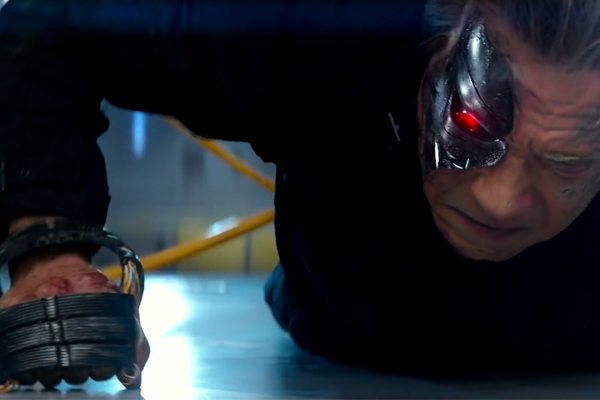
Just before the time machine blows up, ripping John apart, Pops is thrown out and into some gloopy liquid metal. He's presumed dead, but shows up minutes later to free Sarah and Kyle, revealed to have become some T-1000/T-800 hybrid (a T-1800? T-800000?). This is a major step forward in the Terminator mythos (almost as ground-breaking as turning humans into machines), but is actually pretty grounded in the logic presented in the earlier movies. Pops isn't a proper T-1000, but for all intents and purposes he will operate pretty much like one. So how did this happen? The T-1000 substance needs a CPU to consistently hold shape - thus far John's only been able to temporarily replicate vague human forms using lasers - which Pops' open skull provides. He's now totally independent of the T-800 skeleton, but due to his specifically formatting 'brain' retains the same shape and, more importantly, the same programming, meaning he's essentially dealt with his problem of being old and obselete.

How Can John Exist If He Isn't Born?

At the end of The Terminator, Sarah muses on the paradox central to the series - if John doesn't send Kyle back, then he can't be born. This has been a constant throughout the series, providing the main motivation for Terminator Salvation and a key plot beat in Genisys. However, this status quo is totally destroyed by the end of the film. Even though Sarah and Kyle have fallen in love, it's very clear that a version of John doesn't exist in the new timeline. But there is still the original John, now a Terminator, running around. To make sense of that, we once again need to look at Genisys' bizarre time travel logic. If each timeline is an alternate universe, then a new one is created when someone travels back and alters something. The specifics of this are glossed over (mainly because, as a fictitious construct, it doesn't actually make any logical sense), but essentially the events of previous alternate timelines still exist alongside the new adventures; it's just that, as we can only view/access one timeline at once, they appear to be overwritten. That's how the Terminators, John and Kyle can exist without any in-universe origins - they've just jumped realities. As for John parentage, the Kyle who fathered him is from a different timeline to the one we spend most of the film with due to the divergence.

Why Did Kyle Tell His Past Self "Genisys Is Skynet"?

The final scene of the film sees Kyle visit his younger, non-Judgement Day self to deliver an important message - "Genisys is Skynet" (and some more, unheard dialogue that could play a part in a sequel). It may seem like an odd thing to do - Genisys is already destroyed, after all - but in fact serves to highlight the varied forms of time travel in the film. While the future has changed, Kyle has to do a bit of pruning to get the timeline to actually fit. When he first travelled back in time, Reese received visions from the new timeline, including Sarah telling him to run and his younger self repeating Genisys is Skynet. This is a grandfather paradox not dissimilar to the one about John's parentage - the only way he gets to see them is if he makes them happen. It doesn't stand up to much scrutiny, but mainly because it's such an abstract concept, even within the world of the film; Kyle had to tell his younger, alternate self about Skynet because otherwise the past version of himself won't know how to defeat it. It's mind-melting and brings us to the bigger, more overarching question the series has been grappling with for decades.

Do We Have Free Will?

This question is one of the film's key themes, taking Sarah's musings from the end of The Terminator and having them fully realised. Kyle is trained by John and ultimately sent back in time with the express purpose to impregnate Sarah. So, does Kyle have any free will, or are his actions predetermined? The decision on both Connors' parts to hide his true destiny suggest it's something they don't want to address out of fear of being right. The issue of free will has been brought up throughout the franchise. The Terminator was scarily ambiguous about it, with Kyle saying the future isn't set, but with none of the movie's events suggesting that. Judgement Day later suggested the future was in flux and changeable, while Rise Of The Machines twisted it further, adding in a clause of inevitable destiny. Genisys seems to be much more optimistic and clear cut, removing the inevitability of Judgement Day and the constant of John the hero, leaving the future gleefully unknown and variable. Just take a look at Kyle and Sarah's relationship - they now have no pressure and no motivation to fall for each other in this timeline, but do so anyway, suggesting that, while certain things are more likely to happen, that's only down to personal decisions; we do ultimately have free will. There is a counter argument that the unknown future at the end doesn't mean events aren't predetermined, just that, for once, the heroes don't know what's actually coming. This goes rather philosophical, but offers up another way to view the narrative. That the film keeps it totally open makes it hard to draw any conclusions, but is rather fitting given the movies that have come before.

What Does It All Really Mean?

Of course, for all its time travel wrangling, there's always something at the core of a Terminator film (or at the very least an attempt at subtext). The Terminator realised the then-very real horror of nuclear war, as well as putting a lot of effort into showing the difficulties for young women living in modern society. Terminator 2: Judgement Day continued both threads, bringing the threat of destruction out of the Cold War and extending the social metaphor to look at fractured familial dynamics. There's certainly an attempt at creating an odd family structure in Genisys as well, with Sarah and Kyle having to take on their "son" and the film ending with the couple and Pops working as an unconventional unit. However, here that's secondary to the technological elements. Having Genisys be, essentially, a syncing app makes it a product purely of our obsession with tech. Overuse of mobile phones is a well-covered criticism of modern technology, but here operates as a contrasting element to the original; in 1984 everyone was aware of the nuclear threat, but in 2017 Judgement Day came from something everyone had willingly welcomed into their lives.

What Does The Post-Credits Scene Mean?

In the spirit of pretty much every blockbuster at the moment, Terminator Genisys boasts a mid-credits scene. The camera opens on the demolished Cyberdyne building, before working its way through the wreckage to the centre of the structure, revealing that Genisys' core, as well as Matt Smith's villain, have survived, in some form. In plain and simple terms this opens the door incredibly wide for a sequel - Skynet/Genisys will no doubt begin attacking the humans, probably trying to bring about another Judgement Day. However, there's more implications than a plot thread that's begging for expansion. Skynet, against all odds, survived. While it could be dumb luck, is the film suggesting that the machines rising up is inevitable - it happened in one timeline and, through the meddling, is it destined to happen in the alternate timelines too? This would challenge both the idea the future is entirely what we make of it, although doesn't quite clash with the notion of free will. Humans will always face insurmountable odds and all-but assured destruction, but, as we've seen in five movies now, through retaining our humanity (something John failed at) we've kept fighting. Through all the bent and twisted timelines, Genisys could be saying that there's no way to stop threats indefinitely, but that we can always fight back against them. Or maybe Paramount just wanted to set up a sequel. What are your thoughts on Terminator Genisys ending? Let us know down in the comments.

Contributor
Contributor

Film Editor (2014-2016). Loves The Usual Suspects. Hates Transformers 2. Everything else lies somewhere in the middle. Once met the Chuckle Brothers.