The 14 Dumbest Things In Star Trek IV: The Voyage Home
Star Trek boldly went Greenpeace in this whale tale, but for all the fun there's a lot of dumb.

When Leonard Nimoy and Harve Bennett called in director/writer Nicholas Meyer to help them with the fourth Star Trek film he asked what they were doing, and they replied "Something nice."
And it paid off. For the longest time Star Trek IV was the most profitable and popular film of the franchise, known even to non-Trekkies as "the one with the whales." It was a hit because it didn't require you to know much about Star Trek in order to get it, and because it was a family friendly film released in time for the 1986 holiday season.
The Voyage Home is a bit of a romp, a fish out of water romp with tongue planted firmly in cheek, and plenty of comedic moments, so you can't take it too seriously, but at the same time it's not unreasonable to expect events in the film to make some sense, and for the characters to behave appropriately. In the case of this film, a number of silly things happen because they are expedient to the plot, not because they make a lick of of sense. So strap in as we slingshot around the sun to find 14 of the dumbest things that happen in The One With the Whales.
14. The Cameraman Can

So, just how exactly did the Federation and perhaps also the Klingons get their hands on the very dramatic, multiple viewpoint footage from inside the Enterprise bridge during its Star Trek III self destruct? And just who filmed the exterior of the ship going kaboom from several different angles, only one one of which could have been from the Klingon Bird of Prey?
This is, of course, an old movie and TV gimmick, and had happened in previous Star Trek movies, notably when the Enterprise receives an impossible closeup of the Klingon battlecruiser Amar being digitized, and then receiving video of the V’ger cloud after transmitting Epsilon Nine is annihilates.
The reality is: it’s a money saving gimmick. Why shoot another variation on a shot you already have? Would penny-pinching Paramount approve re-blowing up the Enterprise just to get the point of view from the Klingon ship?
It’s understandable, but in-story?
Dumb.
13. Saavik’s Last-Minute Speech

As the story begins the crew of the late great starship Enterprise (no -A) are three months into their Vulcan exile, working on their captured Bird of Prey and twiddling their thumbs waiting for Spock to get his marbles back. (Why they need to do this is never adequately explained; the Klingon ship got them to Vulcan after all.) That means it’s been three months since Kirk’s son David got killed resisting the Klingons on the Genesis Planet. So, why is it that as they are literally about to take off that’s the moment Lt. Saavik picks to stroll in and say…
SAAVIK: Sir. I have not had the opportunity to tell you about your son. David died most bravely. He saved Spock. He saved us all. ...I thought you should know.
Mind you, in the previous film, shortly after David’s death, we got this:
KIRK: What happened?
SAAVIK: He gave his life to save us.
In three months she didn’t have time to say…that?
You honestly get the feeling that director Leonard Nimoy was trying to tie off the loose ends of Saavik and David for Trekkies with all due haste, with zero interest in making the moment matter, or thematically tying it into the story.
And it makes Saavik look dumb.
12. Golden Gate Parking

Golden Gate Park is one of the largest city parks in the United States of America, so it makes sense to land there if you have to land a spacecraft inside the city and within walking distance of destinations within it (San Francisco is actually a very compact city, being only about 11km (7mi) square).
Right?
Well…
The reality of a big city park of that sort is that you can’t hide even an invisible spaceship in it for long, especially one the size of a commercial jetliner because in a big open green space like that what would actually happen is an off road cyclist or frisbee golf player would slam into before lunchtime.
A more sensible place to land would have been Fort Funston or the like out on the coast, which has a lot more open space, albeit it’s a much much longer walk to downtown; speaking of which…
11. Bullitt Time In San Francisco

Movies routinely play fast and loose with geography when on location. The famous Bullitt car chase and the What’s Up Doc? parody of it both have the vehicles popping from one side of San Francisco to the other and back.
Kirk and company do the same when they walk from their illegally parked inviso-ship purportedly in Golden Gate Park and the next thing you know they are at the intersection of Columbus and Pacific, where Chinatown meets the Italian-American neighborhood of North Beach (the musical cue here is titled “Market Street” but it isn’t). This is nowhere near Golden Gate Park.
In fact, most open fields in that park are anywhere from 7 to 11 km (4.2 to 7 mi) from the corner where Kirk finally realizes “They’re still using money.” It’d take anywhere from an hour and a half to two hours to cover that distance on foot, and involve crossing major streets and passing dozens of newspaper boxes, That “double dumbass” action would have happened a dozen times before they got near the spot it actually happens.
Cute, but dumb.
But that’s not the only dumb geographic move in the movie…
10. The Space Tugs Stop When They Lose Power

Even as the Excelsior and other starships in Spacedock sit on their figurative hands and are disabled, we see the engines go dead on a pair of the “tugboat” shuttles (ILM’s Bill George confirmed that’s what they are), and they come to a halt.
Huh?
These are not motorboats on a lake whose engines die and their momentum bleeds off pushing against the water. These are spaceships in a near vacuum. Even if the preposterous airship hangar was pressurized, which there’s no evidence of, their momentum should have carried them in straight lines until they smashed into a Spacedock wall or one of those disabled starships.
Which makes you wonder: if the Probe disrupts all the power sources employed by Starfleet and on Earth, what exactly happened to everything else when it pulled into orbit? It clearly didn’t kill all the power because at Starfleet Command we see dimmed lights and scrambled but operating screens, so what level of power was affected?
As the Bird of Prey gets knocked out immediately upon popping back to the 23rd century, and those Spacedock tugs got insta-offed, we have to assume every powered vehicle and delivery drone in the air above Earth plummeted and crashed. One hopes Earth's government grounded everything before this could happen… but given Starfleet’s wait-til-after-the-last-minute incompetence this is unlikely.
Starfleet is dumb.
9. If You’re Going To San Francisco
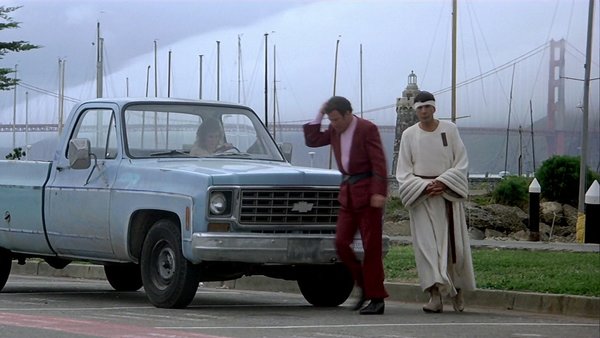
KIRK: ...There she is, from the Institute. If we play our cards right, we may be able to find out when those whales are leaving.
SPOCK: How will playing cards help?
GILLIAN: Well, if it isn't Robin Hood and Friar Tuck. Where're you fellas heading?
KIRK: Back to San Francisco.
Sure, Kirk is a fish out of water in 1986, but he seems a little lost here. Perhaps he needs to turn around take notice that the Golden Gate Bridge is behind Spock and himself, and they are walking away from it. They’re already in San Francisco when Gillian picks them up. In fact, they're on the Marina Green. And, no, they're not on the Sausalito side where Cetacean Institute is purportedly located. The view we have of the bridge is impossible to get from the other side.
Kirk may be from the 23rd century, but by all indications in this and previous films the Golden Gate Bridge is still in the same place. Kirk must know where he is, so, to paraphrase Gillian, “Why the coy geography?”
8. The Father Of Transparent Aluminum
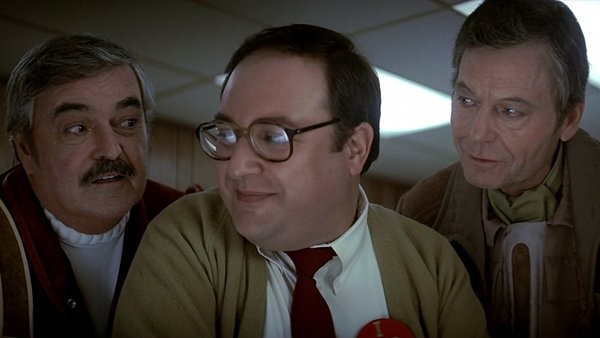
With no “transparent aluminum” to be found in Ronald Reagan’s America, Scotty and Bones have to seek out the clunkier 20th-century equivalent: big slabs of plexiglass.
There's no such thing as a free lunch, so they have to barter to get what they need, and the only thing they have of value to Plexicorp planet manager Dr. Nichols is Scotty's 23rd-century knowledge of materials not invented yet. The movie has some fun with this by hanging a lantern on it.
McCOY: Well, a moment alone, please. ...You do realize, of course, if we give him the formula, we're altering the future.
SCOTT: Why? How do we know he didn't invent the thing?
How indeed, but even if Dr. Nichols was indeed the inventor, when something was invented could affect history as much as who.
And, wait a second...why does it need to be transparent? Or even plastic? Clear plastics are not as durable as opaque ones, and plastics, in general, are less durable and more prone to leaking than stainless steel. So why...
Oh, wait... it's a movie and we want to see the whales, not slabs of steel.
7. He's A Ruskie, But They're Idiots
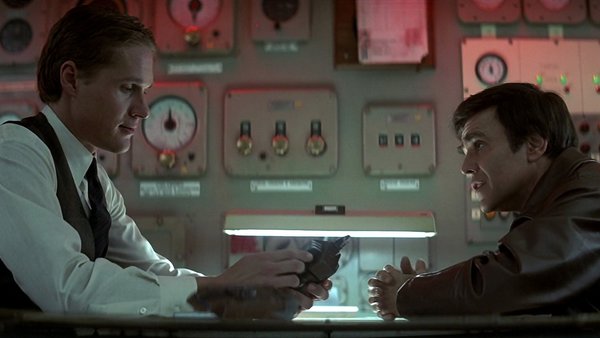
FBI AGENT: Commander Pavel Chekov, Starfleet, United Federation of Planets... Right, Commander, is there anything you wanna tell us?
CHEKOV: Like what?
FBI AGENT: Like who you really are and what you're doing here and what these things here are.
CHEKOV: I am Pavel Chekov. Commander in Starfleet, United Federation of Planets, service number six five six, five eight two seven, D.
Kirk told everyone to remove insignia before they left the ship, so just why did Chekov bring his ID with him? And why does he bother telling his interrogators his serial number? Sure, they’re meaningless in 1986, but anything he tells them is going to be meaningless. He might as well claim he’s Anton Chekhov the playwright.
Speaking of dumb, the agents here are beyond stupid. They have no idea what the devices Chekov carries are and they just keep them on the table where he can reach them, and the interrogator fiddles around with the phaser. What if one was a bomb?
And why is Chekov being interrogated by apparently-non-Navy while still aboard the ship? They’re at the Alameda Naval base. Surely they’d take him to a base facility.
6. The Whale Horizon

Zooming in on something on something hundreds or thousands of kilometers away in space is easy, because there’s effectively zip between you and almost anything you want to look at. Down in the Earth’s atmosphere, that’s something else.
UHURA: Affirmative. Contact with the whales.
KIRK: Bearing!
UHURA: Bearing three two seven, range six hundred nautical.
KIRK: Put them on screen!
GILLIAN: How can you do that?
How indeed, Gillian.
Unlike in space, the trouble with looking at things far away on Earth is that the Earth itself tends to get in the way. The farther away something is, the higher above the surface you must be to get a line of sight on it over the horizon.
600 nautical miles is 1,111 km, and to even see the whales just on the horizon at such distance the Bird of Prey would have to be at a minimal altitude of 96,179m (315,548ft), which is up in the suborbital range where the X-15 rocket plane flew. Up there the sky is black. That’s 9x as high as our familiar fluffy clouds go, but moments earlier, before Uhura reports the distance, we get a POV of zipping through clouds under bright blue skies.
Down where the clouds are anything over 200–280k away would be invisible over the horizon.
And the lower you are in the atmosphere the denser it is and the harder it is to see through the atmospheric haze.
That’s definitely a science dumb.
5. Let’s Do The Time Warp Again…and Again

Time travel as routinely depicted on screen is pretty silly and almost never holds up to the barest of scrutiny because it usually ignores or at least hand-waves away one basic fact: nothing in the universe is truly stationary.
Or, as Monty Python put it:
Just remember that you're standing on a planet that's evolving, and revolving at nine hundred miles an hour, that's orbiting at nineteen miles a second, so it's reckoned, a sun that is the source of all our power, the sun and you and me and all the stars that we can see, are moving at a million miles a dayIn an outer spiral arm, at forty thousand miles an hour, of the galaxy we call the 'Milky Way'
The Earth spins on its axis as it moves on its orbit around the Sun, which itself orbits the Milky Way Galaxy’s center of mass, and the galaxy in turn is moving through space, which itself is expanding at an accelerating rate. Hop forwards in time just one hour and the Earth would’ve moved 8x its diameter out from under you.
As someone said, “It is very cold…in spaaaaace.”
The slingshot around the Sun thing at least avoids most of this, but in 300 years the Sun will have moved along its orbit just over two trillion km (2,082,801,600,000 km), or about a third of a light-year, so each time the Bird of Prey does its spin around the Sun to go backward or forwards 300 years it ought to have to boogie a couple of trillion clicks to find the Earth.
Time travel in movies? Dumb.
4. One Little Mistake

Star Trek IV is a charming movie but action-packed it isn't. So the chase through the hospital is a welcome bit of up tempo fun at just the right point in the story.
But what the characters are doing is foolish.
Why the heck do Kirk, Bones and Gillian hang around in the surgical suite to save Chekov and then try to roll him out from under the noses of the police instead of just beaming back to the Bird of Prey? Oh, sure, they don’t want the surgeon and nurses to see the transporter whisk them away, but that’s an easy fix, just use a blanket or a surgical gown to cover the window in the door to the room where Kirk traps them.
Sure sure, there’d be impossible to answer questions about how the patient and three intruders escaped a guarded room with only one exit, but it would’ve been a lot less risky.
Fun scene, though, even if they're behaving like the Keystone Cops.
3. Ahead, Whale Factor One

It’s fairly preposterous that the Scandinavian whale catcher just happens to locate George and Gracie mere hours after they’ve been released into the ocean, not only because what-are-the-odds but because presumably said whales were liberated from a port, as Gillian explains:
GILLIAN: They'll be flown in a special seven four seven to Alaska and released there.
Territorial waters only extend 22.24 km (12 nautical miles) from the baseline of a country’s coast, and Humpbacks normally swim between 4.8–14 k (3–9 mi) per hour, which means they could be out into international waters in a few hours. This assumes there were dropped off at the perimeter coastline, but if they were dropped off say at Anchorage, Alaska, they'd have to swim hundreds of kilometers down the Cook Inlet to even get near international waters.
How fast are these whales, anyway?
But...
Even if the whales are outside the U.S. territorial water that doesn’t make them fair game for foreign nations. The 1982 U.S. Exclusive Economic Zone around Alaska extends 321 km (200 miles). It would’ve taken George and Gracie at least a day and a half to be fair game, even if they'd made a beeline perpendicular to the coast.
Of course, one could pretend that whaler was violating U.S. waters. They’re clearly bad, bad men, but who knew they were that bad?
2. He’s Dead, Jim?

One of the big crowd-pleasing moments in the film is when Spock executes his FSNP (Famous Spock Neck Pinch as they called it behind the scenes on the original show) on the rude punk blasting his boom box. A gag homaged in Picard season 2.
But put yourself in the place of the other passengers on the bus. They see this punk being rude and then this weird looking character in a robe does something and the punk falls face-first into his boombox, shutting it off. From their point of view, what happened? Do you know anyone who can put someone to sleep like that? For all they know Spock killed the guy right in front of them.
Maybe they hate punk rock music that much.
In any case, Kirk and Spock are lucky the cops weren’t waiting for them at the Cetacean Institute.
Funny, but dumb.
1. Starfleet’s Sitting Ducks

STARFLEET COMMAND (voice): Spacedock, this is Starfleet Command. Launch all vessels. Launch all vessels.
CONTROLLER #2: Sir! Spacedock doors are inoperative! All emergency systems are non-functional.
CONTROLLER #1: Engage reserve power.
CONTROLLER #2: Aye sir.
CONTROLLER #1: Starfleet Command, this is Spacedock on emergency channel. We have lost all internal power.
What’s wrong with this picture?
Starfleet knows this giant “probe” in making a beeline for Earth, and that it’s knocked out at least five ships en route
CARTWRIGHT: Mister President, the Probe is headed directly for us, The signal is damaging everything in its path. The Klingons have lost two vessels. Two starships and three smaller vessels have been neutralised.
Those starships being the Saratoga and the Yorktown. (After V’ger and this, you’d think the Klingons would have had quite enough of invincible ginormous alien contraptions pasting their ships to the wall en route to Earth.)
So, with this seemingly unstoppable unknown bearing down on them does Starfleet set up a picket line of starships? Launch ships to approach this unknown from various trajectories in order to figure out the radius of its power neutralizing force, or study it from afar? Nope. Starfleet keeps its “great experiment” the Excelsior and other ships parked in Spacedock—with the doors closed— until the Probe is literally on top of them, with the result that none of them can make any attempt to contact or escape the probe.
The 1941 Japanese attack on Pearl Harbor was a surprise. Starfleet saw this one coming. That’s not just dumb, it’s criminally negligent and dereliction of duty.