The Dark Evolution Of The MCU's Thanos
Courting Death, Daddy Issues and Misplaced Sympathies...
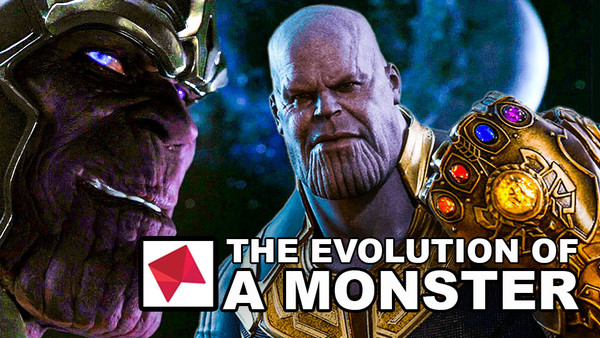
Thanos the Mad Titan. The Destroyer of Worlds. The Decimator and genocidal Universe balancer. Thanos... the misunderstood. The misrepresented. Thanos the chameleonic villain who is absolutely nothing like he was when he first appeared.
You've probably got a fairly well established idea of what Thanos is and what he's always been. He is the obsessive orphaned alien intent on bringing all of the Infinity Stones together because his planet's death instilled in him a fundamental urge to rebalance the Universe for its own good. Whatever it took, to misquote the Avengers' new mantra.
But Thanos wasn't that to begin with. His reason for seeking the Stones might not have even been what it would become in Avengers: Infinity War. Because plans change and the MCU's plans for Thanos changed as the character evolved. Remarkably, he did a great deal of that evolution in the shadows, his gestation period happening off-screen as the Avengers and the Guardians began to unpick how deep hid nefarious influence on their stories really went.
Despite the fact that he spent so much time off-screen in the early days of the MCU, The Infinity Saga is Thanos' story more than anything, and looking into the psychology of the character and how his motivations seemed to change and how he evolved as a character over the first decade of the franchise offers an intriguing parallel of where the MCU itself has evolved.
So let's start at the beginning, shall we?
6. His First Motivation - The Avengers

He might have shown up very briefly in the first Avengers movie, but there was still a fair bit of heft behind him and his presence looms over the film as the puppet master behind Loki's plan.
On paper, this Thanos is fairly one dimensional - and also not all that great at achieving his own agenda. What we know of him, through his interaction with The Other (and also through what that creature says about him second hand) is that he seeks universal dominion. The Other says as much to Thanos when talking about Loki's invasion:
"The Tesseract has awakened. It is on a little world, a human world. They would wield its power, but our ally knows its workings as they never will. He is ready to lead, and our force, our Chitauri, will follow. The world will be his, the universe will be yours. And the humans, what can they do, but burn?"
There's no suggestion there that Thanos was interested in fixing the universe through the Decimation and it would be curious if The Other wasn't aware of what he was looking to do. Think about it: when we eventually meet the Black Order, they are zealots to Thanos' cause. He is not so much a father to them as a religious leader, with Ebony Maw acting as his priest.
Crucially, they know what they're involved in, they believe in his cause. For The Other to have somehow been duped into thinking Thanos was simply interested in Universal dominion is improbable at best. The reality is that it wasn't his plan at this point to rebalance the universe. In actual fact, he didn't have a real plan.
[Continued Page 1 of 6]
5. The Problem With Writing Thanos

At this stage, Thanos was played by Damion Poitier under heavy make-up. The broad plan was to use him as an Avengers villain - in the third film - and when he was introduced, that plan would have included Joss Whedon writing and directing the Thanos-focused Avengers film.
But Whedon had a problem. He didn't know how to write Thanos or what to do with him. When he talks about writing Ultron and the personal experience he had on that film, it's in stark contrast to how he talked about Thanos.
“Ultron’s pain is very, very real to me. He can’t control the way his pain makes him behave. And I can relate to that.”
In contrast, he called Thanos "really difficult to write for," which goes some way to explaining why he turned down the chance to make Infinity War. He told Marvel he was "tapped out" after the difficulties and compromises he was forced to accept making Ultron but there's no doubt his later comments to IGN reflect how difficult he thought Thanos was as a character:
“Honestly, I kind of hung [Thanos] out to dry. I love Thanos. I love his apocalyptic vision, his love affair with death. I love his power. But, I don’t really understand it. He’s had a lot of power, and he was cool in the comics. And I’m like, Thanos is the ultimate Marvel villain! And then I was like, I don’t actually know what I would do with Thanos. So, I liked what [the Russo brothers] did so much, and I thought Josh Brolin killed it. And they did an amazing job of keeping that performance on-screen. But it wasn’t like I was like, here’s a set of directions. I was like, I’m gonna get through Ultron, nap for four years, and then I’ll come to the premiere. Which I did! It was like, this is so cool!”
Also, it pays to mention that Thanos perhaps wasn't JUST interested in taking over the universe as a means for power. In the revelatory post-credits scene, there's a line that seems to fit with what Whedon told IGN about his appreciation of Thanos' "love affair" with Death. When The Other relates Loki's failure to Thanos, he says:
"Humans. They are not the cowering wretches we were promised. They stand. They are unruly, and therefore cannot be ruled. To challenge them is to court... Death."
At that point, famously, Thanos turns to camera and smiles, almost cheekily. He is not a conqueror deterred by resistance, he's just been told something that turns him on. He sees in humanity's defiance an opportunity to court Death. This was what Thanos' real first plan was: he wanted to seduce Death.
So what happened when we met him properly in Guardians Of The Galaxy?
[Continued Page 2 of 6]
4. Thanos, The Father - Guardians Of The Galaxy (& Vol 2)

When the time came for us to meet Thanos in his final form (at least when he had his "real" performer and he'd get to talk, we'd already learned a little more about the dangers of the Infinity Stones thanks to the stinger on Thor: The Dark World. We might not have known it at the time, but that post-credits scene introducing The Collector was the first real time a plan to bring the Stones together was mentioned. And it wasn't even Thanos who introduced it.
Having cast Josh Brolin as Thanos, Guardians Of The Galaxy began to explore another side of the character and it was that shift in focus from the traditional megalomaniac that is the most interesting thing to pick apart first. Particularly as it reflects a change in the MCU's mentality and their means to addressing the supposed Marvel Villain Problem.
Throughout Phase One (and even up to Civil War at the start of Phase Three, in actual fact), most of the villains - aside for Loki, but let's just put him aside for now - were fairly conventional supervillains. Most of them wouldn't have looked out of place in a James Bond movie or an episode of Doctor Who. Sure, they had some personal tie to the heroes, but their grander schemes were barely linked to those ties. The links, in fact, were mostly purely incidental or an inconvenience to the heroes.
More importantly, the links to the heroes - or the dark parallels of them in most cases - existed in place of real backstories and motivations. We didn't need to necessarily know exactly what made them tick because we knew how they fit into the heroes' stories and that was deemed enough. That's what the real root of the Marvel Villain problem was.
For Thanos, it became a different story when James Gunn introduced him into Guardians Of The Galaxy. Or more pertinently, when he introduced his daughters. And as a brief side note, it wasn't JUST Gunn working on the character, according to Joss Whedon, he worked alongside the Guardians director on implementing Thanos into the MCU broadly. The suggestion that he didn't know where to take Thanos (or at least how to write him intimately) also suggests that it was perhaps Gunn who took the lead.
Anyway, instead of simply being a villain intent on universal dominion - even one doing so in order to make the beast with two backs with actual Death - Guardians Of The Galaxy introduced us to Thanos through his actions. In introducing Gamora and Nebula as monuments to his evil as well as having his quest for the Power Stone, he was immediately given more depth in a way we hadn't seen with any villainous character outside of Loki.
It wasn't just that this was establishing that Thanos was a Bad Guy who thought so little of the value of life that he'd destroy it and break his supposed family to remould them - painfully - in his image and to his agenda. After all, Nebula's bodily augmentations and the mental torture he put her through - after stealing her away from her family - are arguably his sickest crime, particularly as he has no affection at all for her. More importantly, seeing Thanos' evil in those terms meant we couldn't ever fully sympathise with him even when he was presented as a far more sympathetic character.
[Continued Page 3 of 6]
3. Thanos And The MCU's Daddy Issues

For all of the sympathising when Infinity War came around and Thanos' plan for the universe was brought up as "the right thing to do", the Guardians version of Thanos was the antidote to that line of thinking. Yes, his motivation in Infinity War fleshed out the character and made him more morally complex and thus more interesting, but Guardians and Guardians Vol 2 (which really doubled down on the idea of Thanos as an abusive father - more of which soon) is the film that establishes the truth of his psychology.
He is a monster.
He might be a monster with a well-intentioned agenda, but he's a monster all the same. And as the Russos would later confirm, Thanos' motivations for rebalancing the universe weren't quite as simple as wanting to be the saviour. But we'll get to that.
For now, let's look a little more at his psychology and how his character at this point reflects an important thread in the MCU's narrative: the Bad Father's trope.
While he's not involved in Guardians Of The Galaxy Vol 2 explicitly, his shadow hangs over the story in a deeply meaningful way. The entire story is one obsessed with the sins of the father. In fact, it's a film that explores fatherhood in several different ways, exploring differences in fathering and being a real dad (with Yondu's story); a child's quest to find himself through his relationship with his parents (Peter Quill); and the age-old idea of the mythology of the father (Ego).
On top of that you have Rocket's orphan anxiety (and his desire to strike out alone), the spectre of Drax's lost children and the Guardians being forced to play parents to Baby Groot. And then there's Thanos' role in the story, which fits in with the MCU's obsession with absent, abusive or neglectful fathers.
Lots of Marvel's chief heroes from the first two phases have some Daddy Issue or other (apart from Captain America). Tony Stark and Thor wrestle with the idea of the actual sins of their fathers (one in terms of his weapons business, one because he was a reformed, murderous tyrant) and with strained relationships and expectations; Loki was a mess of paternal issues; Peter Quill has an Eternal-sized Daddy Issue; The Wasp struggles to connect with her father because of their past; Gamora and Nebula have Thanos and then later Black Panther is faced with the realisation that his father was not what he thought he was.
On top of that you have the thread of fathers attempting to atone for their kids or protect them: Scott Lang, Zemo (admittedly not a hero), Drax and Hawkeye are all painted as more virtuous because of those aspirations. In other words, for the MCU, there are few crimes worse (or few better indicators of moral corruption) than being a bad father, and few better things to be than a good one.
In essence, the fact that Thanos wilfully abuses his own "children" sets up everything we need to know about him.
[Continued Page 4 of 6]
2. The Infinity Stones & Avengers: Age Of Ultron

Once more, Thanos' appearance in Avengers: Age Of Ultron was brief but it at least helped refocus Thanos. After establishing more of his psychology, the post-credits scene was designed to be the first real step in him attempting to get the Infinity Stones.
Up until this point - mostly because of a lack of focus from the film-makers plotting his course - his involvement with the Infinity Stones was vague. We knew he wanted them, but we had no idea why. Had they dropped them entirely after Guardians of The Galaxy and returned to him simply wanting to take over the universe, we would have lost very little. In fact, it probably would have suited Joss Whedon more.
But because this was the Infinity Saga as defined by the Stones appearing throughout the first two Phases, the refocus had to happen, which is why we got the confusing stinger of him retrieving the Gauntlet. Why confusing? Well, because Infinity War established that the timeline of Eitri forging the Gauntlet made that stinger impossible. But if we take it solely as a means to announce that Infinity War was coming, it's still a useful step in the Thanos canon.
It also, for the first time, afforded us the luxury of knowledge that he had an end game. If there was a Infinity Gauntlet, there was an a Snap and there was an Infinity War. But at this stage, because of what we knew - or what we didn't know, more specifically - of Thanos, we had no way of knowing why he wanted to wipe out half of existence. That came with Infinity War...
[Continued Page 5 of 6]
1. Avengers: Infinity War And Endgame

It's tempting to posit a theory that Thanos was a misunderstood hero. In actual fact, lots of people did in the wake of Infinity War. They saw his intent to rebalance the universe as the will of a good man that has been twisted into extremism. They would say that Thanos and Tony Stark are very similar characters and that their paths could be the same as both are intent on saving the universe no matter what it takes. They're both extremists, but their goals are fundamentally good.
But that's not entirely true, because that presumption is no more than a misunderstanding of his evolution across the entire MCU. And it's one we were encouraged to believe because of the genius of the Russos and their writing team. They made Thanos the main character in Infinity War and they made him perversely sympathetic. But there's no getting around the fact that he is also a megalomaniac with a messiah complex who delights in genocide and whose crimes against his own family are unspeakable.
As the Russos revealed after Infinity War came out, the sympathy you felt was no more than a trick. A horribly effective trick designed to add even more depth to the most complex villain the MCU had ever seen, who somewhat incredibly had started out as a one dimensional Big Boss figure.
Infinity War is the gloss on the complex, twisting building process that went into Thanos. When you begin to realise that his mentality is not merely to save the universe, you can begin to understand more of what the Russos meant about his messiah complex and why he is in no way a hero.
Thanos didn't pull the Decimation off because he wanted to be a good guy. He did it because he is a sociopath who was thwarted in his attempt to save Titan. That's why he didn't use the Stones to double the resources in the universe. As Joe Russo confirmed, his epiphany about getting the Stones and wiping out half of existence came when the Titans turned on him:
“Well, he was told ‘no’ to an idea that he had that he felt was the only solution, and then was proved right to himself when that solution was not acted upon. So his messianic complex — he is now committed to following through on the idea he had many many years ago. He is not a stable — although he appears stable at times, he is not a stable individual.”
He is fundamentally morally bankrupt. He doesn't believe that genocide is even something to consider when it comes to proving himself right. And while he's changed massively as a character since Joss Whedon first introduced him, it fits that this is the same character who was aroused by the idea of "courting death" and who treated his daughters like ants to be tortured with a magnifying glass. Even as he has evolved, the essential ideas that drove the character - that he is rotten to the core, have never changed. Just as surely as his big purple chin has remained the same.
The final evolution of Thanos is arguably the most intriguing of all. After Infinity War, Thanos is a redundant gunslinger, living in retirement. He might have achieved what he set out to do, but everything that we know about him beneath his apparent desire to save the universe suggests he is not a man bred for inaction. He is a war machine, plain and simple and the idea of him being put out to pasture, even on his own terms, does not match that psychological profile.
If he's got time to kill, he'll wish that's exactly what he was doing. Torture is his sport. Murder is his hobby. And while it's also tempting to think of him as a wounded animal running away from the Avengers in Endgame, the reality is that this will be EXACTLY what he wants.
Let's see how it ends...