The Disturbing Truth Behind Pennywise
Why Stephen King's dancing clown is so perfectly terrifying...

Let's talk about fear. Here's a question for you: Why is a clown so scary?
They're supposed to be figures of fun and childlike entertainment. They visit sick children in hospital, they fall over and take custard pies to the face for their entertainment and they provide sometimes delicious burgers and fries at McDonalds. We ought to love them universally.
So how come when it came to Stephen King telling a story that would bring together every scary fantastical figure from horror for a retelling of the Three Billy Goats Gruff fairytale, he didn't choose a werewolf or a spectre for It's most frequent form. He chose to make his literal personification of fear a dancing clown. Not a grotesque, bloodied monster of a clown. Just a clown.
So let's ask it again? Why is a clown so scary? Here's the disturbing truth behind Pennywise and why he's so horrifically effective.
People tend to flock around the idea of John Wayne Gacy's legacy being key to the success of Pennywise's look. After all, the overlap in killer clowns has got to be a fairly small Venn diagram. It's even true that Gacy's look partly inspired Pennywise's design in the novel - just as Ronald McDonald, Bozo the Clown and Clarabell the Clown did - but it's telling that only one of those was a murderer. At least a proven one.
In reality, the impact of Gacy's murderous tale is a symptom of the same fear that inspired Pennywise's chilling impact, rather than a cause. Gacy was more frightening because of his link to clowning. He didn't make clowns more scary. That came well before he did.
The simple fact is that clowns were already scary. When he's been asked over the years why he chose Pennywise to be It's most frequent form, King has responded with the simple statement in various forms that "kids are scared of clowns." When he was asked about the supposed "killer clown" trend a few years ago that caused a media panic but had no more nefarious purpose than whipping up hysteria and fear, King said it again - it got out of hand because clowns are just really f*cking scary.
That's not really enough though, is it?
[CONTINUED - PAGE 1 of 5]

There's some psychology behind the fear of clowns that ties quite succinctly into some of the ideas in It too. According to one study by the University of Sheffield, "clowns are universally disliked by children. Some found them quite frightening and unknowable." That doesn't quite sit with the idea that clowns ought to be loved by kids. But when you think about it, the idea of an adult disguised as something fanciful for the entertainment of children could only have come from adults. No child ever conceived of a child - they are things created by adults on an assumption that fundamentally fails to understand why they wouldn't EVER appeal.
The psychology states that clowns might be feared by children because their makeup hides their faces, potentially making them threats disguised as something supposedly innocent. Think about it: if you paint a permanent smile on your face, you're likely to have something to hide. And even if you don't, wearing a mask makes you permanently unpredictable when so much of how we interact with people is based on reading their expressions for insight.
Another study, this time by California State University concluded that young children are "very reactive to a familiar body type with an unfamiliar face". Children don't like disguises. It's why you see so many videos of infants traumatised by their fathers shaving off beards they've always had. Or why they react so poignantly to someone they know wearing a hat or glasses. It seems innocuous, but it's based on a fundamental fear.
And even more horrifyingly, clowns aren't just a naturally occurring thing to be scared of. They're crafted and essentially, as adults, we thrust the idea of clowns on children despite the way young brains perceive things almost guaranteeing they'd be scared of them. What torture!
No wonder they'd be stigmatised even further than a typical phobia in that context. They're not just terrifying, they're a terror gifted to children by parents. A monster birthed out of something supposedly nurturing. Imagine the horror of someone throwing you a birthday party and making the centre-piece something that makes your blood run cold. The horror of the clown would only be equalled by the perverse encouragement of your parents to love it. Their misunderstanding amplifying every fear tenfold and ruining every presumption of parental protection you ever have.
The idea of safe spaces is an intriguing one and it's actually something that fed into Bill Skarsgard's performance as Pennywise. Or at least his approach to establishing the right dynamic between himself and the young cast...
[CONTINUED - PAGE 2 of 5]
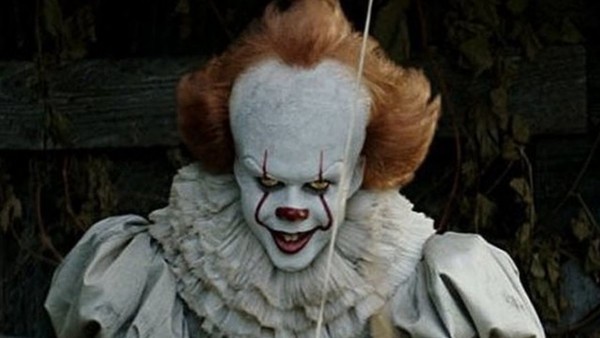
Both Skarsgard and director Andy Muschietti spoke about Pennywise being disturbing because he is fundamentally unexpected and unpredictably. In the director's words: “Pennywise does things that make absolutely no sense, but they’re very disturbing because of the weirdness." Essentially, Pennywise is scary because unpredictability is scary. Stability, whether emotional or tangible is dependable and reassuring.
It's inherent draw comes from the fact that it's VERY EXISTENCE defies stability. It is a reimagining of the troll under the bridge in the Three Billy Goat's Gruff story. It is a revelation that everything that the people of Derry believed to be solid and stable - the very bedrock that they built their homes and lives on - is a lie containing something as dangerous as It.
The fact that It's favourite form is a clown is no accident either. It is as confident a form as it is perverse, which goes back to the idea of the fascination with John Wayne Gacy's murders. The typical idea of someone who would kill multiple people would be someone capable of blending in to hide themselves. For them to dress up ostentatiously as something as recognisable as a clown and to actively draw attention to themselves is the very epitome of unpredictability. Like Gacy, Pennywise's murderous intent SHOULD mean operating in shadow and not standing out.
For him to be a colourful, garish clown standing in a normal environment and still doing what he does is unthinkable. He doesn't fit any more than those creepy clowns belonged in our real world back in 2016. They were menacing not because they held some threat, but because they didn't belong. They too were unpredictable.
And again, it was something Bill Skarsgard channelled for his preparation to play the character. He's somewhat evasive when asked about that preparation, because of the threat of demystification, but we know that he was consciously removed from the kids on-set. Andy Msuchietti confirmed he separated the kids from Pennywise "to try to capture that first impression that first reaction" and while he's not a method actor, Skarsgard's method of warming up was disquietening too. He would live in this little black tent on set and then when he was preparing, out of the blue, the rest of the cast and crew would hear his creepy laugh.
The way Muschietti describes it is almost like Skarsgard himself were a force of fear:
"...And that’s where everybody shuts the f**k up. He comes in like a long shadow."
There's something to be said about the merit in authentic fear, even when it's part of a performance. That's why Stanley Kubrick was so happy to basically break the law in order to get a truly incredible performance out of Shelley Duvall in The Shining. There was nothing to say DuVall wouldn't be capable of performing well, but Kubrick took it a step further, enforcing method through what amounted to abuse. The results play out on screen in a morbid, fascinating way that it is almost too perverse to watch.
To his eternal, creepy credit, Bill Skarsgard decided on a similar approach to making sure he made a mark on the Losers' Club in far more than a disposable way. He did so - with help from the film-makers, of course - by building a mythology for the character and protecting it from being uncovered and demystified.
In a weird sort of way, just as It itself fed off the fear of the characters, Skarsgard's performance - like Jack Nicholson's in The Shining - fed off the authenticity of his co-star's emotions. That, in itself, begins to help explain exactly why It works so horrifyingly well as a character. Because fear is a hell of a currency. And because they didn't know what to expect from him, he ticked the unpredictable box too.
[CONTINUED - PAGE 3 of 5]

Going back into the film again, that disconnect between parents and children is an important part of what makes Pennywise specifically so powerful and so terrifying. Because Stephen King doesn't just base his monster's fear factor on something as innate as "clowns are creepy," regardless of him explaining Pennywise that way repeatedly.
Were he just a conventional "evil clown" archetype, Pennywise would kill any old kids. He would terrorise them to make them taste better - more on that soon - and he'd have his fill and move on. But he's not as blunt and unimaginative as that. Pennywise's targets - the Losers' Club - all have something else that serves not only his desires for tastier prey but also King's own ideas of fear and vulnerability.
Remember the idea of a clown inherently tying into how kids would perceive their parents and how protected they'd feel? That specific vulnerability - one bred in isolation and abuse - is very much a mirror of that feeling and a means to amplify the terror.
For King, Pennywise is irresistibly drawn to the Losers' Club because they're already broken. They're abused or bullied or in some other way shaped by trauma. They've been through something that caused a premature loss of innocence and installed something in their minds that would help It get its claws into them. It identified a doorway in them created by abuse and trauma and alienation - all of the things that make them the Losers' Club (and which are worn as perverse badges of honour) - and pushed Pennywise through it.
Pennywise thrives on control. His powers amount to manipulation, which relies on his ability to get his victims to dance to his tune. Control too is at the heart of all of the abuse and bullying that the Loser Club endure, whether from their families or from Henry Bowers. And when It takes control - just as when the abusers did - it takes it away from the victims and puts them at the mercy of an unpredictable tormenter. When that tormenter doubles down on the unpredictability by being something as weird and outrageous as a clown, all bets are off.
That's why the clown comes back to each of the characters even as It appears in different forms throughout the story to them. It recognises that their shared experiences spell out a similar vulnerability to the one that makes clowns inherently scary, so it appears in the form that sparks those feelings.
Fundamentally, It's goal is to make its victims as scared as possible. It's said that fear makes human flesh taste better - like a seasoning, effectively - so its manifesto is one aimed at maximum impact. It knows that each of the Losers Club has a reason to feel unprotected or abandoned, so it chiefly appears in a form that provocatively reminds them of that.
It's not even likely that Pennywise would appear to other children as frequently as he does to the Losers' Club, regardless of the suggestion that the clown is It's favourite form. Because Pennywise is a statement aimed at reminding those kids that fundamentally, they are alone.
In the end, that's also the key to their defeat of him, because the kids have been through enough - whether because of abuse or bullying or some other trauma - to build up their defences enough to fight back. It's weakness is in its assumption that all humans are weak and can be manipulated at will and It's biggest mistake is going after more vulnerable, victimised children who have been thrust together because of a shared spirit bred in their difficult pasts.
They do the unthinkable and resist and they fight back against It's assumption that they will never be able to, which is exactly why they win. At least why they win the first battle.
[CONTINUED - PAGE 4 of 5]

Intriguingly, the second time the Losers' Club encounter It, he still manifests as Pennywise for the most part and you really have to question why. Surely, if King's explanation that "kids just hate clowns" was so pertinent, then the Losers' Club would have nothing to fear of Pennywise when they've grown up. It would still have power over them, because it would appear in whatever form appealed to their most inherent, ADULT fears. Pennywise would be unlikely to appear again. So why does he?
Once more, you have to return to the idea of the kids being traumatised before their encounters with It. Those psychological and emotional wounds - which were primarily the reason for the Losers leaving Derry - left a mark and guaranteed that they would later be susceptible to It and Pennywise even as adults. Their relationship with It very much mimicks adult experiences with childhood trauma. Mental health issues can manifest in adults years after the so-called trigger, pulling the foundations from under you most unexpectedly and robbing you of emotional stability and control.
For it to return in adulthood - and so unexpectedly - particularly when you may not have a fully memory of the trigger event is why it can be so traumatic. It's not something that Andy Muschietti is avoiding addressing either, as the very reason there are flashback sequences with the 1989 cast in It: Chapter 2 is because the gang's experiences as adults dredges up memories they didn't know they had. They are the unreliable narrators of the first movie because it's a story being told in hindsight: it's only when more trauma starts unlocking old doors that they remember the new details.
That too filters into the idea of unpredictability and instability as the most effective forms of fear. Pennywise is the harbinger of old fears - he takes away the safe space of adulthood from the grown-up Losers' Club and they are immediately thrust back into those vulnerable states. They become no more than children once more - albeit ones with more experience - whose supposed armour is stripped away. It doesn't matter that they beat It before. It doesn't matter that their abusers are no longer around. It doesn't matter that most of them escaped Derry and everything that defined it as a place that needed to be escaped. They're back to being the Losers' Club. Scared, vulnerable and preyed upon.
In the end, the simplest way to express that, at least in the lexacon of Stephen King's horror works, is to once more torment them with an inherently childlike fear. Because
, as the master says, clowns are just really f*cking scary.