The Evolution Of The Joker - Movie Timeline
The making of cinema's most iconic clown...
Given all the - traditional - vagueness associated with the Joker's origin, it should come as no surpise that the story of how he came to the pages of Batman's comics is also a muddled one. Apparently the product of three creators, Joker's true origin - whether it was down to Bob Kane, Bill Finger or Jerry Robinson or all three - died with those three.
But there is something interesting - and very pertinent - about Robinson's account of the Joker that has shaped the way the character has appeared in his various movie appearances over the years.
In the comics, Joker was initially a murderous force of nature and a typically unhinged serial killer type. The initial plan was to kill him off after his second appearance as his continued appearances was deemed to compromise Batman's ability as a hero. Thankfully, that was overruled and he returned to become Batman's most famous villain of all time.
From, there, what Robinson said about him rings particularly true. He claimed in 1975 that he wanted to create a supreme arch-villain who could really test Batman, and not just a run-of-the-mill crime lord designed to be disposed of after one story. Even more pertinently, he wanted to establish Joker as a reflection of his studies at Columbia University into characterisation on the importance of contradiction. Joker became Batman's contradiction.
Unfortunately, controversy would eventually clip Joker's wings through the second half of the 1950s as the Comics Code Authority stamped down on comics content and turned the increasingly murderous Joker into a goofy moron. At that point his clown appearance became less of an expression of the grotesque intended to shock and more a fitting costume or the fool he'd become.
By the time the first Batman movie came out, he was still that same fool, even as the comics had relegated him to the verge of obscurity, but there was still something important in his relationship with contradiction that still rung true...
[CONTINUED on next page]
5. Batman 1966

The first movie Joker wasn't just an expression of the comics, he was a reflection of societal anxieties in a period of great social and cultural change. Cesar Romero's flamboyant, rapscallion clown was ostentatious, larger than life and a chaotic challenge to acceptable norms.
In the world that gave birth to Adam West's Batman, the Caped Crusader wasn't so much a champion for Gotham's downtrodden, little people - he was an instrument of the law, a weapon of government. He was a stick-in-the-mud stooge in a costume designed to infiltrate stranger worlds but who clearly wasn't made of the same stardust.
In the eyes of "the establishment," Romero's Joker was an extreme symbol of the dangers of flower power, free expression and cultural defiance. His costume wasn't just that of a clown, it was of someone alien to the ideas of restriction and morality that were crumbling with the arrival of rock and roll and mini-skirts and his whole absurd characterisation painted his villainy as being fundamentally tied to his difference.
Given the rise of race riots and the cultural clashes between generations, it should come as no surprise that "the man" would build a nightmare out of the difference and exoticness that Robinson had claimed were his inspiration for the Joker.
After a movie and three seasons, Romero's Joker gave way to another take on the character - albeit after a considerable period walking the wilderness, but again, he was a reflection of the society that created him. And that very much transferred across to the next Joker, a couple of decades - and several aborted attempts to make a Batman movie - later...
[CONTINUED on next page]
4. Batman 1989

As with all of Burton's Batman universe characters, his Joker was at least partly coloured by his own experiences with so-called "acceptable society." He was an oddity himself to the degree that the British crew who welcomed him to the late 80s Batman set were baffled by him, not only by his inexperience (and perceived lack of credentials) but because of his gothic, "vagrant" look. No wonder he sought company in Gotham's freaks.
Unlike the 1960s Batman though, Burton adopted the idea of his Batman also being a freak. He was a monster who just happened to have a different motivation to the villains he sought to take down. And while some of those bad guys were sympathetic figures who were the product of their treatment (Penguin and Catwoman), it's no accident that the two who were most obviously malignant to their core were the most linked to corporate greed.
Burton's Joker has way more in common with Max Schreck than he does with Penguin. Sure, both live in the underworld, but Joker's aspirations are pinned more to consumerism than to acceptance and his vengeance at his transformation is merely a bolt-on to existing evil.
For a man who had frequently been accused of being a drug addict because of how he looked, whose quirks of personality were deemed strange and offensive and whose inner sweetness came as a surprise to those who initially judged him, Joker wasn't a horror movie monster. Because horror movie monsters were who Burton had grown up with, who he'd found kinship with. Batman is his horror movie monster - Joker is something else. He's a yuppie villain, wearing a suit even after his transformation, relying on commercials to spread his evil messages.
And more than that, Joker was a reflection of something more personal to Burton and a means to express the contradiction of his own image. He was an alien to his family, misunderstood by his father and mother and estranged from his brother, he was a young boy who sought comfort in the oddities of Vincent Price's works. That's why his work so frequently features stunted identities trapped in youth - Burton had a fear of growing up and for him, Joker was everything about growing up and following patterns that he hated.
This Joker is an instrument of mass order - he seeks not just to control Gotham's residents, but to transform them, as one, into his grotesque image. He's the very personification of corporate consumerism, forcing his brand on others as Batman stands up for individualism. Therein lies the fundamental dichotomy of the two. Bruce Wayne was Burton, a loner, isolated but fiercely committed to helping protect identities like his own, Joker was the personification of late 80s greed and the increasingly commodification of identity.
And again, it was contradiction that really captured Burton's imagination, right down to Joker's design, and in particular the contrast of his garish suit and deep red blood with his pale skin. All of that set him as Batman's binary opposite.
That idea might have ended up going through a serious filter by the time the Joker returned after the whole Schumacher debable, but Christopher Nolan's version was still based on Burton's agenda to "take the absurd and make it real"...
[CONTINUED on next page]
3. The Dark Knight
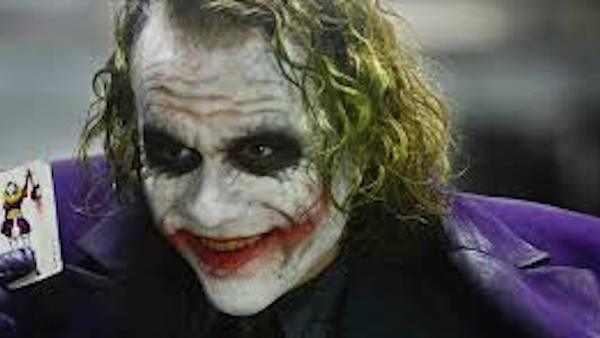
By the time Heath Ledger's Joker arrived, he did so not in a pure adaptation of the Batman comics, but what the director and Ledger DID draw from the comics was that same old idea of dichotomy.
Nolan's trilogy is fairly obsessed with duplicity - the whole series is essentially one big masquerade ball where everyone's masks slip and we get to see their real demons. And more than previous movies, partly because of those ideas, Ledger's Joker was even more overtly presented as a flipped image of Batman. Tim Burton's writing had imagined Joker and Batman as two sides of the same character and Nolan took that idea and truly ran with it.
For all of the vagueness and the frustrations around Ledger's Joker's origin, the single most compelling truth he tells is the suggestion that he was created by Batman. He gave him purpose and balance and without him, there simply would be no Joker. And he sets about proving that the same conflict exists in everyone - a real world ideological examination that's as old as Shakespeare's works on conflict and evil. He wants to prove that everyone, including Batman can be their own Joker if they're just given the right push and the most intriguing idea of the whole trilogy is of everyone guided not by a devil on one shoulder and an angle on the other, but a Batman on one and a Joker on the other.
There are less real world allegories in this Joker, but that is perhaps because he's very much in a real world that barely even looks like Gotham, but the key point of him is that same old idea of contradiction and difference.
And even though it failed miserably, difference was the driving force behind the next Joker too...
[CONTINUED on next page]
2. Suicide Squad

In some ways, Jared Leto's Joker was borne out of a need to both reclaim the character for the fans of the course, but also to be so different and so revolutionary that he could barely exhibit any of the character's defining characteristics.
He wasn't so much a reflection of society as he was an attempt to take superficial things out of the comics
But then, as David Ayer initially planned, Leto's Joker WOULD have been more of a product of social anxieties around toxic masculinity and the commodification of sex as a weapon. His relationship with Harley Quinn should have been Ayer's commentary on the dynamic between unlawful male sexual aggression and power inequalities in relationships but so much of it was edited out that his Joker ended up lacking drive, nuance or substance.
It's also probably fair to say that Leto's Joker missed Batman, but he was never meant to be his opposite. In Suicide Squad, Harley Quinn is the yin to his yang and it's in her that we see Ayer exploring what should have been this film's most clever real world consideration - the idea of how easily people can be radicalised, given the right inspiration.
In a world otherwise governed by complex villains playing heroes - complex because each of them had something we were supposed to empathise with - this Joker is a wildcard. He's arguably more dangerous because there's nothing of Batman reflected in him, but without the subtleties that were ripped out of his characterisation, all we got was a pantomime, garish idiot whose motivations were missing, taking that message about radicalisation with it.
Hey, but at least his failure meant that we got to see another performance pretty quickly off the bat...
[CONTINUED on next page]
1. Joker (2019)
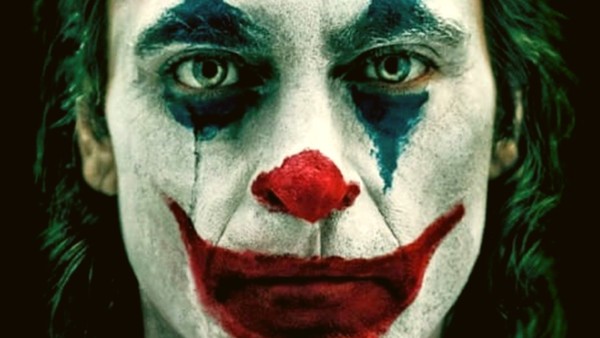
After years of never finding out where Joker came from - largely because the conversation was a redundant one until it became so definitive in the Ledger Joker's story - the latest Joker seeks to offer shape to how Joker was created. And there's a big reason why it's necessary.
This movie isn't merely an attempt to demystify the character, it's more a means to reframe him and tell the story of how the Joker inspired Batman, rather than the other way round. We've seen that before, of course, in Batman 1989, but there's more to it here.
In stark contrast to Ledger's Joker - which will always inevitably be the most valuable comparison point, given its success - Arthur Fleck is not a reflection of Batman. Yes, he's a walking contradiction, marked by difference and almost all of the other defining characteristics of the other Jokers, but he's more of a reflection of Gotham itself.
Joker thrusts us into a Gotham breaking apart, torn from within by insidious greed and implied corruption as the real people - like Fleck - are chewed up and spit out. His perverse blossoming is in a cocoon made by the city's wilful neglect of him and of everyone like him and he rises like Gotham's saviour (though it's not something he personally embraces) - which is something we saw in Nolan's Joker too.
The allegories in Joker are the most pertinent part of the film and the one most likely to fire up discourse after its release. Because Joker isn't just a product of his Gotham, he's a product of our world too. He's the result of the same kind of celebrity cult worship, the same kind of mental health system failings, the same disconnect between rich and poor and for Phillips at least, he's a response to the perils of supposedly "woke" culture. Let's leave that bit alone, for now, but he's holding a mirror up to our world again.
In a world where tyrants occupy actual seats of power, where truth no matters counts if it's less entertaining than a lie and where morality has been diluted to the point where "the people" reinforce the messages of "the man" and "the establishment" as some corporate hero, of course there'd be no superhero to take on Joker.
Joker holds a mirror up to our faces more than any of the other Batman arch-nemeses before him. Arthur Fleck has gone from being Batman's mirror image - a phenomenon created by Batman's very existence - to being an impulse reaction to OUR existence. If he makes you feel uncomfortable, maybe ask yourself why a little more.
This latest Joker is just as much about contradiction, but he's the logical result of what happens when a society sees things it doesn't like about itself and tries to hide them. Gotham and Thomas Wayne made a clown of him, amplifying what was already there, and if they hadn't failed Arthur, there'd be no Joker. There's very much a message here about looking to our own that we cannot ignore.
Which Joker do you enjoy most? Share your observations below in the comments thread.