The Hateful Eight: 18 Easter Eggs & References You Need To See

The Good, The Bad And The Thing.

You can expect a lot of things from Quentin Tarantino films: violence, swearing, liberal usage of confrontational racial language and a slightly creepy obsession with feet. He's a dependable film-maker after all - an auteur, in other terms - whose commitment to his own topes is only as strong as the director's mainline into the beating pulse of film history. Because Tarantino is an obsessive film collector, his films are inevitably stocked full of references, parallels and straight up redone beats from films he loves and those that have in some way shaped his knowledge and style. Given that he is a massive Western fan, it's no surprise, then, that The Hateful Eight is positively drenched in Easter Eggs, references and homages to the genre. And the references go beyond that, dipping into Tarantino's own canonical mythology and borrowing liberally from other genres easily, to the point where watching almost invites the challenge of spotting where you've seen things before and why they matter to the director...

18. The Numerical Title

Interestingly - and somewhat shockingly - The Hateful Eight is Tarantino's longest title yet. Everything else he's released has come in at two words: with an almighty three, this one's a comparative monster. The eight in the title is also no accident: this is Tarantino's eighth film after all, and the naming convention follows Fellini's decision in titling 8½, which was his eight and a halfth release. Obviously, the title is also a play on The Magnificent Seven.

17. The Lawrence Of Arabia Tribute

Though the opening sequence is beautifully shot, it is intentionally agonisingly slow, with the majesty and scale of the snowy "white hell" punctuated very slowly by the emergence of the carriage carrying John Ruth. The same thing happens when Chris Mannix appears in the distance, with a slow reveal showing him approaching the foreground. In both cases, the framing and the approach to the scenes feel like a conscious tribute to this famous scene in Lawrence Of Arabia... https://www.youtube.com/watch?v=ud1zpHW3ito

16. "Butterfield Overland Stage Co." & Stagecoach

The inscription above the door of Ruth's carriage reads "Butterfield Overland Stage Co, which recalls the actual company of the same name that operated in the mid 19th century. Butterfield Overland Stage Co. was actually real. It didn't operate in Wyoming in real life, but there's a reason Tarantino used that particular company... It's included as an obvious homage to John Ford's classic movie Stagecoach, starring John Wayne. And it's no accident that he recalls specific shots (as above). So much for hating John Ford.

15. The Setting Is An Obvious Homage To The Great Silence & McCabe And Mrs. Miller

One of the greatest ever spaghetti westerns - Sergio Corbucci's The Great Silence - offers a lot of similarities to The Hateful Eight that it's impossible to avoid. It is set in a snow-covered Utah filled with bounty hunters and a host of notoriously shady characters, just as Tarantino's modern redo is. Tarantino has clearly taken a lot of inspiration from Corbucci's western - the entire film seems to be an homage to the white-washed cinematography of Silvano Ippoliti. The Hateful Eight also looks a lot like Robert Altman's masterpiece McCabe And Mrs. Miller - not only in its snowy setting, but in its interiors. The inside of Minnie's Haberdashery is very much like the inn that is the setting for the opening scene of Altman's film.

14. It's A Spiritual Follow Up To The Thing

It should come as no surprise that Tarantino only screened one film to the cast during filming: The Thing. Hopefully Kurt Russell has no problem watching himself. There are a lot of obvious references to the classic horror - and not just the presence of the magnificently moustachioed Russell. Obviously, Ennio Morricone created similarly haunting scores for both, and more generally, there are distinct thematic similarities: the cold setting, the paranoia, the duplicitousness. It's no accident that the end sees two characters - one black, one white - waiting to die. Even more specifically, three songs from The Thing's soundtrack are included as part of The Hateful Eight's soundtrack (two didn't actually make it into the film itself). Plus the scene in which OB and Mannix put down a line between the Haberdashery and the outhouse is a delightfully spot-on nod.

13. Kurt Russell's Best John Wayne

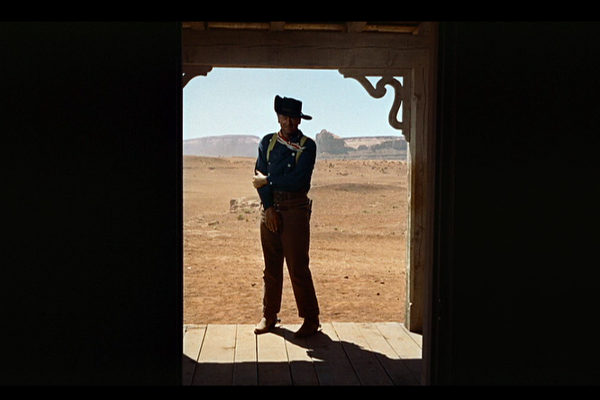
Kurt Russell essentially repeats the John Wayne impression he does in Death Proof, this time extending it out into a whole performance. There's a lot of Rooster Cogburn's uncompromising loner with a reputation for violence and justice in there. He even goes as far as re-appropriating one of Wayne's catchphrases - "that'll be the day!" - from The Searchers. As a further nod to the same film, there's a shot that frames Warren in the doorway that is yet another example of Tarantino deferring back to an obviously favourite scene in The Searchers (which is now the single most iconic shot from that film...)

12. Not In The Testicles!

In what is becoming something of a trademark for Tarantino, this is the third film that sees a character gets shot directly in the balls. This time, it happens to Marquis Warren, who gets a particularly nasty sub-perineum shot from below the floorboards. It all started in Pulp Fiction when Zed was parted from his boys after being unveiled as a heinous, rapist pig. Here's a nice, graphic video of him doing it in the most ridiculous detail in Django Unchained... https://www.youtube.com/watch?v=2NqRzDGFzcY In Inglourious Basterds the shoot-out/stand-off in the bar ends with testicular trauma and death, and there's also a shot in Nation's Pride of a guy getting shot in the crucials. Basically, it seems he doesn't like balls.

11. Lance Lawson

At one point John Ruth and Chris Mannix talk about the impending hanging of Lance Lawson in Red Rock. The ears of Tarantino's fans would have pricked up at that point. Lawson was of course the owner of now fabled video store Video Archives, where Tarantino once worked before he made it big. A character of the same name also appears in The Rules Of Attraction, which was directed by fellow Video Archives worker Roger Avary, who wrote Pulp Fiction with Tarantino. Eric Stoltz's Lance in Pulp Fiction is also named for the same guy.

10. The Musical Cues

Inevitably, the film borrows music from other important films to Tarantino, as well as the songs it takes from The Thing. "Now You're All Alone" from Last House On The Left plays as Joe Gage follows Minnie's hired man and kills him: it plays out over a very similar scene in the original. "Regan's Theme" from Exorcist II also features - though there's no demonic possession - and so too does "There Won't Be Many Coming Home" from The Fastest Guitar Alive.

9. Channing Tatum's Anti-Typecast Cameo
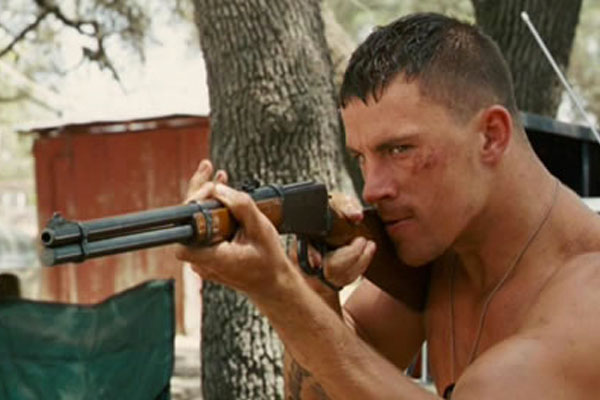
Obviously Tarantino loves a cameo as much as he loves casting those he's worked with before. He's basically like a more violent Christopher Nolan. Zoe Bell obviously turns up as Six Horse Judy and Tarantino himself turns up as the unseen narrator in the middle. But it's Channing Tatum's appearance as the nefarious Jody that is most notable. His casting has been suggested as an homage to Once Upon A Time In The West, which featured Henry Fonda as the primary antagonist, a controversial against-type casting designed to shock the audience. In both cases the effect was huge and went exactly as planned.

8. "This White Hell"

John Gage mentions the weather outside the Haberdashery being a "white hell", which is a throw-away line, but it's so deliberately delivered that its importance is insisted. That's because the line calls back to the White Hell Of Pitz Palu, a film mentioned in Inglourious Basterds and which gives Archie Hicox his German cover's home town. The allusion to that character is also not accidental (more of which later)...

7. The Pulp Fiction Bonnie Situation

As a hint to something not being quite right, Sweet Dave's favourite chair in Minnie's is covered with blankets and furs, which Warren notices quickly but for some reason says nothing about until after sh*t starts going down. The furs obviously hide the bloodstain of the unfortunate victim killed in it by "Mexican Bob". That deceptiveness mirrors the way Sam Jackson's Jules and John Travolta's Vincent cover up the accidental slaying of Marvin in the back of the car.

6. Warren's References

Major Marquis Warren's look very obviously references El Topo: he and the lead character both have the same wide-brimmed hat and they feel even more similar in spirit. He also feels very heavily influenced by The Good, The Bad And The Ugly's Angel Eyes in his characterisation, which makes the question of whether he's actually good or evil an intriguing one.

5. The Inglourious Basterds Tagline

As well as Kurt Russell's John Wayne pilfering, there's another borrowed catch-phrase of sorts. At one point, Michael Madsen's John Gage says "A bastard's work is never done"€” which was used as one of the taglines on posters for Inglourious Basterds. Incidentally, 'Mexican Bob' is also the name of a character in the original True Grit.

4. Mr Orange's Death

Perhaps in tribute to Tim Roth's duplicitous character, the scene in which he's shot calls back to the pay-off to his most famous double role in a Tarantino film. That scene is extremely similar to when he is first shot in Reservoir Dogs: the gut shot is definitely a tribute, and the scream of agony he lets out is almost note perfect. Interestingly, Roth seems to return to his Pulp Fiction accent - a slightly more regionally heavy version of his own accent - when the deception is unveiled. It's a strange decision narratively, as no American would be likely to pick up the subtleties of English language anyway, but it fits with Tarantino's fascination with language and accent that he was particularly interested in in Inglourious Basterds.

3. The Gunsmoke & Bonanza References

In the run up to release and afterwards, Tarantino spoke of his fascination with Gunsmoke and Bonanza as a child so it shouldn't come as a surprise that he has referenced both in the names of some of his characters. Jackson's Marquis Warren is named after Charles Marquis Warren, the writer of Gunsmoke, and Daisy Domergue is probably a nod to actress Faith Domergue who played a small role in Bonanza and frequently appeared in other classic Western movies.

2. Hicox

Another one for fans of names. When Tim Roth's Oswaldo Mobray reveals that there's a bounty on his head as a member of Jody's band of outlaws, he reveals that it is under his outlaw name: English Pete Hicox (a name known to bounty hunters - which makes it strange that he chooses to hide his Englishness by being even more English...) That follows the trend of Tarantino reusing names and linking families across films; here it seems that Pete Hicox is clearly an ancestor of Michael Fassbender's Archie Hicox from Inglourious Basterds.

1. Red Apple Cigarettes

Clearly there was no opportunity to add in Big Kahuna Burger or Teriyaki Donuts on account of the time-setting, but Tarantino did sneak in one of his favourite brands. Red Apple Cigarettes make another appearance in his canon, and while the cigarettes themselves aren't mentioned, their obvious precursor - Red Apple Tobacco - is mentioned. Minnie reveals that she smokes the band when Jody asks her to roll him one. Meanwhile, Bob the Mexican smokes "Manzana Roja" - Spanish for Red Apple. Did you spot any other Easter Eggs or references in The Hateful Eight? Share your finds below in the comments thread, and for more comprehensive focus on the references, Easter Eggs and homages in all of Tarantino's work, see our complete, exhaustive guide here.

Contributor
Contributor

WhatCulture's former COO, veteran writer and editor.