The Mandalorian Changes Everything We Know About Boba Fett
Both Jango and Boba Fett are given a definitive new origin in The Mandalorian.

The latest offering from The Mandalorian, The Tragedy, may have been the shortest episode of the series to date, but it was no less action-packed or rewarding than any episode that preceded it.
At long last, fans rejoiced in seeing fan-favourite Boba Fett return to the Star Wars universe, after nearly forty years of his fate being left uncertain at the hands of the Sarlacc Pit in Return of the Jedi. His appearance was teased at the end of the season premiere, The Marshall, with actor Temuera Morrison returning for the episode’s closing moments.
However, the episode was noteworthy for many reasons. Not only did it give us the proper return of Boba Fett and finally answered the question over whether or not he survived the events of Return of the Jedi (although we still do not know how), it also answers another long-standing hot talking point among the Star Wars fandom: as to whether Boba Fett, and his father Jango Fett, were in fact Mandalorians.
While they both wore the recognisable armour, it was never clear what the Fett’s relationship was with the Mandalorian people, even within the inner circle at Lucasfilm and later Disney.
So how does this change what we know about the Fetts? To answer that, we need to go back and look at the origins of both Boba and Jango and how this new revelation changes everything.
4. Boba Fett - Mandalorian, Or Mercenary?

Boba Fett needs no introduction. Despite an understated role in the original trilogy, fans quickly flocked behind this striking, masked Bounty Hunter and quickly made a name for himself within the community.
While being first introduced in The Star Wars Holiday Special in 1978, his first canonical appearance was in The Empire Strikes Back before his premature demise at the hands of Han Solo and the Sarlacc Pit in Return of the Jedi.
But at the time, the legacy of Boba Fett and the Mandalorians was very much in its infancy. For the purposes of the story, Boba Fett was nothing more than a bounty hunter or mercenary in cool looking armour. The armour itself was in fact originally designed to be worn by a new Imperial 'super commando', but when they realised that they couldn’t afford to make many versions of the costume, they recycled it to be used by a single bounty hunter. And the rest, as they say is history.

The original concepts drawn up by Ralph McQuarrie for the Imperial super trooper did eventually come to fruition through the introduction of Imperial Supercommandos in the animated series Star Wars Rebels - Mandalorian warriors who served the Empire.
Due to the incredible fan response that Boba Fett received in his two canonical appearances, the legend of the Mandalorian began to grow and is the reason that George Lucas went on to reveal the origins of Boba Fett in the prequel trilogy, through his father, Jango Fett.
3. Jango Fett's Origin In Star Wars Legends

In the old Legends continuity, Jango Fett originated from Concord Dawn, a planet in the Mandalorian sector, where he lived on a farmstead with his family. The Fetts got caught in a conflict between a group of radicals called the Death Watch and the True Mandalorians, led by Jaster Mereel.
After his family was killed in the firefight, Jango was taken into the care of Jaster Mereel (who later became a father figure to him) and became part of the True Mandalorians as a Squad Commander. Serving as a Squad Commander, Jango fought alongside Jaster Mereel and the True Mandalorians for many years, but it was at the battle of Korda Six when his mentor fell at the hands of a Death Watch ambush, when Jango himself took over as leader.
As the new Mand’alor, Fett led the Mandalorians as much as Jaster Mereel had done before him, fighting Death Watch and their leader Tor Vizsla during the Mandalorian Civil Wars, and even coming to blows with the Jedi, led by none other than Jedi Master Dooku. In a devastating defeat on Galidraan at the hands of Death Watch, Jango’s entire battalion was wiped out, and he was stripped of his armour and sold into slavery.

After eventually escaping, he tracked down his armour back to Galidraan and hunted down Vizsla’s ship. During a final confrontation, using the blade on his gauntlet, he carved a deep wound across Vizsla’ abdomen and left him to die at the hands of a pack of hungry dire-cats.
With the leader of the Death Watch dead, the remaining members fled and the Mandalorian Civil War slowly came to a close - but not without devastating costs to Fett. Without a war to fight, or comrades to flight alongside, Fett turned away from his people and turned his talents to the solitary life of a bounty hunter. It was through his career as a bounty hunter that he was approached by former Jedi, now Sith Lord, Dooku.
Tasked with hunting down his former apprentice, Komari Vosa, Jango became part of a competition that was designed to seek out the most skilled warrior to become a template for what would become the Grand Army of the Republic.
2. Wait... Star Wars: The Clone Wars Reveals Jango WASN'T Mandalorian?

However, the comic that told Jango's origins (Open Seasons) was seemingly undone by a single line that originated in the animated series The Clone Wars. In the episode, The Mandalore Plot, Obi-Wan Kenobi travels to Mandalore tracking a Separatist saboteur who wore Mandalorian armour. When speaking to Mandalore’s Prime Minister Almec, he mentions the meeting he had with Jango Fett on Kamino, to which Prime Minister Almec replies:
“Jango Fett was a common bounty hunter. How he acquired that armour is beyond me.”
Mandalore was a very different place to the one that preceded it. Under the rule of the Duchess Satine, Mandalore had become a people of peace, adopting a more pacifistic approach to the galaxy. It would make sense for Almec to quickly distance the Mandalorian people from Jango, who opted for a much more violent lifestyle.
What’s more, from what we saw in The Mandalorian episode, The Heiress, those that were taken into Mandalorian society as Foundlings (or Children of the Watch) were considered to be religious zealots, cast out from traditional society. With Jango being a former foundling, during this new age of Mandalore, it’s but another reason for them to shun any connection that he may have with their people.
It's unlikely that was originally the intent of the retcon seen in The Clone Wars, but either way the episode cast doubt on both Fetts' Mandalorian status for a whole decade, until the second season of The Mandalorian came around.
1. Chapter 14 Restores The Fetts' Mandalorian Status

So why is the most recent episode of The Mandalorian such a big deal? Well, the devil is in the details.
First off, the chain code in Boba’s armour, formerly his father’s, confirms that Jango was originally a Mandalorian foundling. This makes him Mandalorian and by heritage, makes Boba a Mandalorian as well - in the same way that Din Djarin is Mandalorian. Both were taken into the care of the Mandalorians. Whether they were both Children of the Watch remains unconfirmed, but throughout this season, Din has been meeting Mandalorians from very different walks of life, which in turn will reflect how he chooses to live his.
If you break down the Chain Code even further, beyond what Boba tells Din, the translation also mentions “Concord Dawn” and “Mentor Jast”. This lines up with how Jango was depicted in Legends - born on Concord Dawn and taken in by Jaster Merrell. The chain code restores some of Jango's backstory that was lost when the old Expanded Universe was rendered out of canon. And while it's not confirmed whether this brings all of Open Seasons back into canon, with a name-drop like the Mandalorian Civil Wars, you know it’s not long before it's explored further in the Disney-era.
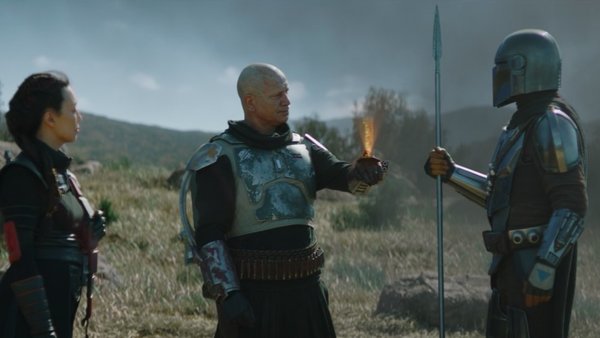
Dave Filoni has already previously brought back elements of the old Expanded Universe that have since been de-canonised, like in Star Wars Rebels. Grand Admiral Thrawn and the Dark Troopers, both of which have now been either used or referenced in The Mandalorian, originally only existed in the old Legends. And now, Filoni and Favreau have done the same for the Fetts. It sets up the continuation of their story and gives Boba a place and purpose in The Mandalorian, rather than just as a supporting character in the backstory of something greater.
With a spin-off show already rumoured for Boba Fett (which seems all the more likely now), the restored Mandalorian status of the Fetts adds more to their story and character - past and present.
Watch Next
Star Wars: You'll Never Get 100% On This Mandalorian Quiz
