Thor: Love And Thunder - 9 Things From The Comic You Need To Know
Everything you need to know about the Goddess of Thunder.

A little under a month since Marvel closed the curtain on the years-long third phase of the MCU with Spider-Man: Far From Home, the studio took the time this weekend to unveil the future of the series, and in particular, the hotly anticipated structure of MCU Phase Four.
Dozens of announcements broke as Marvel Studios head Kevin Feige took to the stage at SDCC's famous Hall H, with particular highlights coming in the form of Shang-Chi, Hawkeye and Blade, but certainly one of the more exciting was Thor: Love and Thunder, a direct follow-up to the Taika Waititi-directed Ragnarok from 2016, set to release November 2021.
The big reveal in this case, however, was not that Waititi was returning, but rather that Natalie Portman would reprise the role of Jane Foster and become - as she did in the comics - the All-New, All-Different Mighty Thor. The cast and crew assembled on stage were mum with the details, but Waititi in particular was keen to pay homage to the comic that inspired their upcoming work - Jason Aaron, Russell Dauterman and Matt Wilson's Mighty Thor.
It's possibly one of the best comics to have been published this decade, and while it doesn't share the same namesake as the fourth Thor film (Thour?) does, it's sure to influence it in a big way. Here are the biggest details from the comic, and what you need to know about it in the wake of SDCC.
9. The Odinson Becomes Unworthy
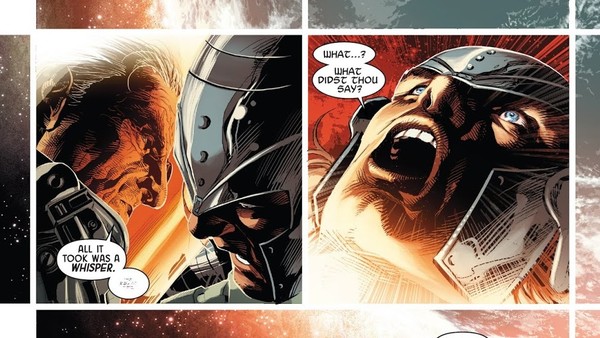
Jane Foster's ascendency to the mantle of Thor was only made possible by the Odinson losing the title. Two Thors cannot exist at once, after all, and so in the build up to the then latest chapter in Aaron's stint on the character, the God of Thunder was made unworthy. This came in the pages of Original Sin, where Nick Fury - now a cosmic being known as 'the Unseen' - whispered an uncomfortable truth in Thor's ear, one that would remain a closely guarded sequel for over three years.
The aftermath saw the God of Thunder unable to lift Mjolnir, as the enchantment on the hammer ensured that anyone deemed unworthy wouldn't be able to use its power. Thor had grappled with his destiny to lift his hammer for thousands of years, and it was effectively wrenched from him with but a couple of words. (It's also important to note that, while it's pretty much impossible for the MCU to replicate this moment exactly, Chris Hemsworth's Thor is already on his way to being considered unworthy.)
Aaron and Dauterman's comic then begins with the God of Thunder despondent on the moon, dejected at the fact he's no longer fit for his own title. The Odinson remains in this depressive state for months to come, but eventually comes to understand his new place as an 'Unworthy Thor', before eventually reclaiming the hammer years later.
It doesn't go smoothly at first though. When he first sees this new Thor, he deems her an imposter and a thief, and vows to uncover her identity to reclaim his birthright.
8. The New Thor's Identity Is A Mystery (At First)

Although the cat is now very much out of the bag already when it comes to the identity of the Goddess of Thunder, with Waititi et al. confirming as much on the stage of Hall H last weekend, it was a closely guarded secret during the character's early appearances. There was a genuine effort from fans to uncover her identity, during which time the Odinson led his own investigation that implicated everyone from Angela to Lady Sif and Valkyrie as key suspects.
The real culprit, as it turns out, was much more surprising.
By the time she appears in the Mighty Thor, Jane Foster had not had a pivotal role in a Thor comic in a while. She reemerged during the pages of God of Thunder with a cancer diagnosis, and it seemed at the time as if it was Aaron's way of giving the character a quiet exit.
Not so. In the eighth issue of Mighty Thor, we discover that it was Jane who headed for the moon (with a little help from Heimdall) and was deemed worthy to lift Mjolnir. It's unlikely the fourth Thor film will adopt the same approach, given how it's led with the announcement that Portman will wield the hammer on the big screen, but maybe expect the Odinson to have trouble figuring out who it is at first.
7. The Odinson Wields A New Weapon

By now, audiences have seen the God of Thunder wield two weapons (maybe three if you count Gungnir, but that's besides the point for now). Both have been firmly of the hammer persuasion, but those familiar with the character's comics will know that the Odinson isn't the God of Hammers - in fact, he first started out with an axe.
Years before the Son of Odin would wield Mjolnir, the character's preferred weapon was an axe called Jarnbjorn. It could pierce even the most indestructible of armours and served Thor well when battling Apocalypse, and he resorted to using it again once he found himself lacking in worthiness come 2014.
Jarnbjorn might not be Mjolnir, but what it lacks in bark it more than makes up for in bite. The biggest difference really is that without Mjolnir Thor can't fly, and so he rides around on an enchanted goat, called Toothgnasher. He's accompanied in his endeavours by another magical creature called Thori, a Helhound who just loves to murder. (It's cute - honest!)

While it's unlikely the MCU will venture this far into the future, but during his time as the Unworthy Thor the Odinson also managed to wield a hammer from the multiverse that gave him the power of Thor for being pretty much the opposite of worthy, so there's still scope for him to put the hammer down while Jane is the Goddess of Thunder.
6. ...And Has To Figure Out WHY He's Unworthy

So, by now you've probably gathered that Jane becoming Thor coincided with a rather unfortunate period for the Odinson. He'd lost his favourite weapon, his father, Odin, was going a bit mental (as in, 'let's rule Asgard like a tyrant!', mental); and to make matters all the more worse his left arm gets sliced off by Malekith. It gets replaced by a cool, shiny, uru-laden one, but you can understand why he wasn't all too happy and losing a limb.
As was stated previously, it takes some getting used to for the God of Thunder to realise he's unworthy. He goes through all the stages of grief, only accepting his new fate in the pages of his own spin-off series, the Unworthy Thor, which saw him faced with the dilemma of wielding the Ultimate Universe's version of Mjolnir.
But whereas the old Thor would've jumped at the chance to find a replacement, he realised it wasn't his destiny. He then continues to aid Jane's Thor as she deals with the escalating War of the Realms engulfing Marvel's various worlds, finding worth in a life without Mjolnir, and a shiny golden arm.
5. It's All Gorr's Fault

The Dark World's Malekith may have been the main antagonist of Mighty Thor, but there's no way he's returning to the big screen. No, Thor's closing chapter deserves a threat far greater.
Although the Odinson encountered Gorr years before Jane Foster would become the Goddess of Thunder, the villain still plays a pivotal role in both Thors' arcs; the former because it's his proclamation that renders him unworthy, and the latter because, without Gorr, Foster would've never wielded Mjolnir.
The God Butcher, as he's known by to the Asgardians, is a formidable foe and one of the most exciting threats introduced to Marvel in years. He's one inextricably linked to the symbiotes - with his famed weapon, the necro-sword, forged from the alien race of shapeshifters - and while Thor possesses a storied and vast gallery of rogues, Gorr might just about break into the top five.
For those who don't know, Gorr was raised on a famine-stricken and desolate planet that worshipped the gods of the Ten Realms. His life was defined by death, but when he saw a Celestial fall from heavens, he resolved that the gods weren't as immortal as he was led to believe, and resolves to exact his revenge - no matter how long it takes.
Worth and responsibility are two concepts wedded to the concept of Thor, and Gorr is the perfect figure with which to realise them.
4. Jane Foster Faces A Deathly Dilemma

Jane Foster is nothing short of inspirational. She becomes Thor out of a profound sense of duty and responsibility for those who've previously given so much, and to right the wrongs of those now beholden to a darker path.
She does this, despite the fact it's also killing her. Jane faces a cancer diagnosis early on and is undergoing chemotherapy, and it would've worked... save for the fact that, whenever she transforms into Thor, the Asgardian magic purges the chemicals from her system. Her situation eventually gets so severe that transforming one more time could literally kill her, but Jane - being the hero she is - resolves to keep fighting the good fight.
It's impossible to tell whether or not Love and Thunder will adapt this specific element, but something would definitely be lost were it to avoid the topic altogether. Jane's cancer is a fundamental aspect of her time as Thor, and one that made the arc's climax all the more emotional.
No doubt a similar effect would be desired were Waititi and co. to adapt it as faithfully as they seem to suggest they will.
3. Asgard Goes To War... With Everyone

Naturally, Jane Foster became Thor at a time where Asgard wasn't in a particularly happy place. Malekith was amassing a coalition to take over the Ten Realms, Odin had returned more incompetent than ever, and the arrival of a new Thor was not greeted too warmly by the Odinson's inner circle - at least not at first.
Jane wins over everyone's trust eventually by being... well, amazing - and rises to the occasion as Asgard's protector on dozens of occasions thereafter. Meanwhile, in her human form, Foster also acts as Earth's representative on Asgard, fighting a war on two fronts in the process.
The central conflict during Mighty Thor was between Asgard and Malekith, Odin and Thor, and later Asgard and the Shi'ar (of X-Men fame). Basically there isn't a shortage of action, with Jane's arrival as Thor coinciding with a transitionary period for Asgard and the other Realms.
Basically, if you've ever wanted to see what happens when Asgard has to fight as an entire force together, you won't find a better example than Mighty Thor.
2. What Happens To The Goddess Of Thunder

It's difficult to quantify the emotional pay-off of Mighty Thor without discussing its ending, or accounting for the events that came after. Basically if you're at all concerned about the possibility of spoilers in the upcoming Thor film, it might be an idea to look away now.
SPOILERS FOR MIGHTY THOR AHEAD!

In the finale of Mighty Thor, Asgard are coming up against the overpowering threat of the Mangog, a physical avatar of the cosmos' hate for the gods with one sole purpose - to kill them all.
In the closing battle, the Odinson has just intervened on behalf of Jane, realising that if she transforms even just one more time, she could die. Destiny proves too great to ignore however, with Thor arriving to save the day making for a bitterly triumphant moment. She uses her remaining energy to send the Mangog, and with it Mjolnir too, all the way into the sun - seemingly killing both in the process.
Jane then passes away in the Odinson's arms, as the duo share one last kiss before she has to say goodbye - or so they thought.
Foster finds herself pulled between the living and the dead as she approaches Valhalla's gates, ultimately being resurrected as the Odinson combines his powers with the All-Father's to resurrect his former love. Jane goes on to receive treatment for her cancer, and even becomes the new Valkyrie a few years later, even reassuming the mantle of Thor in one brief battle, but the conclusion of Mighty Thor effectively brings her time as the Goddess of Thunder to a close.
1. How Much Will Love And Thunder Lift From The Comic?
To date, the MCU has mostly stayed away from adapting Marvel's comics beat for beat, instead preferring to lift specific moments and reinterpret them for a new audience. Still, no one could deny that the Captain America trilogy owed parts of its success to Ed Brubaker and Steve Epting's comics, as it was they who decided to resurrect Bucky Barnes as the Winter Soldier in the mid-noughties.
Likewise, Infinity War and Endgame - although very much their own stories - lifted elements from the original Infinity Gauntlet storyline from the early nineties, as well as Jonathan Hickman et al's Infinity series from a few years ago. Civil War took the basic premise from Mark Millar and Steven McNiven's 2006 event, but put its own spin on it by adding a new motivation to the conflict between Captain America and Iron Man.
Point being, there's a trend at work here. It's unlikely that Love and Thunder will take the entire story from Aaron, Dauterman and Wilson's series, but expect some of the pivotal moments mentioned above to feature in some way.
--
Are you excited for Thor: Love and Thunder? Let us know in the comments.
MCU Quiz: How Well Do You Know Thor?
