Troy: 5 Reasons Why It's Worth A Re-Visit
 For those of you out there who are Dwayne Johnson fans, or fans of his wrestling days in particular, you'll know full well that back in January The Rock finally became WWE Champion again as part of the company's huge PR stunt of generating more publicity for their part-time superstar's movies (were it needed) and guaranteeing itself higher TV ratings and increased pay-per-view buys. Looking ahead, wrestling purists will sniff that, staged as the matches already are, there's no chance in hell that Rocky will be walking out of next month's Wrestlemania still holding the title as schedule dictates he must take a leave of absence to film his next round of movies. Amongst these projects lies an adaptation of the comic-book series Hercules: The Thracian Wars, in which he's set to play the titular character, naturally. Brett Ratner as director aside, I'm reasonably excited about this film, if for nothing else because it's been far too long since we've had a Hercules film on the big screen. We've seen plenty of pretenders in recent years; ever since the success of Gladiator back in 2000 which provoked renewed interest in the long-defunct Sword and Sandal genre, in what came to be known as the Gladiator effect, we've seen films about Achilles, Alexander the Great, Perseus, Theseus, and, of course, those 300 Spartans in their rubber pants at Thermopylae. Johnson himself also played a Hercules-like character in 2002's The Scorpion King. But none of these characters can match the legacy of Greek mythology's original and most famous musclebound hero, yet you have to go back 16 years to find a film that featured him as the protagonist: the well-meaning, kid-friendly, and highly Disney-fied treatment that was 1997's Hercules, which endowed him with the inspirational yet somewhat trite adolescent rags-to-riches story arc that Disney had already perfected with Aladdin. So it's clear that a more mature cinematic treatment of the hero is long overdue, and we've still got until summer 2014 to wait for it. In that time, assuming you are excited about Ratner and Johnson's project of course, why not go back and re-visit some of the previous Classically-themed movies that have taken to occupying our cinemas? One of these would be Wolfgang Petersen and Brad Pitt's Troy from 2004, an epic that was one of the first signs of the Gladiator effect. Though it represented a solid box-office success, grossing almost $500 million worldwide, it proved far less of a hit with critics and Classicists, or those who at least who claimed to have a knowledge of the source material. What follows then are five reasons why this film in particular is worth a re-visit and should not be so unfairly maligned.
5. It's Not Actually Inaccurate
 Probably the most frequently encountered criticism of Troy is that it is inaccurate or unfaithful to the source. To such I people I would immediately question: what source? The Iliad? True, the film does reference the Iliad in the closing credits, but at no point did the filmmakers claim that their movie was an adaptation of Homer's poem. Nor do the credits state that film is 'based on' the poem, as is the norm for most adaptations, but rather that it was 'inspired by' Homer, thus in a way echoing the ancient tradition whereby the simple transmission of stories encourages the creative spirits in other individuals to spin their own yarns. And what of the Iliad itself? There's a common misconception nowadays that the Iliad is the single repository of all Trojan War mythology, which is quickly dispelled when you actually read it. The poem is barely about the war in its entirety, rather a single, albeit highly important episode lasting around 50 days in the ninth year of the conflict. Patroclus and Hector are the only major characters to perish. In my experience, many readers exhibit surprise when they realise that the poem covers neither the war's origin nor its end through the trick of the Wooden Horse, that Achilles does not die within its content, that there is no mention of his vulnerable heel (he is in fact completely mortal and is wounded elsewhere on his body), and that Patroclus is actually said to be older than him. Much of the popular knowledge that people have of the Trojan War mythology comes from an accumulation of various other sources or re-tellings. And that's just it. There is no one definitive version of the Trojan War or of all the stories involving its associated characters. The Iliad is just one version of one part of the war from an overall body of stories known now as the Epic Cycle, though a version that over the centuries has amassed special cultural primacy, both on account of and contributing to its continued survival. Myth by its very nature is flexible and malleable, constantly re-told and re-shaped to suit the perceived needs and characteristics of new audiences over time. The film fashions itself as genuine history, but really represents just a conspicuous leaf or branch on the tall tree of Homeric storytelling. This historical focus is underlined by a generally realistic approach as far as the plot is concerned, with the Olympian gods especially having no overt presence, a particular bugbear for many critics. But, irrespective of purely cinematic reasons (the inclusion of the gods would have led to a severely bloated cast for instance), this omission is hardly unprecedented. Gods aside, the Iliad is widely recognised as containing far less supernatural elements than other versions of the story which contributed many of the popular facets of Greek mythology which we readily accept today- Achilles isn't invulnerable as I've already mentioned, Heracles is described as dead, and there are no demigods. In the fifth century BC Greek dramatists would also explore the concept that gods were not powerful external forces but rather manifestations of intense internal emotion. And after them numerous authors such as Dares and Dictys would write similarly rationalised and quasi-historical accounts of the war which increasingly played down the role of the gods in the conflict. One topic that came under particular scrutiny was the issue of Achilles and Patroclus' relationship, in that it was portrayed as completely non-sexual. In this respect the film certainly could lay claim to being an adaptation of the Iliad, since at no point does Homer make any reference to them being lovers; indeed he has them going to be bed with separate women at one point! This is not to deny the competing tradition of the pair as lovers which has held sway over a multitude of authors and readers. But it is clearly going too far to claim that the film is inaccurate simply because it does not follow the tradition that you prefer, when competing ones visibly existed. Some of the choices that Troy does make however, are completely unprecedented- most notably Hector killing Menelaus. But once you accept that the myth has a long history of being re-told and that textual fidelity is something of a myth itself, there's no reason that this should itself represent a problem. In my case I was wholly surprised by the event but pleasantly so, since it completely defeated my expectations and because Menelaus had not been particularly sympathetically portrayed up to that point. Of course, none of this means that you should necessarily like the choices made by the filmmakers from an artistic and cinematic point of view - that's clearly far too subjective. But hopefully it's been made clear that claims of inaccuracy and lack of fidelity are the wrong criteria by which to judge the film. In fact, if you are going to criticise Troy for not being enough like the Iliad your time would be better spent condemning Hollywood's previous big-budget epic on the Trojan War, 1956's Helen of Troy, when the filmmakers deliberately misled audiences into believing their movie was a faithful adaptation of the poem by explicitly stating so in trailers, and produced promotional TV shows in which they claimed the Iliad to be one of the greatest love stories of all time. Anyone who's read Homer will know that by this point in the war Paris and Helen have come to pretty much despise one another... http://www.youtube.com/watch?v=iHi7Kcf42TQ
4. Tackling The Trojan War Onscreen Is Hugely Ambitious
 Similarly, ambition isn't necessarily a reason for why you should like a film, but in this case I think it's something that should especially be acknowledged and admired, and I'm generally all for lauding ambitious films (The Fountain and the recent Cloud Atlas for example). The origin and conclusion of the Trojan War are pretty well known I'd hazard. It's caused by Helen's elopement from Sparta to Troy with Paris, whereupon the Greeks all club together to bring her back and sack the city. After ten years this is finally achieved through Odysseus' trick of the Wooden Horse. These are the bare-bone facts of the story that need to make it into any Hollywood film, not only because most such films tend to respond to a need for totality and completion but also because it cannot be assumed that the modern cinema audience will be familiar with these details. The Iliad, as I've already mentioned, isn't about the Trojan War per se, rather one important fifty-day episode in the ninth year, but familiarity with the poem's background was already ensured for the ancient audience since its characters were the heroes and gods of the living mythological traditions that permeated all aspects of the ancient world. The same cannot be said for modern western society. We have our own history, stories, and legends that form the bedrock of our culture. And Troy was not made for Classicists and academics; a film of its budget needed a strong commercial performance and thus it had to be designed to appeal to as broad a demographic as possible. Though I don't want to get into discussion of modern average audience sophistication, this meant primarily that the film had to include a great deal of exposition and include the war's beginning and ending. Concerning those who did know the basic story, seeing elements such as the Wooden Horse fully realised onscreen was patently a desire that needed fulfilment also. By way of modern comparison to the Iliad's reception in ancient times, Second World War films tend to cover individual battles or campaigns and the overall backdrop is far more commonly known so as to not require detailed explanation. Such films I would suggest might easily be seen as microcosms of the entire conflict; the Allied victory in a certain battle or war theatre serving to echo on a reduced scale the final global outcome. Of course, no film of realistic length could hope to narrate the war in its entirety, but similarly no single film concerned with the Trojan War, even one that incorporated both its origin and outcome, could hope to incorporate every single story and tradition from the inherited conglomerate of mythology. Outside the realm of modern history, British culture possesses its own popular tales and legends that are constantly retold and reinterpreted, King Arthur and Robin Hood for instance, as evidenced by the number of films and television shows over the past century, many of which focus on individual parts, rather than the whole, of their overall legend. Undoubtedly however, the one story that has perpetuated all of western culture is that of the New Testament, the life of Christ, of which knowledge is so universal that this alone could be said to justify Mel Gibsons artistic choice to have The Passion of the Christ cover only the final twelve hours of Jesus life, with little introduction or reference to the preceding events of his story. And that was a film that grossed $612 million worldwide.
Anyway, once you've accepted that any Hollywood treatment of the Trojan War is likely to include both its origin and outcome, and when you consider Troy in the context of its cinematic predecessors, it becomes readily apparent just how ambitious it was. Helen of Troy from 1956 covered the war from start to finish. There's a heavy focus on the romance of Paris and Helen who are film's main protagonists, whilst Achilles, the war's most famous hero, is sidelined as a secondary villain who threatens their love. The tumultuous events of the Iliad, which deal with Achilles' wrath towards Agamemnon, his subsequent withdrawal from the army, and the resulting devastative consequences for the Greeks, are accordingly marginalised and covered within roughly a minute so as to not distract too much from the 1950's-inspired romantic fiddle-faddle. The film unequivocally presents the Trojans as the good guys and the Greeks as the bad guys, adopting an all too familiar Hollywood cliché in epic films.
Fifty years later Troy doesn't marginalise the love theme or the grander scheme of the entire war; there's plenty of time devoted to Paris and Helen's relationship and the war's origin, but crucially the film swings the pendulum back somewhat to the essence of the Iliad by having Achilles as the principal character and focusing heavily on the theme of his wrath towards Agamemnon and the effects this has on the Greek army. Whatever one personally thought of it, Achilles' meditation on the human condition as prompted by his indignation at the high king was a far more ambitious artistic decision than anything we'd seen in the film's Hollywood predecessor. It could well be argued that the finished product is clunky, that the focus on both the love plot and the wrath plot against the backdrop of the whole conflict is not especially well balanced, but it was a bold move nonetheless. Petersens film is also considerably more even-handed in the treatment of the two sides, with far less of the black-and-white-ness that had characterised the 50's version. Greeks and Trojans alike are shown to be both valiant and flawed, in a more realistic and empathetic depiction of war.
I still reckon the most ambitious move would be if Hollywood did do a film of the Trojan War focused solely on the events of the Iliad. It's a long shot, but hey a guy can dream...
3. The Acting Was (Mostly) Of A High Standard
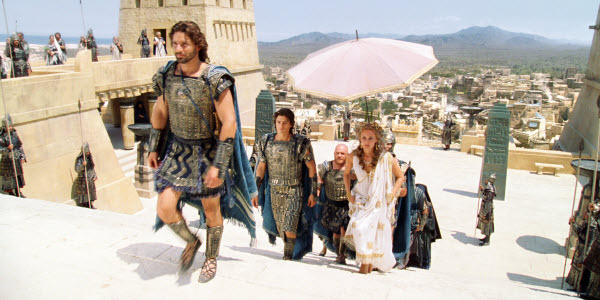
I'm not going to comment much on Brad Pitt's Achilles here. It's an established convention that Hollywood films which feature a largely British cast must also have a central American actor making little attempt to conceal his accent and whom the rest of the characters must rely on above all to get them out of a particular mess.
Neither Diane Kruger's vapid Helen nor Orlando Bloom's doe-eyed Paris are anything to write home about, but the rest of the cast are largely superb in the roles and characterisation that the filmmakers intended for them. Eric Bana especially was a wonderful Hector, fully capturing the conflicted warrior's state of emotions, torn between his sense of honour, duty to protect his city, and devotion to his wife and son. Peter O'Toole made for a hugely sympathetic Priam, his rotting teeth providing much of the emotional clout during the moments when he pleas for the return of his son's body. Sean Bean proved a suitably wily Odysseus, anchoring the film as its narrator and key negotiator in sticky situations whilst never missing an opportunity to exhibit his cunning and quick-wittedness (more on that later). Elsewhere Agamemnon was effectively (if somewhat predictably) represented as a covetous, scheming, yet cowardly imperialist in a typically powerhouse performance by Brian Cox, whilst Brendan Gleeson's Menelaus in the limited screen-time that he had was sufficiently gruff and promiscuous so as to limit audience dissatisfaction at his death, but also exhibited a close enough relationship with Agamemnon so as to underline the film's prominent fraternalistic theme.
2. It Did Innovative Things With The Mythology
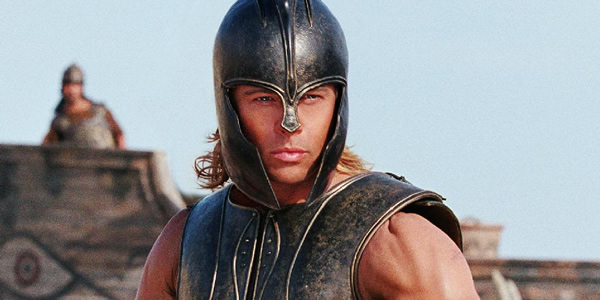
And no, I don't mean by this that it just made changes to the story. I've already explained that that's the wrong way to go about critiquing the film. What Troy quite cleverly did was rationalise some of the more supernatural parts of the mythology- give an explanation for how they came to be conceived.
Everyone knows for instance that Achilles is meant to be invulnerable with the exception of his heel. That's the one place where he can be wounded and the one place that Paris just so happens to shoot him with an arrow. I mean we still use the phrase Achilles heel in everyday conversation, duh.
But how can you feasibly have this element in a movie that's adopting a realistic and historical approach to the Trojan War? Well, it's not so much what's true in reality but rather what you hear and choose to believe (sound familiar anyone?) Right from the start when Achilles is first introduced we're informed of the stories that are already being told about him- stories that claim he cannot be killed because of his prowess on the battlefield. Achilles appears to brush off these rumours without truly dismissing them. He craves the attention and the glory. It's soon made very clear in his duel with the Thessalian champion Boagrius that his greatest asset is his speed: leaping deftly around his opponent's guard he executes his fatal jump-stab move in the blink of an eye. This rapidity characterises all of his movement for the entirety of the film up until its end, and at no point is he shown to be wounded within this time. You can clearly see the basis for the rumours of his invincibility.
Fast-forward to the film's climax when Achilles has saved Briseis from Agamemnons guards, Paris arrives on the scene and shoots an arrow straight through his heel. Achilles turns and seeks to charge down his attacker, but encumbered by his wound and with all of his speed gone he can only manage a limp towards Paris, allowing the Trojan to now pepper his torso with arrows, in what you might reasonably call a rip-off of Boromir's death in Fellowship of the Ring. Somehow Achilles is able to pull out all of these chest arrows but soon succumbs to his multiple wounds, collapsing dead on the ground. But he has been unable to remove the very first arrow, and it's this image that's presented to the Greek soldiers once they arrive on the scene: their greatest warrior lying dead with a single arrow sticking out of his heel. Paris and Briseis have fled; there have been no other witnesses to the events, so the inescapable conclusion that must be reached by the soldiers is that Achilles, previously thought invulnerable, has died from this wound. And thus the legend spreads....
Again, this doesn't mean you ought to forgive the film for everything that you thought was wrong with it up until this point, but it's innovative use of the mythology and a clever explanation of the origin behind one of the most popular supernatural facets. And it's a technique that often gets repeated. I don't know how many people saw Tarsem Singh's Immortals from 2011, but that film featured a scene with the hero Theseus defeating a giant man wearing a metal bull mask. At the movies conclusion several years later Theseus exploits have become legend and a statue is shown depicting this duel but with the giant enemy now replaced with the all-too familiar Minotaur.
1. The Directors Cut Is Vastly Superior
http://www.youtube.com/watch?v=rxRr2d7tR7A I won't go claiming that it's as much of an improvement over the theatrical version as the director's cut of Kingdom of Heaven, but Petersen's second cut of Troy is still a superior film to the original on pretty much every level. There's about 30 minutes of extra footage: battle scenes are extended and shown to be more graphic and bloody, and there's considerably more footage of the actual sacking of Troy, barely seen in the original cut. There are plenty of new scenes, most notably a humorous introduction to Odysseus on Ithaca which delightfully nods to the events of the Odyssey. A lot more detail is given to the city itself, showing us how it operates in peacetime and as it prepares for war, thus allowing us to sympathise more with its inhabitants once the fighting commences.And it's not all about what's added but also what's taken out: the ghastly scene in which Helen tends to Paris' wound following his duel with Menelaus with its cringeworthy dialogue about cowardice and courage is mercifully removed. Aside from this, and permit me this slight instance of male chauvinism, their love scene is reframed to include more actual nudity of Diane Kruger. Come on, there are already dozens of male chests on display as it is....
The film's musical score is also given a huge overhaul. To give a brief re-cap, composer Gabriel Yared originally worked on Troy's score for over a year before being removed from the project shortly before the film's theatrical release after test audiences supposedly found it too old-fashioned. In came James Horner, he of self-plagiarising fame, who impressively wrote a replacement score within four weeks, but one that sounded rushed and predictably lifted from a number of his previous compositions, especially Enemy At The Gates (he was still using that film's principal motif five years even further down the line in Avatar). The end result featured plenty of orchestral bombast and bluster and incessant female wailing, which ultimately left the soundtrack feeling like a second-rate version of Hans Zimmer and Lisa Gerrard's work on Gladiator. The end credits also featured a perfectly decent but unnecessary and overbearing ballad by Josh Groban.
To me the musical cues of the director's cut genuinely prove that less really is more. Groban's song is removed and the irritating wailing all but eradicated. Many of the generic heroic and action motifs were removed in favour of a score that was distinctly more understated, sombre, and melancholic. Call me a killjoy but the more sorrowful and low-key tone of the soundtrack served to more effectively underscore the horrors of war and the sacrifices and tragic loss of life that it entails- a key theme running throughout the story.
So there you have it, five reasons why I don't think Troy deserves to be as maligned as it has been and why it's worth a re-visit, especially the director's cut if you don't happen to have seen that version yet. What do you think? And are you at all excited by the upcoming Hercules film or by any other classically-set films that might be in production? Please leave a comment below.