What Does The Ending Of Annihilation Really Mean?
Mind blown.

Annihilation is available to stream now on Netflix in most of the world, and if you live in the U.S., you've even been able enough to watch it on the big screen (you lucky devils).
However you watched it, it's fair to say that Alex Garland's intoxicating sci-fi odyssey leaves audiences with plenty to think about once the credits roll, from the nature of the extraterrestrial, life-warping bubble known as the Shimmer, to the ambiguous fate of Natalie Portman's protagonist Lena, and the beautiful madness that was the film's unforgettable third act.
There's plenty to unpack and a lot of fan theories already doing the rounds online, so factoring in what little concrete information the movie gives us, combined with a careful reading of its themes and an added sprinkle of guesswork, it's time to take a deep dive into Garland's stunning film and try to figure out what it all means...
7. What Happens

The movie's third act sees Lena making a sole trip to the lighthouse at the centre of the Shimmer in the hope of discovering its source. Most of her team has already been killed off, save for Ventress (Jennifer Jason Leigh), who headed there alone earlier on.
When Lena enters the lighthouse, she discovers an incinerated corpse, which a video camera reveals to be that of her husband Kane (Oscar Isaac), who killed himself with a white phosphorus grenade, before urging a Shimmer-generated doppelgänger of himself to leave the Shimmer and find Lena.
At this point, Lena heads into a hole in the lighthouse, where she finds a faceless Ventress who skittishly discusses the nature of the Shimmer, before transforming into a peculiar shape. This shape takes a drop of blood from Lena's face and generates a metallic, featureless mimic of Lena, which "attacks" her as she attempts to escape the lighthouse.
As the mimic comes to more closely resemble Lena, she manages to trick it by placing a phosphorus grenade in its hands and quickly fleeing. As the mimic is set ablaze, the flames engulf the lighthouse, burning it down and appearing to destroy the Shimmer.
Back on terra firma, the second Kane's critical medical condition has miraculously resolved itself with the Shimmer's destruction, and when he is reunited with Lena, he tells her that he doesn't think he's the real Kane. As for Lena? She doesn't seem so sure whether she really came back from the Shimmer either, as her eyes let off an incandescent glow in the film's ambiguous final image.
So, what all that in mind, what exactly does it all mean?
6. Self-Destruction Is Survival

If Annihilation has any one central theme, it is surely the notion of self-destruction, which is quite blatantly brought to light when Lena talks to Ventress about Kane "going on a suicide mission" about half-way through the movie.
Ventress insists that Lena's confusing suicide with self-destruction, adding that almost nobody commits suicide, but almost everybody self-destructs in one way or another, because of our human impulses to drink too much, smoke, throw away a good job or a healthy marriage.
The latter impulse is especially true in Lena's case, effectively annihilating her home life with Kane through her infidelity, and in somewhat poetic terms, Lena's mimic ends up doing the same thing at the end of the movie by burning its own home, the lighthouse, down.
Curiously, though, it is the drive to self-destruct which ironically also allows Lena to survive and possibly even evolve into something new.
She kills a mimic of herself in order to earn her freedom from the Shimmer, while at the same time stripping away her original cellular makeup and leaving the Shimmer a changed person both physically and emotionally.
5. Depression & The Battle Against The Self
There's already been much written about the film serving as an allegory for depression and the tireless war the mentally ill wages against themselves.
For starters, every member of the team has a depressive affliction which drives them towards the possibility of self-destruction, from Lena's infidelity to Ventress' cancer, Anya's (Gina Rodriguez) alcoholism, Josie (Tessa Thompson) being a cutter and Cass (Tuva Novotny) mourning her dead daughter.
The Shimmer itself feels like a literal manifestation of depression's oppressive power, be it the fact that it's a literal bubble that exerts influence on those inside it, or the fact that it alters conventional reality and causes time to pass in a haze (something any depressed person can account for).
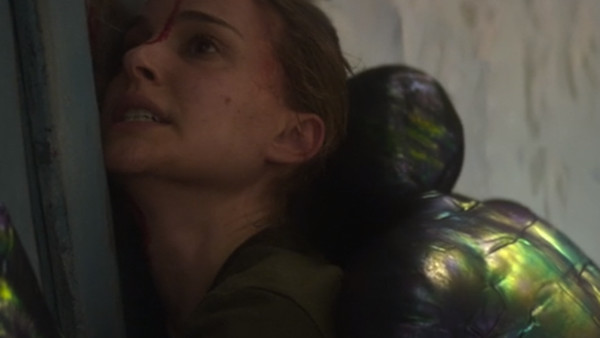
This is realised most literally, and most affectingly, in the third act when Lena runs for the lighthouse door to escape, but finds herself being pressed up against it by the mimic. Though an initial reading of the scene would seem to suggest the mimic is trying to kill her, it's clear on reflection that the mimic is just echoing her own fleeing behaviour, resulting in Lena being damn-near suffocated by herself (again, self-destruction).
In order to prevent being literally killed under her own weight, Lena has to let go and stop fighting the tide. Conversely, the one suicidal member of the group, Josie, also decides to let go, but rather than give in to her deathly impulses, she's able to transmute into something else: a plant vestige of her former self. Her depressive tendencies literally sprout new life, it seems.
Sci-fi has been a ripe genre for highlighting existential angst in all its forms, from a fear of the unknown to questions about what it means to be human, and Garland's film concludes as a potent statement on the internal struggle so many humans face every day.
But with the film's examination of emotional turmoil in mind, let's look at how it confronts the more tangible, physical threats that humanity faces...
4. Cancer & Creation

Cancer is a major aspect of Annihilation's narrative, namely that Ventress is dying of cancer as she heads into the Shimmer, and the way the Shimmer alters the Earth's landscape, causing tumour-like objects to grow. Just like cancer, it is relentlessly pursuing its biological mandate without any consciousness or malevolence.
However, Garland also interweaves this with the notion of creation, as Lena plainly states that she believes the Shimmer does not desire destruction - because it doesn't desire anything, of course - but rather its "goal" is instead to change Earth. After all, its "cancerous" properties also facilitate the prismatic DNA soup which allows Josie to become a plant statue, and transforms Ventress from a slow-dying slab of meat into a beautiful, glowing, nebulous entity.
So, what is destruction and what is creation? That is at the heart of this movie: Lena destroys the "cancer" that is the Shimmer, and her original self is, for all intents and purposes, broken down and reconstituted into something new, thanks to the Shimmer's effects. This is evidenced by not only her glowing eyes, but also the water trail visible on Lena's glass at the end of the movie, separating into two trails just as a cell divides in two.
It's an extremely interesting way to consider the nature of the human body, its inevitable breaking down, transformation and destruction. But Annihilation also has much to say about the prospect of immortality...
3. The Nature Of Immortality

The notion of immortality if broached in unconventional ways in this movie, surely most horrifyingly when poor Cass is mauled to death by a bear-like creature, which is then able to use her dying screams to lure the rest of her unit.
The team even talks about how utterly horrific it must be for a human to die and only leave behind something so horrifying, which feels all the more pointed as Cass' daughter is dead, and so her DNA somehow mixing with the creature is all that remains of her on Earth. The creature is killed shortly thereafter, of course, but given the nature of the Shimmer as a prism, could Cass' death scream ultimately have materialised elsewhere?
It's also telling that one of the film's flashbacks shows Lena reading the famous novel The Immortal Life of Henrietta Lacks, which is the true story of the titular woman who died of cervical cancer in 1951, but her cancer cells were taken for experimentation purposes, and are still in use today as the first ever immortalised cell line, known as HeLa.
The allegory between Lacks' cancerous cells and Cass' lingering death scream are clear, that both get to "live on" in some biological form, but as the most horrifying aspect of themselves. At least in Lacks' case it led to major medical breakthroughs. Cass? Not so much.
Lena discusses immortality with Kane in a flashback, noting it to be a fault of our genes, and with Lena's genetic makeup clearly being altered by the Shimmer at the end of the movie, could she have unlocked a key to enduring human life?
After all, a tattoo of the ouroboros - that's a snake eating its own tail, perhaps the universal symbol for immortality - appears and disappears on the arms of various team members throughout the film. Could this tattoo have emerged from a previous expedition member who died within the Shimmer, and this is how a piece of them now lives on?
Whether or not Lena has indeed found a key to raising the limit on human lifespans by film's end, can we even be sure she truly made it back to civilisation?
2. But Which Lena Escaped The Shimmer?

Though the most broad, on-the-surface reading of Annihilation would seem to suggest that the original Lena defeated her mimic version and made it home, there is a certain ambiguity to the ending, with the glow in her eyes possibly implying things aren't quite what they seem.
Remember that, during her "fight" with her mimic, there was a moment where she passed out after falling to the floor, and it's entirely possible - if perhaps unlikely - that Lena and her metallic double were somehow swapped.
Whether you buy that or not, earlier drafts of the Annihilation script clearly wanted the ending to be ambiguous, with Garland writing, "There is no clear indication as to which LENA lived, and which LENA died."
The balance of probability suggests that the "original" Lena did indeed make it out, but given how drastically she has been altered by the Shimmer, namely physically but also emotionally, it's really more apt to say that this is a third, wholly new Lena, distinct from both her former self and the mimic version. A chimera shaped by the Shimmer, if you like.
1. The Future Of Humanity

Despite Annihilation being (very loosely) based on a trilogy of books, Garland has stated that he has "zero plans" for any sort of sequel, which all things considered - for the sake of preserving its tantalising ambiguity and that paltry box office haul - is probably for the best.
Still, Garland sews some fascinating seeds for audiences to consider what happens from here. Firstly, is the Shimmer absolutely, unequivocally gone? It's clearly living on in Lena and Kane in some form, but what will this allow them to do? Can they exert influence on the cellular structures of those around them? Will it grant them extended life or maybe even biological immortality?
What about procreation? If Lena and Kane's new forms do decide to stay together - and that's a big "if", but the pull would be undeniably tantalising - could they effectively begin the creation of a new, advanced form of humanity?
Garland leaves the door wide open but with virtually no hint of what is to come for these two, so as wonderfully frustrating as it is, it's all left in the audience's lap.
This is amusingly similar to the end of the director's prior film Ex Machina, where AI Ava (Alicia Vikander) escapes to the outside world, but her fate and the influence she exerts on the world is left totally up in the air.
What did you think of Annihilation's insane finale? Shout it out in the comments!