What Does The Ending Of Joker REALLY Mean?
Gotham Begins...

The time has come and we all now have a new Joker to be excited about. After the disappointment of Jared Leto's Suicide Squad performance, Joaquin Phoenix's version is a return to the form of Heath Ledger's. What he has achieved is quite stunning and he will deservedly be showered in praise.
The film itself is also great - you can read my review of it here - and despite Todd Phillips' assertion that this is a stand-alone movie, there is surprising potential for this to set up more movies in this timeline. Hell, there's even potential for it to link to the next Batman movie, if Warner Bros really want it to.
For now, despite this "just" being a comic book movie, there is a lot to interpret in the ending, so let's get into exploring exactly what it means.
Inevitably there are SPOILERS for Joker to follow...
6. "You Get What You Deserve"

For all of the talk about the dangerous message associated with Arthur's transition into Joker - or at least the capacity for dangerous interpretation, anyway - the simple message at the end of Joker is one that's been at the heart of lots of movies: crime and punishment.
Joker sits alongside the likes of Falling Down, Taxi Driver, Rambo, A Clockwork Orange and even Fight Club (to a lesser extent), in that it focuses on the overlap between people victimised by society, the resulting identity crisis and what happens when that society fails its vulnerable people.
While Joker does kill Murray Franklin because he's looking to make a statement about a society that can step over its victims unless they're good for entertainment or exploitation purposes, his reaction is a very specific one to him. While Todd Phillips has been saying things that poison the water a little - like his ridiculous comment about woke culture killing comedy, which has absolutely nothing to do with anything explored in Joker - the key message to take away is that this film is about what can happen when people aren't looked after.
It explores the failing of systems - ones that wilfully exploit the poor and lower classes, ones that fail because of institutional neglect, ones designed to take advantage - and how Joker is created not by one man, but by many. And if it does make you feel uncomfortable that's the point.
5. Gotham Falls
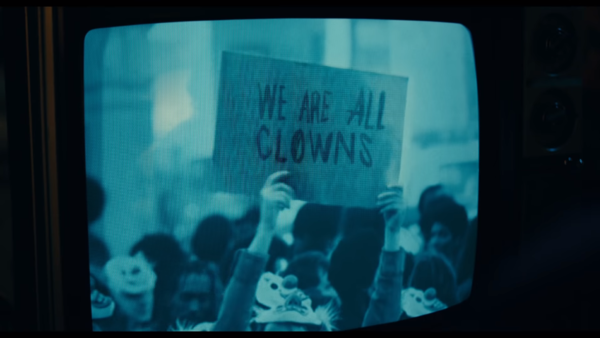
One of the best things about Joker is how it explores where Batman's Gotham comes from as much as where Joker does. When we're introduced to the city, it's like any other really, though it bubbles on the edge of civil unrest because of inequality and financial neglect of everyone but the top 1%. It's very much tied into our modern political climate and the culture of unrest.
From there, Joker is essentially an origin story for Gotham itself that could quite easily lead into the Nolan films or even Tim Burton's (with a little more imagination). The establishment is corrupt, at odds with the people and those who rise up champion outsiders and "freaks" as their idols.
It doesn't take a lot to imagine that this Gotham could end up losing its way so much that it ends up needing Batman. And the whole story adds an element of greater tragedy, as the slight retelling of the story means that Gotham's fall to worse corruption, crime and darkness ended up being kicked off by well-intentioned people fighting corruption and inequality.
4. The Clown Prince Of Gotham

For the first time, we also get a look at a Joker who really IS the Clown Prince and not one who simply claims the title for himself perversely. Jack Nicholson's Joker had designs to invent himself to be a conqueror, Heath Ledger's imagined himself as the saviour of Gotham and Jared Leto's was the underworld leader, but none of them had the people behind them.
Joker's parallel story to the rising protests means he ends up being co-opted by the same movement that helps him find his place in the world. His rescue at the end (albeit temporarily) makes him their appointed idol - the head clown - and it feels like this could be an origin story not just for Joker but for an entire army behind him.
It would be a travesty if this didn't lead to more of this story, because the continued fall of Gotham and how it splits into criminal and moral factions (i.e. Joker's and Batman's) is a story worth telling and so is Joker's.
3. Batman Begins

Intriguingly, one of the biggest changes Joker makes to the comics material is how it portrays Thomas Wayne and how that leads into the surprise inclusion of Batman's origin story. Wayne is a painted as an unsympathetic corporate monster, who calls the protesting lower class "clowns" who need to be saved from themselves. He's your typical out of touch fat cat and he's behind all of Gotham's unrest. Him or people like him.
In the end, then, his death at the hands of one of the protestors as Gotham falls into open uproar and rioting is seen more as form of justice, rather than the traditional idea of it being a criminal tragedy that robs Bruce Wayne of his wholly innocent parents.
However we get there, the climax shows us the infamous Batman origin as Bruce is seen standing over the dead bodies of his parents. So for all of the talk of this being a totally stand-alone movie, this could very easily be the story that leads to the Bruce Wayne we will meet in Matt Reeves' The Batman.
And rather wonderfully, that also means that a film involving BOTH Robert Pattinson's Batman and Joaquin Phoenix's Joker could be possible. And it really, really needs to happen.
There's an interesting new element in there too, because this version of the origin completely changes Bruce Wayne too. Rather than him being the victim of a crime that killed his innocent parents, he's going to be fighting on behalf of the people his father represented against the people that hated him. In other words, rather than fighting crime and corruption on behalf of the downtrodden, Batman could be doing the opposite.
Obviously, a lot will change in the time before Bruce becomes Batman, but how he reconciles the fact that his father was killed for being a perceived monster and that his killers are victims of a failing society is very interesting to consider.
2. Arthur Gets What He Always Wanted

When it comes down to it, Arthur's reasons for doing what he did come down to him no longer being willing to be constantly beaten by people in power for their own pleasure - an allegory for his abuse as a child. He kills Murray because he exploited and mocked him, he killed Randall because he betrayed him, he was - effectively - doling out his own brand of justice.
But really, there's another motivation here that is more subtle. Early on Arthur talks about feeling best when he was in hospital and when he actually visits Arkham, he talks with the admin clerk and confesses his crimes when the clerk tells him why people find themselves locked up there. Arthur wants to be in Arkham and you can see it in all of his behaviour - not just in his crime, but in his very posture.
He walks around with his shoulders hunched and pulled across his body as if he's bound and at one point he writes a joker about a straitjacket being too tight. His whole demeanour and posture is designed to reflect someone who was comfortable wearing a straitjacket. And as further proof of that, when Arthur is most distraught, he empties his fridge and climbs in, creating himself a confined cell.
Arthur was locked away for his own good, but in a way it's where he felt most comfortable and most safe (which you would if you were sent back to the same mother who allowed your abuse). When he ends up there at the end, it's a realisation of his real dream.
1. How Much Is Even Real?

One of the most interesting questions posed by the end of Joker is about reality versus fantasy.
There are hints throughout that Arthur is an unreliable narrator, which start when he explicitly says he didn't feel real for a long time. We also see his fantasy of being in the Murray Franklin Show audience and then later we're told his entire relationship with Sophie is in his head.
There are more subtle hints that what we're seeing is not necessarily reality (because it's seen through the filter of his eyes), too. Firstly, when he kills the three yuppies on the train, he uses a six shot gun but fires seven shots and then right at the end, when he laughs at the sight of Bruce Wayne and his dead parents, it's an impossible shot. There's no way Arthur could have witnessed it - it's no more than another fantasy. Sure, it could have been based on reports of the deaths, but he can't have seen it.
Without ever really explicitly stating it, the film challenges what we know to be real in a sort of insidious way, which means there's no real way to definitely say that the origin is a definitive one.
What did you think of Joker? Share your reactions below in the comments thread.