What Does The Ending Of mother! Really Mean?
Have your Bible handy...

Let's get this out of the way immediately shall we? mother! is weird. Like really, really, really f*cking weird. It's the kind of film that would play at Cannes and delight all sorts of people who'd stand and applaud as others walked out loudly tutting. It's Darren Aronofsky's Holy Motors. His Only God Forgives. And it's going to be talked about a lot.
There's a very good chance that quite a few of the words spoken about it will be a variation of WHAT THE ACTUAL F*CK?! But you get the sense that that's exactly what the director was aiming for. And judging by Paramount's statement on the reaction to the film, they knew it as well:
"This movie is very audacious and brave. You are talking about a director at the top of his game, and an actress at the top of her game. They made a movie that was intended to be bold," says Paramount's worldwide president of marketing and distribution Megan Colligan. We don't want all movies to be safe. And it's okay if some people don't like it."
It's fair to say the film has been divisive, but if art is judged solely on its ability to make you feel, Aronofsky - provocateur that he is - has achieved something incredibly impressive. mother! is a viscerally affecting experience, steeped in religious imagery and horror tropes (though not as overtly as the trailers suggested).
And as some of the more provocative critics who loved it have said, maybe there's just a slight touch of audiences not quite understanding what he was trying to say. Luckily, the remedy for that is unpacking the ending and trying to establish exactly what Aronofsky was trying to say. Or what he was trying to encourage his audience to think about broadly, which is probably a more relevant consideration...
9. The Ending

Just when you think we're getting a slightly weird home invasion mystery with some supernatural teases (and the faintest suggestion that Javier Bardem is the devilish focus of a cult's adoration), the last 20 minutes of mother! go absolutely wild.
From the moment the poet impregnates his wife and the film skips 9 months, it's a tumble down into weirdness. At the point of conception (or the point at which it's revealed), Him is immediately filled with inspiration to write and eventually crafts a single page work that proves to be his magnum opus and a focal point for renewed fervour from his fans.
They turn up to celebrate him in their droves, invading the house and quickly unleashing anarchy as their adoration turns into something more violent. They rip the house to pieces, seeking to leave a mark of their existence and terrorise Mother as she goes into labour.
Everything basically then descends into a fever dream that could easily double for a late 1990s Metallica video. Swat police turn up and battle the "fans" and Mother gives birth, only to have the infant cruelly snatched away by Him, who seeks to show off his progeny. Somewhat inevitably, the baby is killed (and, extra weirdly, eaten), Mother goes insane with rage and kills some of the murderers before destroying them, herself and the house in a fire.
As she lies dying, Him removes her heart (and crushes it to reveal another of his mysterious diamonds), and when he replaces it in the strange mount its predecessor sat in, the house resets and Mother is reborn in a direct mirror of the opening shot of the movie. Only this time, it's not Jennifer Lawrence. Cue countless WTFs, and frantic lunges towards Google.
So what does it all mean?
8. Is It All A Drug-Induced Dream?

Darren Aronofsky has a thing about playing with the perception of reality: in both Black Swan and Requiem For A Dream he plays with the idea of dosing and escapism that make the films' portrait of reality completely unreliable.
mother! continues that sort of idea, as - without any real attempt to explain it - Jennifer Lawrence's character repeatedly seeks comfort from her pain through substance abuse (the mysterious golden powder she adds to water). And it's telling that she hides its existence from Michelle Pfeiffer's character when she asks about pain-killers - that's just typical addict behaviour.
Ironically, of course, her pregnancy makes Mother remove the drugs from the equation as she pours them away, but that doesn't necessarily mean we then entered the realms of reality. It's a little too coincidental that she seems to will the pregnancy into being - remember, dreams are said to be wish fulfilment - and that her husband is suddenly able to write once more.
And it could easily be read thatthe escalation of the final act and the startling move into weirder territory could be her mind's struggle to deal with the removal of her fix. That too has been a motif for Aronofsky before, and even if only some parts of the film demand such a drug-related reading, the idea of altered perception and trustworthy narrative is very pertinent all the way through.
7. It's An Ecological Nightmare

As Jennifer Lawrence has already publicly stated (via The Telegraph) that the film “depicts the rape and torment of Mother Earth. It’s not for everybody."
“It’s a hard film to watch. But it’s important for people to understand the allegory we intended. That they know I represent Mother Earth; Javier, whose character is a poet, represents a form of God, a creator..."
Basically, unpicking that a little more, mother! is about man's over-zealous responsibility for the rape and pillage of the Earth. Lawrence's Mother is an embodiment of Mother Earth, and the house is an extension of her - it is her creation and a part of her (hence her connection to it). And that connection was pushed heavily (which is why she is barefoot all the time, and why she reacts so viscerally when the house is damaged).
At one point, she demands to know why Him's followers are destroying the house - when all she wanted was to create something to be proud of and comfortable in - and one angrily offers an answer: they want to make a mark to "prove" they were there. It's a fairly pertinent reflection of humanity's arrogant, occasionally spiteful treatment of the Earth.
6. Octagons, Christ And The Idea Of Infinity

The shape of the house is very important in mother! as it suggests that this loop of creation and destruction is perpetual and had trapped Him and his various mother figures forever.
Symbolically, octagons in architecture are said to represent infinity (as well as offering pleasant aesthetic benefits) as Aronofsky discovered in his research for the film:
“There are all of these alchemy theories about the octagon and numeric beliefs about the number eight and about infinity and regeneration. The reason I like the octagon shape as a filmmaker was when I shot through a doorway you’re not looking at a flat wall. You’re looking at a diagonal wall that adds depth and just makes things more interesting.”
The director also discovered that Victorian scientists believed that the octagon was the perfect shape for the brain, which in turn influenced the way some houses of the period were designed. And specifically, when an octagon is fused in design with a dome (as in the case of the film's house's roof) it symbolises the fusing of the spiritual with the physical.
In short, the links to spiritual considerations and the ship are impossible to ignore, which is why there are so many in the film, and it's perhaps best to consider Freddy Silva's analysis of the shape from Legacy Of The Gods:
(The octagon) "represents the ultimate balance between material and invisible forces, the fixed male and mutable female; total balance between material and spiritual, heart and mind: the fully aware, 'christed' human. It is both the inhalation and the exhalation of the breath of creation... the octagon symbolizes the ultimate aim of esoteric traditions. Notable, enlightened figures throughout history such as Mohammed, Merlin, the archangel Michael and Jesus have been characterized by either the octagon or its numerical value 8, and the infinity symbol; in gematria the name Jesus carries the value of 888."
5. mother! And Feminism

There's a rich seam of feminist defiance (or the dream of it) in mother! that has prompted talk of it being a feminist picture (even if it ultimately defers to a nightmare of claustrophobic patriarchy).
As Jennifer Lawrence says:
"To me, this is incredibly feminist in the way that these Victorian, patriarchal novels show these loving, amazing husbands that are very slowly and delicately taking away their wives’ dignity... To be a feminist movie, we don’t have to all be women and all be aggressive. Before we knew what feminism was, people were writing these novels that showed women’s strength being drained from them.”
Mother spends most of the film watching in despair as things happen to her and her voice is ignored until she's eventually even stripped of the one thing that was wholly hers (decorating the house, which was her statement of individuality). It's only at that point that she takes on the role of the mother, as if it's an enforced deferred role that she only sees as a "good" idea when everything else is taken away from her.
And even then, the child too ends up being taken away from her, leading to her final statement of defiance - murdering the child's killers and destroying herself and the house. That's her feminist strike against Him (a name as reflective of patriarchy as it is of a God), and the true horror of the ending is that she is ultimately doomed to simply relive the same issues, despite that act of defiance.
4. Him Is God The Creator
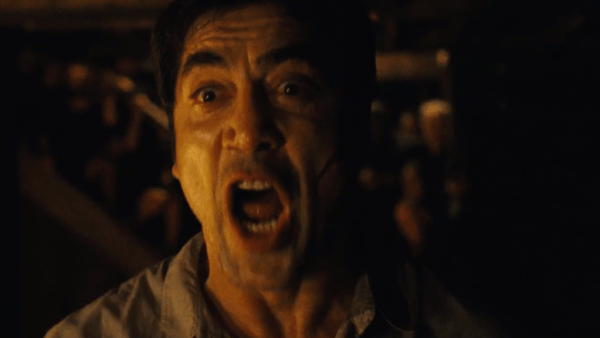
If you missed it from the name, a fairly conventional reading of mother! says that Him is God, the creator. He even mentions being a creator several times, singularly driven by creating and unfulfilled unless he's able to.
He is worshipped by followers who believe he is solely speaking to them (through his words that seem to appeal directly to them), he's seems almost supernaturally able to comfort those in emotional turmoil (including Mother herself), and he ultimately builds life whenever the apocalypse comes (as it does when Mother destroys the home).
Jennifer Lawrence seems convinced of this reading, as she's publicly stated, and there's a lot of evidence to back it up. In fact, Him being the focus of wayward religious zeal (which paints him as a sort of charismatic cult leader) is very much the image of God as a figure wanting to please all his followers, even when they misinterpret his will and his love. The vicious take-down of dangerous organised religion in there is bound to find a lot of fans in the world's church organisations.
3. Mother Is God (And Him Is The Devil)
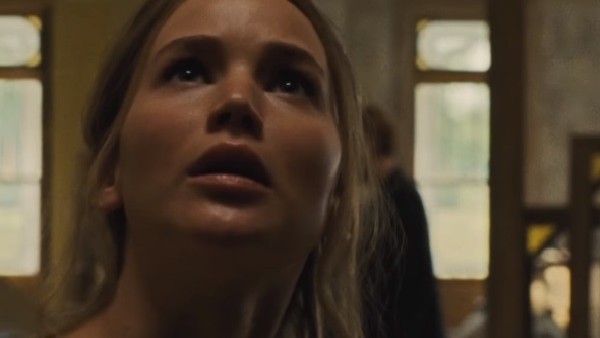
There's actually an alternate reading of who the real God is in mother! While it may be simple to say Him is because of the creator imagery, Mother is just as involved in creation.
She brings the house to life in more real terms, she creates new life in the form of her child and it is her act of vengeance that brings everything to an end. It is also her that warns Man and Woman not to be tempted by Him's diamond, her that warns about the danger of the coming flood (the unattached sink) and her that recognises the real evil of mankind.
If Him is shown as God the Creator, she's more the penitent God, suddenly faced with the mistake of humanity and aware that it has to be destroyed. She's the Old Testament God.
And the distinction between her and Him could go even further. At one point we see a picture of Him with horns drawn on his forehead, and there's a compelling argument that he could be the archetype of the charismatic devil (albeit one that isn't quite as consciously evil as traditionally painted) who ultimately tempts mankind to their fall, inspiring Mother's need to purge.
2. The Fall Of Eden
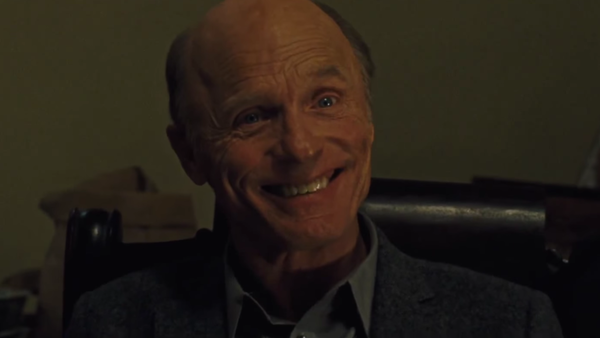
Again, Jennifer Lawrence was quite open about her interpretation of the characters of Man and Woman:
"Michelle Pfeiffer)) is an Eve to Ed Harris’s Adam; there’s Cain and Abel; and the setting sometimes resembles the Garden of Eden.”
The imagery is impossible to ignore in that respect. We even basically see the creation of Woman, as there's a brief flash of a tell-tale injury to Man's ribcage just before Pfeiffer's Woman appears out of nowhere at the house.
The strange diamond is clearly also a symbol of the tree of knowledge and the story of the apple: the pair are warned against going into the forbidden area of the house, and when they defy that, their accidental destruction of the diamond effectively leads to the spiral towards doom.
Man and Woman even have two warring sons - Cain and Abel - with one killing the other and then literally being sent out into the wilderness. And Woman is very obviously played as the more mischievous temptress as Eve tends to be read.
1. The Baby Was Obviously Christ
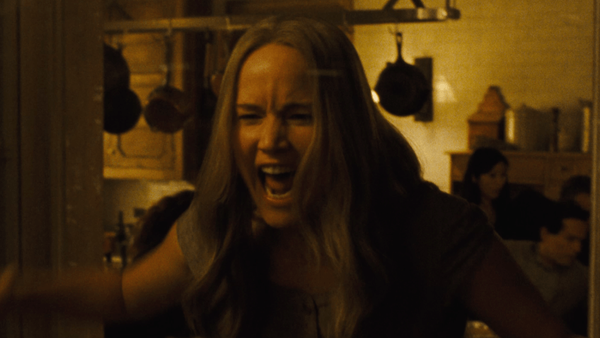
Whoever you choose to believe is God, the baby that sits at the centre of the film's most controversial imagery (let's state it overtly, it's a horrific, horrific sequence) is clearly Jesus Christ. He is presented, purely, to mankind and is slaughtered and devoured before Him says that the only way to move on is to find a way to forgive the killers of their sins. It's basically a disturbing distillation of the Christ story.
Linked to that, there's a sort of allegory about forgiving the crimes of the past. Without forgiveness, the film states, we are doomed to destroy ourselves - whether in despair or vengeance - and to endlessly relive the same sins over and over. That's a fairly depressing thought, to be perfectly honest.
There are other religious elements in there as well - the new poem is the New Testament, the ceremony of marking followers' heads is the mark of Ash Wednesday, the bloodied spot on the floor is the stigmata of Christ, and there are character names on the castlist including Herald, Penitent and Good Samaritan.
Basically, if you look with even a tiny bit of religious knowledge, you'll see there's a lot to piss off the clergy.
Do you feel like you understood mother!? Share your own interpretation below in the comments thread.