World War Z: 3 Things That Worked And 3 Things That Didn't
 With a $200 million budget, World War Z is the most expensive zombie film ever made. And although it deserves to be remembered for more than this stark statistic, its reputation and box office potential may already be determined by the well-documented production troubles that have granted the film an unwelcome notoriety. Last-minute rewrites, an unfinished script, all scenes shot in Moscow dropped from the final cut, Hungarian counter-terrorism customs officers revealing that the film's prop firearms were, in fact, fully functional...such setbacks not only bumped up the budget from its initial $125m estimate but they also pushed back the film's release date from December 2012 to June 2013. So, now that it has finally arrived, is it the greatest zombie film ever to grace our screens? Well, no. But nor is it the disaster that many critics are claiming it to be. Instead, it's a fast-paced and surprisingly intelligent drama/horror hybrid that boasts some thrillingly tense chase sequences, spectacular special effects and a solid, unshowy performance from its lead role (and co-producer) Brad Pitt. The actor plays Gerry Lane, a former United Nations worker who is called upon to investigate the pandemic that has already claimed half the human race. And director Marc Forster gets to dust off his globe-trotting skills (last seen in Quantum of Solace), while ensuring that we're never kept in one country for too long. Steven Soderbergh's Contagion was a zombie film without the zombies; a hermetically-sealed, hypothetical horror that swapped high-paced action scenes for shots of scientists squabbling over each other to find a cause and a cure. And a straightforward adaptation of World War Z threatened to be more of the same; with its epistolary concept - what would essentially be a two-hour interview - not being especially conducive to the words 'summer blockbuster'. But then, how best to tackle Max Brooks' 2006 source novel: a cult favourite that pieced together transcripts between a UN employee and the eyewitness accounts of the world's survivors? Perhaps a faux-documentary, with all action shots confined to flashbacks? Let's not forget just how much money was spent here. And so the gentle hum of the recording tape was drowned out by the cacophony of helicopters, plane crashes, grenades and gunfire. After all, it is a war. This may have led to a film that few fans recognized, but on the plus side, it also meant that we're waiting barely five minutes before we're thrown into the fray. And once we're in, the action rarely stops. Below are three of the film's strongest points, followed by three features that ultimately raise more questions than answers. Contains Spoilers
The Strong Points...
3. It Isn't Afraid To Use The Z-Word
 Considering the sizeable amount of money stacked behind it, the film is placing an tremendous amount of faith on a six-letter word. A word that everyone knows and yet no one dares say. A word that urgently needs to be reclaimed from the clutches of bargain basements and straight-to-DVD releases. For it seems that nothing kills a zombie quite like referring to it by name. At the start of the film, the cause of the outbreak is initially thought to be rabies; yet it is only when a report emerges from South Korea, supposedly the first to mention the dreaded z-word, that the possibility of something much more sinister rears its ugly head. When this report is read aloud, it is met almost immediately with a derisive snort from a government official. She speaks for the audience member who demands to know just why a very serious drama about the survival of the human race could be so suddenly sullied by those six letters. And yet, here we are. Given the film's title, you could argue that they hardly had a choice but, henceforth, the term 'zombie' is unashamedly adopted (if sparingly used). No 'mutants', no 'creatures', no 'walkers' here. The zombies themselves seem to be cut from the mould of 28 Days Later: rapid, ravenous and extremely dangerous. As well as pouncing on their prey, they throw themselves head-first into car windshields, charge into crowds and spill over rooftops in a frenzied, many-limbed mass. They swarm across cities and deserts, literally chewing up the scenery. And, above all, they're terrifying. As Gerry discovers, it takes twelve seconds for a corpse to reanimate; their convulsing back into 'life' both creepy and convincing.
2. Spectacular Set Pieces
 If there's one thing that we've learned from the film's trailer, it's that they are especially proud of the above shot. And quite rightly so. It's the scene in which a safe zone in Israel is suddenly overwhelmed by hordes of the infected; having been lured over by the jubilant cries and singing from inside the quarantined area, they scramble atop each other, only to fall, en masse, onto the unsuspecting victims below. It's just one shot of several that confidently showcase the film's sense of spectacle: the sheer scale of destruction, the impenetrable force of the attack, the wave after wave of pure terror. But the scene's pinnacle, as it were, arrives moments later- when the zombies reach the top of the wall, cling onto the undercarriage of a passing helicopter and drag it into the dusty ground below. For not even the skies can escape the grasp of the undead, as Gerry, along with his Israeli 'escort soldier' Segen (Daniella Kertesz), discover on a diversionary flight to Cardiff's WHO research facility. Suddenly finding themselves trapped in the path of a charging zombie, Gerry buckles up, snatches a grenade from Segen's belt and tosses it into the corner of the plane. This depressurises the cabin, sucking everything and everyone out through a gaping hole in the side of the aircraft. Remember, life insurance pays off triple if you die on a business trip... Needless to say, this isn't the standard emergency procedure and so the plane is instantly plunged into the Welsh woodland. The shot of Gerry suspended amongst the wreckage is astonishing; the shard of metal sticking out of his abdomen a genuine shock. Although the script needed something to distract you from the realisation that, yes, Gerry and Segen were the only two to survive the crash...
1. A Nailbiting Third Act
 Having hobbled to the WHO research facility (good job the plane crashed where it did, eh?), Gerry and Segen are, understandably, treated first with suspicion and then with hospitality. After theorising with the officials, Gerry comes to the realisation that the zombies are choosing to ignore the terminally ill- as they would be unable to propagate the virus - and so he sets about testing his hypothesis by injecting himself with a terminal but, crucially, curable pathogen. The only trouble is, the wing in which the pathogens are stored is now teeming with zombies, after one of the doctors accidentally infected himself and his colleagues. But still he must go... Although what follows comes dangerously close to conventional horror; creeping down corridors, shadows scuttling under a flickering fluorescent light etc, it's nevertheless gripping stuff. While a couple of officials volunteer to assist him (briefly swappping their role from WHO doctor to Doctor Who) the rest can only huddle around surveillance screens and watch humanity's last hope tentatively negotiate one corner after another. When Gerry reaches the vault, it's made perfectly clear that choosing the correct pathogen becomes as imperative as cutting the right wire... You can certainly see why the video game tie-in was a no-brainer. Mmmm...brains. Click 'next' to read three criticisms of World War Z.
Things That Didn't Work...
3. Gerry's Family Are Given Nothing To Do
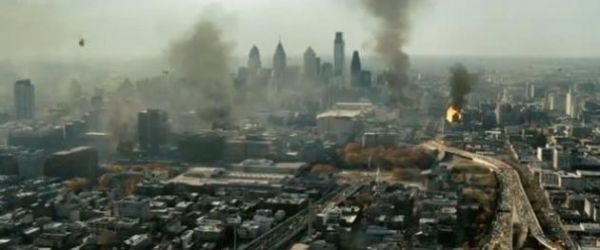
 When a character is written out of a film or show, but the possibility of their return is not quite ruled out, they are said to have been 'put on a bus'. Here, Gerry's family are put on a boat. Having been rescued by Gerry's former colleague Thierry (Fana Mokoena), the Lanes are lifted from the panicked streets of Philadelphia and are flown by helicopter to a US Navy ship off the coast of New York. On board are leading scientists, top military personnel and a precocious virologist who seems to speak only in soundbites (perhaps it's nitpicking, but when racing against time to rescue humanity, do we really have to observe military protocol and pause to salute every brass bigwig that steps into shot?) It is here that Gerry is asked to help on the front line. He agrees, knowing that his family would be safer circling the Atlantic for days on end than braving the hordes back home. And it is here that his family practically disappears from the plot. Having passed his wife Karin (Mireille Enos) and daughters into the capable hands of the Navy, Gerry can concentrate on saving the world and anticipating a hero's return. His family, however, can look forward to the onset of cabin fever and staring at the ceiling on those anxious, sleepless nights. Gerry and Karin each have mobile phones, but his quickly runs out of battery and hers can barely receive a signal. So it becomes a waiting game. On the handful of occasions that we do return to the ship, we can never fully ignore that creeping thought at the back of our minds that tells us that this is the subplot. And so we prepare ourselves for the discovery that the ship has unwittingly allowed a bitten victim to board. We expect to be jostled back and forth between Gerry and his family as they each become reluctant action heroes and overcome the odds. If it sounds too obvious, then that's because it is. This doesn't happen. Instead, they wait. And wait. Karin could use this time to comfort Tommy, the stowaway orphan whose parents had sheltered the family before being overwhelmed by the attack (incidentally, and even by film standards, this lad seems to have recovered from his parents' death a little too quickly) but instead she finds other ways to alleviate her boredom. Namely, glaring at Thierry in that 'you've sent my husband to his death' way and sleeping with her ear to a faulty phone. It's probably just as well that the phone doesn't work, now that she finds herself with considerably fewer lines of dialogue than everyone else. And herein lies the filmmaker's dilemma: as these scenes are largely unnecessary, do you keep your audience invested in this family's tension by letting them stew for a bit longer, or do you offer them an obligatory zombie attack to tide them over until we're back to Brad? It's realism versus entertainment: one story's too boring, the other's too far-fetched.
2. There Will Be Blood - But Only A Bit
 Watching the army blast their way through a zombie invasion is, of course, what blockbuster season is all about. Yet, amongst the fire, the rubble and the flesh-eating frenzy, there is undoubtedly something missing. Half the world may already be dead (or at least, making the other half run for their lives ) but there's barely a drop of blood to be seen. Is this a problem? Well, for a film that strives for realism, the conspicuous absence of blood becomes equally as distracting as though it were splashed across every reel. We're not crying out for needless gore (there are plenty of other zombie titles that will easily fulfil our bloodlust) but at the same time, we can't pretend that being pounced upon by a pack of frothing, fanged creatures isn't gonna leave a scar. The film's 15 rating (UK) is hardly pushed to its limits; there's no sex/nudity and virtually no swearing, but instead it promises two hours of ''intense frightening zombie sequences, violence and disturbing images''. Intense and frightening it may be, but one can only wonder what nightmares would have been unleashed had the film been afforded an R rating. For, incredibly, in the US the film has been given a PG-13 certificate; a decision that will, sadly, doubtless deter more than it attracts. Which, of course, is hopelessly counter-productive. For while the decision may be a surprise, the thinking behind it is less so. In fact, it couldn't be simpler: the less red stuff we see, the more green the film will make. Given its monumental budget, the studio needs to claw back every dollar that it can. And so, rather than appealing solely to the gorehounds, World War Z holds the rather unique position of featuring a zombie apocalypse that the whole family can enjoy. But this compromise, somewhat perversely, seems to have alienated both parties: it's too tame for the horror crowd, while not exactly being the first thing that springs to mind when you're taking the kids on a trip to the cinema. The movie may prefer to keep the splatter (and at least two minor characters' deaths) offscreen but it can still pull out a sucker punch. When Gerry stumbles out of the plane wreckage, his injury is made all the more shocking simply by the fact that most of the violence had hitherto been kept out of sight. Even the scene in which an arm is swiftly amputated is strikingly sanitised. It is moments like this that threaten to undermine the film's authenticity: presenting a bowdlerised version of events in which the zombies are killed whenever the camera just so happens to be looking elsewhere is, for horror fans at least, a cut too far.
1. Anticlimactic Ending
 If you left the cinema thinking that the last half hour didn't fit so comfortably with the rest of the film, there's a very good explanation for that. Screenwriter Damon Lindelof was tasked with rewriting the third act yet claimed that, as shooting had begun before the script was finalised, he would not be able to finish it in time. And so the dubious honour fell to Drew Goddard, who, alongside Joss Whedon, had conjured up one of the most mindblowing finales in recent times with last year's Cabin in the Woods. As a result of the film being stitched together thus, some critics have described the film's denouement as disjointed. Those looking for the seam would perhaps pinpoint the plane crash as the spot where Goddard first put pen to paper. But it's the ending that'll leave you tearing your hair out. The pathogen with which Gerry injected himself has been made into a vaccine and consequently distributed worldwide to great success. And so, having given humanity (and himself) the shot in the arm it so sorely needed, Gerry is en route to meet his family at a safe zone in Nova Scotia. But his voiceover informs us that, while the world looks to be on a path to recovery, "his isnt the end; not even close." You'd be forgiven for raising a sceptical eyebrow at this message. Because if there's one thing you can be sure of, it's that the film looks pretty wrapped up by now. When you've destroyed half the world, where else do you go? And although we may be able to look past such a dubious deus ex machina (Gerry picking the one safe pathogen over the dozens that would've surely killed him), having our Hollywood happy ending enforced by a montage of news reports is something of a final insult. As the music swells, the camera pans out and Gerry and Karin embrace, we end the film on an oddly antiquated device: a freeze-frame. Husband and wife are reunited and, to top it off, they even have a 'son'; having adopted Tommy in all but name. But, like a grey, ghostly hand forcing its way up from the soil, it turns out that the War isn't over yet. When you've destroyed half the world, where else do you go? The other half. Both Forster and Paramount had expressed an interest in using this film as the starting point for a trilogy, but for now, the studio has just signed up for a sequel. Perhaps they'll think twice about the budget this time?