X-Men: Days Of Future Past - 25 Easter Eggs & References You Must See

How many did you spot?

Understandably, given the heritage of the film in terms of its own franchise, as well as the fact that it is a comic book movie, X-Men: Days Of Future Past is full of Easter Eggs, references and in-jokes aimed squarely at comic book fans. It's almost a cliche now to say that the genre is as fundamentally defined by these fan-baiting references as it is by any over-riding film-making tropes. Writer/producer Simon Kinberg spoke recently about the desire on the project to appeal to fans of the film series, and engage them in a way that paid due homage to the films that came before:
"We wrote it wanting it to be a really deep dive for the fans, so that almost every scene would have little tickles of other moments from the comics, or moments from the movies. But we also wrote it with the intention that it€™s going to be the most watched X-Men movie of all-time, and if it works, it€™s going to bring an audience that€™s never seen these movies, or only casually seen them. So those things need to be invisible for a general audience.€
With that in mind, it's no surprise that the film is packed with references that are among the most obscure in comic book movies, though it's not quite true that the film's call-backs and references acknowledge all of the X-Men movies to date.

25. 20th Century FoX

The first Easter Egg comes before the film even starts as Fox unveiled a special indent that changed the iconic 20th Century Fox reveal into a celebration of the X-Men universe, the light fading on the logo to leave the X alone, illuminated as the fanfare was replaced fittingly with the familiar tones of the X-Men theme.

24. Fritz Lang's Metropolis

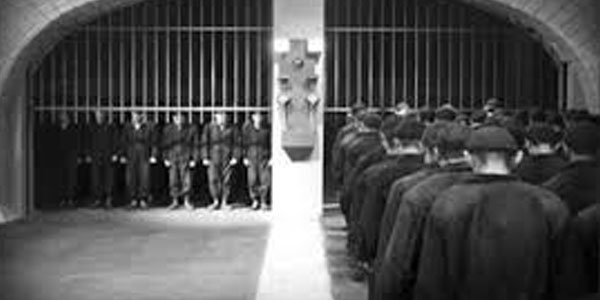
The film opens on the dystopian future timeline, with mutantkind all but wiped out after a very James-Cameron-sounding war for the world that saw the Sentinels over-zealously mis-interpret their prime directive and round up everyone, whether human or mutant. The imagery in the scene is very much in fitting with the typical portrait of Earth After Humanity, and feels like a conglomerate of sci-fi dystopias, but there is something very specific in the internment imagery used. Not only do they call back to the very start of the X-Men franchise, and Erik Lensherr's captivity in the concentration camp (the Nazi imagery is not accidental, considering Singer's allusion that Bolivar Trask is basically Hitler) they also reference Fritz Lang's Metropolis. Whether intentionally or otherwise (and it seems intentional) the shot of mutants and humans being herded into the camps feels like a direct homage to dystopian classic, with a similarly stark soundtrack, and the later mention of the worst of humanity remaining in charge seems a nod to the same source.

23. The Influences

As well as Fritz Lang's genre-maker, the film draws upon the rich heritage of time travel movies, with Simon Kinberg openly admitting that Singer was influenced by The Time Machine (1960), Back to the Future (1985) and Looper (2012). Arguably the most pertinent reference point is The Terminator (1984) whose vision of the future is very much referenced in the visual landmarks of Singer's future dystopia. Not only that, but the seemingly obligatory shot of Wolverine's impossibly chiselled backside when he first travels back in time feels very much like a cheeky nod to the Terminator's own first naked appearance. James Cameron also played an important part in helping Bryan Singer form his ideas of time-travel, which were based very much on Terminator and its first sequel, and informed Singer's take on String Theory:
"Until an object is observed, it hasn't really happened yet. The time-traveller whose consciousness travels through time I call The Observer, and until the Observer returns to where he travelled from, the result hasn't occurred yet. So he can muck about in the past and it isn't until he snaps back that the new future is set. As a result, we have parallel action, and there's underlying tension because there's always that threat Wolverine's consciousness could return to the future and leave the world in an even darker place."

22. Ink
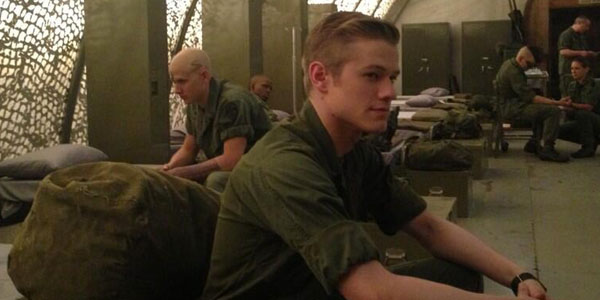
As well as the cast of new X-Men who were given their own posters and grand reveals, the film also includes a couple of unannounced mutants in the shape of Ink, a member of Young X-Men, and an unnamed character who resembles Quill in the comic books, but who possesses psionic powers that he uses to possess victims and make them collapse. It's likely that this character - billed only as Mutant Soldier - is an amalgamation of Quill and Kid Omega, as Ken Leung's character was in X-Men: The Last Stand (since he was clearly wrongly billed as Kid Omega). Is this an in-joke referencing the misnomer, or just a coincidence? It seems too close to be an accident, especially given his lack of name. Along with Havoc and Toad, the unnamed mutant and Ink - who in the comics gains his powers thanks to a mutant able to empower mutants by covering them in symbols - form the special army squad that Mystique rescues from Saigon.

21. Bishop & Kitty's Powers

In the Days Of Future Past comic, it is Kitty Pryde who is sent to the past, but the timeline issues meant that there was no way she could phase back to her former self, since she wouldn't be born for 20 years, so Singer brought in first Bishop and then Wolverine to take her place. The mutant is marked with the scarred M delineating his mutant status, and also implying that he has escaped from captivity. Kitty's new powers of being able to send minds back through time takes advantage of Bishop's traditional ability to time travel, establishing a precedent for the skill and also references the fact that it was Bishop who was sent back in the DOFP arc in the hugely-popular cartoon adaptation of the 1990s comic, before Wolverine is chosen to be sent back thanks to his regenerative mutation.

20. Wolverine

Wolverine Fist Of North Star The Wolverine seen in this film is the bridge between both timelines and he plays his part well, avoiding stealing the limelight as he did in earlier X-Men sequels but being no less important as a result. In the original comics, he dies pretty quickly to show how much of a threat the Sentinels are, but since he's used as the time travel device here, he gets a reprieve, and comes with a couple of his own Easter Eggs. First, though most of the future X-Men wear sombre, functional outfits, Wolverine's costume integrates yellow and blue elements as a second obvious call-back to his classic comic book outfit after Cyclop's jibing in the first film. The second is more obscure, but when Wolverine wakes in the past and immediately finds himself in an uncompromising situation with three mobsters, he is riddled with 7 bullets, which form an pattern like the Big Dipper; a reference to classic manga Fist Of The North Star (1984). That anime is set in a post-nuclear apocalypse world, where a lone saviour rises to stop the oppression of others by a powerful minority, so the similarities are well-placed.

19. Wolverine's Apartment

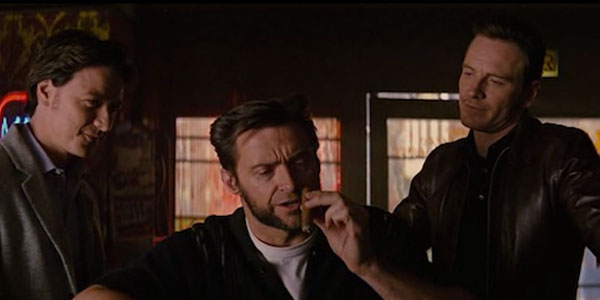
The first time we see 1970s Wolverine, he wakes up in his apartment next to the daughter of his boss - who he was supposed to be protecting - and according to Hugh Jackman, the scene is packed with reference points to look out for. When asked by IGN when the best time to pause the movie is, he responded:
€œHe lands back in his apartment €“ and I don€™t want to tell you where it is. But you should pause it because there€™s a lot of really cool clues in his apartment. Nick-nacks and stuff that he€™s got around."
There are certainly visible hints to the character's heritage, like the oriental take-away boxes that appear in multiple places, and the print of a picture of Mount Fuji on his wall, and presumably there's more (along with the bullet hole pattern). Quite what they are might well require the Pause Button.

18. The Recurring X

It's no surprise to learn that production designer John Myhre hid X-symbols in all of the sets he designed for the film, because the symbol runs throughout the film. Xavier's wheelchair wheels of course have the iconic X, it appears on a hatch uncovered in the prologue establishing the condition of the world in the future, it's on a tape recorder in the background of young Professor X's first appearance, and the fountain at the front of the mansion has overgrown with a hedge that forms the same X within a circle. If you look hard enough the symbol is in pretty much every sequence, and is definitely one for completist spotters.

17. Acknowledging The Errors Of Past Films

As well as being a bigger allegory about genocide and ethnic cleansing - as well as humanity's inherent propensity to dangerously over-reach in scientific terms - the themes of extinction definitely reference the state of the "main" X-Men franchise after The Last Stand and X-Men Origins - the two movies that have pretty much been wiped out by this film entirely. If it isn't enough that Wolverine is the sole saviour capable of keeping his old cohorts alive, and the young cast ensuring their legacy is able to be remembered, some of the dialogue is too far on the nose for it not to be in reference to the series itself. When Magneto says "We've been given a second chance" you get the sense he's addressing the ghosts of the franchise's past as well as the that of the characters.

16. "Go F*ck Yourself"

Calling back to the most fan-baiting moment of First Class, Wolverine is charged with going to recruit Professor X to his cause, and eventually the professor recognises the berserker mutant from their attempt to get him to help 10 years previously. Rather than the mild mannered professor of Patrick Stewart's days, this younger Xavier is impulsive and fractured and his response is a beautiful repost to Wolverine's own short shrift given in First Class. He retorts to mention that moment, and offers an aggressive, loud "F*ck off!" to give Wolverine his comeuppance finally. There's also a humorous metal detector gig where Wolverine walks through without setting the alarms off (he's still adamantium-less at this stage of course) though he clearly fully expects to be searched, and double-takes at the machine and half-shrugs comically.

Contributor
Contributor

WhatCulture's former COO, veteran writer and editor.